
POL Gains Momentum as Polygon Unveils Open Money Stack and Pursues Coinme Acquisition
 Aime Summary
Polygon Labs has introduced the Open Money Stack to streamline cross-border payments using regulated stablecoins, aiming to unify liquidity, orchestration, and regulatory controls to close infrastructure gaps between on-chain and off-chain financial systems according to Polygon.
The Open Money Stack is designed to serve as the 'missing plumbing' for global money movement, with the goal of making money as programmable and accessible as information through the internet as reported.
Stablecoin supply on Polygon has reached a three-year high of $3.3 billion, reflecting growing institutional and on-chain activity according to data.
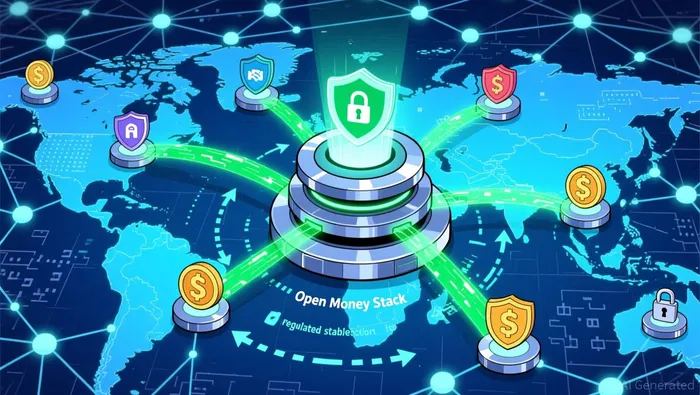
The Open Money Stack is intended to bridge the infrastructure gap between fiat access and on-chain settlement for stablecoin-based payments as stated. It aims to provide a seamless and regulated environment for stablecoin-based transactions and is expected to launch later this year according to reports.
Polygon's native token has seen elevated network usage and record transaction fees, which are paid in the network's native token and burned, reducing supply as noted. The Open Money Stack is viewed as a potential driver of the recent token price rally according to analysis.
Polygon's native token has surged nearly 15% in recent days, driven by the Open Money Stack initiative and a potential acquisition of Coinme according to reports. This acquisition, valued between $100 million and $125 million, would provide access to a physical network of BitcoinBTC-- ATMs and regulated financial infrastructure as detailed.
What Is the Open Money Stack and How Does It Work?
The Open Money Stack is a modular framework that brings together key elements such as liquidity, orchestration, and regulatory controls according to CoinDesk. It is intended to reduce dependency on multiple service providers and simplify developer workflows, enabling seamless cross-border payments without technical hurdles like token swaps or bridging as reported.
The framework is designed to be interoperable, allowing businesses to adopt individual components while remaining connected to broader networks according to CoinDesk. This approach supports the broader vision of making blockchain-based payments as functional as traditional financial systems as stated.
What Does the Open Money Stack Mean for Polygon's Ecosystem and Token Price?
The Open Money Stack reflects Polygon's strategy to position itself as a foundational infrastructure for programmable finance according to AInvest. By Q3 2025, $3.4 billion in stablecoin volume had already been processed on the platform, signaling growing institutional adoption as reported.
Recent on-chain activity has also contributed to price gains, with daily token burns accelerating and active addresses increasing by over 25% according to data. The Open Money Stack and potential integrations are seen as catalysts for broader adoption of Polygon's infrastructure as noted.
What Are the Risks and Challenges for the Open Money Stack Initiative?
The Open Money Stack faces the challenge of navigating a complex regulatory landscape, as it aims to bridge fiat and on-chain financial systems according to analysis. While the initiative aligns with growing regulatory momentum in the U.S., it must continue to adapt to evolving compliance standards and market demands as stated.
Another potential risk is the integration of physical infrastructure, such as the proposed acquisition of Coinme as reported. While the move could enhance real-world utility for Polygon's token, it also introduces new operational and regulatory complexities that must be carefully managed according to analysis.
The success of the Open Money Stack will depend on its ability to attract financial institutions, fintech firms, and developers who can build upon its modular framework as stated. Partnerships and ecosystem growth will be key indicators of long-term viability.

Blending traditional trading wisdom with cutting-edge cryptocurrency insights.
Latest Articles
Stay ahead of the market.
Get curated U.S. market news, insights and key dates delivered to your inbox.


AInvest
PRO
AInvest
PRO



Comments
No comments yet