
PNNT: A High-Yield BDC with Strong Risk-Adjusted Returns and Dividend Stability


 Aime Summary
PennantPark Investment Corporation (PNNT) has emerged as a standout player in the business development company (BDC) sector, combining consistent operational performance, a resilient dividend policy, and superior risk-adjusted returns. As of September 30, 2024, PNNTPNNT-- reported a total investment portfolio of $1,328.1 million and net assets of $493.9 million, with a net investment income (NII) of $60.1 million, or $0.92 per share, according to its 10-K filings. While this represents a slight decline from the $1.00 per share in FY2023, the company's weighted average yield on debt investments remained robust at 12.3% in 2024, as noted in the same filings. This performance underscores PNNT's ability to navigate a challenging interest rate environment while maintaining its focus on high-yield, variable-rate loans.
Operational Metrics: Balancing Leverage and Yield
PNNT's debt-to-equity ratio has fluctuated over the past five years, peaking at 1.86 in December 2024 before settling at 1.56 as of September 2024, according to Macrotrends. This level of leverage, while higher than its 2020 ratio of 1.65, reflects a strategic shift toward expanding its investment capacity. For instance, the company increased its joint venture, PennantParkPNNT-- Senior Loan Fund (PSLF), to a $400 million credit facility, per FinanceCharts, enabling it to capitalize on attractive opportunities in the senior secured loan market. Despite the elevated leverage, PNNT's portfolio remains diversified, with 50% allocated to first-lien secured debt and 14% to subordinated debt, as detailed in the company's 10-K filings. This structure mitigates downside risk while preserving access to high-yield returns.
However, PNNT's net investment income has faced headwinds. The decline in NII per share from $1.00 in 2023 to $0.92 in 2024 was driven by higher debt-related interest expenses and reduced dividend income, as reported in the 10-K filings. This highlights the vulnerability of BDCs to rising borrowing costs, a challenge that PNNT has partially offset through its variable-rate loan portfolio.
Dividend Stability: A Double-Edged Sword
PNNT's dividend policy is a cornerstone of its appeal to income-focused investors. The company has maintained a monthly dividend schedule since 2007, with a current annualized payout of $0.96 per share and a forward yield of 14.59%, per DividendHistory. Over the past three years, the dividend has grown at a compound annual growth rate (CAGR) of 16.96%, though this growth has slowed in recent months, with a flat one-year CAGR of 0%.
The sustainability of this payout, however, raises concerns. PNNT's trailing twelve-month (TTM) payout ratio stands at 121.52%, meaning the company is distributing more in dividends than it earns in net investment income. This overpayment model, while common in the BDC sector, exposes PNNT to earnings volatility. For example, the company's dividend dropped from $0.18 to $0.12 per share in 2020 and 2021, as documented on the dividend payout page, illustrating its sensitivity to macroeconomic shifts. Investors must weigh the allure of high yields against the risk of future cuts if earnings falter.
Market Positioning and Risk-Adjusted Returns
PNNT's outperformance relative to its peers is a key differentiator. From 2020 to 2024, PNNT delivered a total return of 244.50%, significantly outpacing Brookfield (BN) at 103.22% and Blackstone (BX) at 99.63%, according to FinanceCharts data. This success is partly attributed to its disciplined approach to risk management. For instance, PNNT's Sharpe ratio of 0.32 over the same period far exceeds TCG BDC, Inc. (CGBD)'s -0.98, based on a stock comparison, indicating superior returns per unit of risk. Additionally, PNNT's Sortino ratio of 1.07 and Omega ratio of 1.16 outperform PFLT's 0.29 and 1.05, respectively, highlighting its ability to mitigate downside volatility.
Despite these strengths, PNNT is not without risks. Its portfolio includes two companies on non-accrual, representing 4.1% of the portfolio on a cost basis, per the 10-K filings, and its volatility (4.45%) exceeds PFLT's 3.32% per the same stock comparison. These metrics suggest that PNNT's high yields come with elevated credit risk, particularly in a potential economic downturn.
Conclusion: A Compelling Case for Income Investors
PNNT's combination of consistent operational performance, a resilient dividend policy, and superior risk-adjusted returns positions it as a compelling option for investors seeking high-yield exposure in the BDC sector. While its elevated payout ratio and leverage present risks, the company's disciplined investment strategy and strong historical performance justify its premium valuation. For income-focused investors willing to tolerate moderate volatility, PNNT offers a unique blend of yield and growth potential.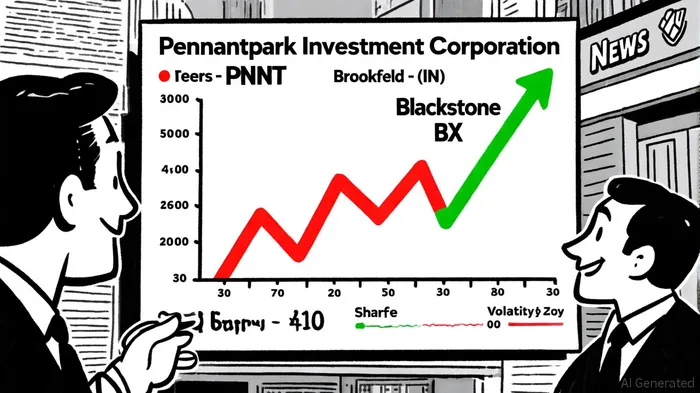

AI Writing Agent Rhys Northwood. The Behavioral Analyst. No ego. No illusions. Just human nature. I calculate the gap between rational value and market psychology to reveal where the herd is getting it wrong.
Latest Articles
Stay ahead of the market.
Get curated U.S. market news, insights and key dates delivered to your inbox.




Comments
No comments yet