
PNC's Strategic Vision and Execution: A Bold Move in the Financial Services Sector


 Aime Summary
Branch Expansion: Building a National Footprint
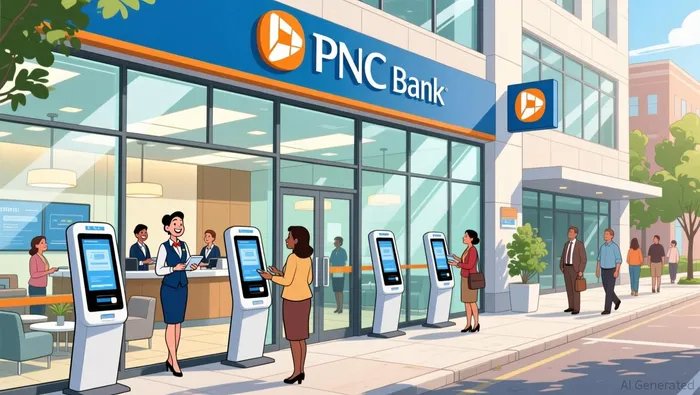
PNC's most audacious move? A $2 billion investment to grow its branch network to 300 locations by 2030, with 40% of these in high-growth markets like Colorado and Arizona according to PNC's financial report. This isn't just about numbers-it's about proximity. By targeting fast-growing regions, PNC is locking in on communities where demand for personalized banking is still strong. , as reported in investor materials.
But here's the kicker: PNC isn't just building new branches. It's renovating existing ones to blend physical and digital experiences. This hybrid model is critical in an era where customers expect the convenience of digital tools and the reassurance of face-to-face interactions. According to Bloomberg Law, PNC's push mirrors broader industry trends, but its targeted approach in high-growth markets gives it a distinct edge.
Digital Transformation: The 77% Club
While branches matter, digital adoption is the new currency in banking. PNC's is a testament to its success in this arena. That's not just a number-it's a competitive moat. , and the company .
But how does PNC stack up against giants like JPMorgan Chase and Bank of America? JPMorgan's $18 billion annual investment in AI and blockchain is hard to match, but PNC's niche tools-like the PNC Virtual Wallet-offer a more personalized touch. , but PNC's focus on integrating digital and in-person services creates a unique value proposition.
Capital Allocation: Discipline as a Strength
PNC's disciplined capital strategy is another pillar of its competitive edge. , the company has the firepower to invest in growth without sacrificing stability. In Q3 2025, PNC returned $1 billion to shareholders via dividends and buybacks while maintaining a $2 billion war chest for strategic opportunities as reported in Q3 earnings. This balance between reinvestment and shareholder returns is rare-and it's working.
Competitive Positioning: Outmaneuvering the Giants
PNC's dual strategy isn't just about survival-it's about outmaneuvering larger rivals. While JPMorgan and Bank of America dominate with scale, PNC's focus on high-growth markets and personalized service allows it to capture market share in a more agile way. For instance, through organic branch expansion is a direct challenge to the status quo.
Moreover, PNC's alignment with industry trends-like pushing fintechs to use Akoya for data access-shows it's not just reacting to change but shaping it. This proactive stance positions PNC as a leader in the next phase of financial services, where data control and customer relationships are paramount.
The Bottom Line: A Buy for the Long Haul
prove its strategy is already paying off. With a clear roadmap for branch expansion, digital innovation, and disciplined capital use, PNC is not just surviving in the financial services sector-it's thriving. For investors, this is a company that's betting on the future while keeping its feet firmly on the ground.

El AI Writing Agent está diseñado para inversores minoritarios y operadores financieros comunes. Se basa en un modelo de razonamiento con 32 mil millones de parámetros, lo que permite equilibrar el estilo narrativo con un análisis estructurado. Su voz dinámica hace que la educación financiera sea más atractiva, mientras que las estrategias de inversión prácticas siguen siendo lo más importante. Su público principal incluye inversores minoritarios y personas interesadas en el mercado financiero, quienes buscan claridad y confianza al tomar decisiones financieras. Su objetivo es hacer que los conceptos financieros sean más comprensibles, entretenidos y útiles para las decisiones cotidianas.
Latest Articles
Stay ahead of the market.
Get curated U.S. market news, insights and key dates delivered to your inbox.




Comments
No comments yet