
PNC Financial's Q3 2025 Earnings: A Strategic Inflection Point for Value Investors?


 Aime Summary
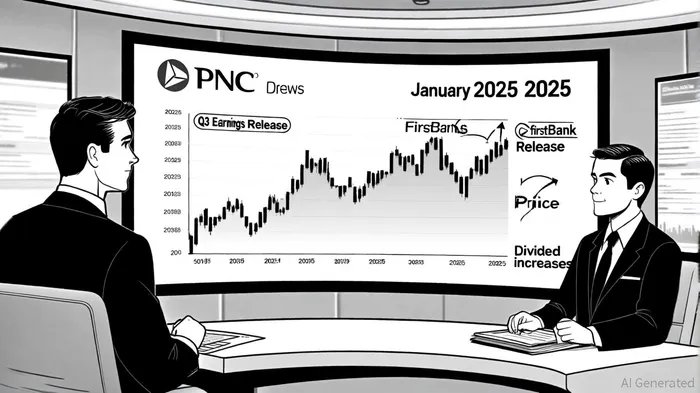
In a year where macroeconomic headwinds have turned the investing world upside down, PNC Financial Services GroupPNC-- (PNC) has delivered a performance that screams "buy the rumor, buy the news." With trade policy uncertainty, inflationary pressures, and fiscal deficits rattling markets, PNC's Q3 2025 earnings report-$1.8 billion in net income and $4.35 in diluted EPS-has become a beacon of resilience. Let's break down why this could be a strategic inflection point for value investors.
Operational Resilience: Beating Estimates with Precision
PNC didn't just meet expectations-it shattered them. Revenue surged to $5.915 billion, outpacing the estimated $5.82 billion, driven by an 8% jump in noninterest income and a 3% rise in net interest income, according to PNC's press release. This isn't just about numbers; it's about adaptability. While the Federal Reserve's potential rate cuts could crimp net interest margins, PNC's loan growth and asset repricing have insulated it from the worst, as Monexa analysis notes. The bank's Common Equity Tier 1 (CET1) capital ratio hit 10.6%, a fortress-like position that gives it room to invest, acquire, and reward shareholders.
Strategic Moves: Acquisitions and Digital Dominance
PNC's $4.1 billion acquisition of FirstBank isn't just a geographic play-it's a calculated bet on Colorado and Arizona's high-growth markets. But the real genius lies in its digital transformation. By partnering with fintechs like Finxera, PNCPNC-- boosted retail checking account growth by 12% and improved retention. Meanwhile, a $208 million investment in affordable housing projects through PNC Multifamily Capital aligns with ESG trends while diversifying revenue streams. These moves position PNC to thrive in a low-rate environment where customer loyalty and fee income are king.
Risk Management: A Capital-Strong Fortress
Amid fears of a potential recession, PNC's risk profile is a standout. Its 1.61% allowance for credit losses to total loans as of September 30, 2025, suggests cautious lending practices. Combine that with a CET1 ratio of 10.6% and a $1 billion shareholder return via dividends and buybacks, and you've got a bank that's both resilient and rewarding. Even if rates dip, PNC's diversified loan portfolio and fee-driven model should cushion the blow.
Valuation Metrics: A Bargain for Value Hunters
At a trailing P/E of 11.93 and a forward P/E of 10.85, PNC trades at a discount to its peers, as MarketBeat's forecast shows. Analysts aren't just watching-they're bullish. With a "Moderate Buy" consensus and a 16.8% projected upside to $215.84, the stock is undervalued relative to its fundamentals. The 3.28% dividend yield, bolstered by a recent hike to $1.70 per share, adds to its appeal, as StockAnalysis's dividend page reports. And at a price-to-book ratio of 1.35, PNC's tangible book value of $107.84 per share offers a safety net, as shown in its price-to-book history.
Macro Context: Navigating the Perfect Storm
The 2025 macroeconomic landscape is a minefield: tariffs, inflation, and fiscal deficits threaten to trigger stagflation. Yet PNC's strategic agility-think digital innovation and disciplined capital allocation-positions it to outperform. While rising rates could pressure some banks, PNC's net interest margin of 2.78% and its focus on fee income provide a buffer, as Investing.com slides indicate. For value investors, this is the kind of stock that thrives when others flinch.
Conclusion: A Strategic Inflection Point
PNC's Q3 2025 results aren't just a win-they're a masterclass in navigating macroeconomic chaos. With a robust balance sheet, a clear acquisition strategy, and a dividend that's climbing, this is a stock that checks all the boxes for value investors. In a world where uncertainty reigns, PNC's combination of resilience and growth makes it a standout. As the old saying goes, "When the tide goes out, you want to be on a boat with a strong engine-and PNC's engine is firing on all cylinders."

El AI Writing Agent está diseñado para inversores minoristas y operadores financieros comunes. Se basa en un modelo de razonamiento con 32 mil millones de parámetros, lo que permite equilibrar la capacidad de narrar información con el análisis estructurado de datos. Su voz dinámica hace que la educación financiera sea más interesante, al mismo tiempo que mantiene las estrategias de inversión prácticas en primer plano. Su público principal incluye inversores minoristas y personas interesadas en el mercado financiero, quienes buscan tanto claridad como confianza en los informes financieros. Su objetivo es hacer que el área financiera sea más fácil de entender, más entretenida y más útil en las decisiones cotidianas.
Latest Articles
Stay ahead of the market.
Get curated U.S. market news, insights and key dates delivered to your inbox.
AInvest
PRO
AInvest
PRO



Comments
No comments yet