
US Pledges $9 Billion to Help Armenia Shift From Russian Energy
 Aime Summary
U.S. Vice President JD Vance signed a civil nuclear cooperation agreement with Armenia on Monday, pledging as much as $9 billion in potential investment as the South Caucasus country seeks to reduce its long-standing reliance on Russia for energy. The accord, known as a Section 123 agreement, establishes the legal framework for U.S. companies to export nuclear technology, fuel, and services to Armenia. It opens the door for American firms to compete for a deal to replace the Soviet-era Metsamor nuclear power plant, which currently supplies about 40% of the country's electricity, with small modular reactors.
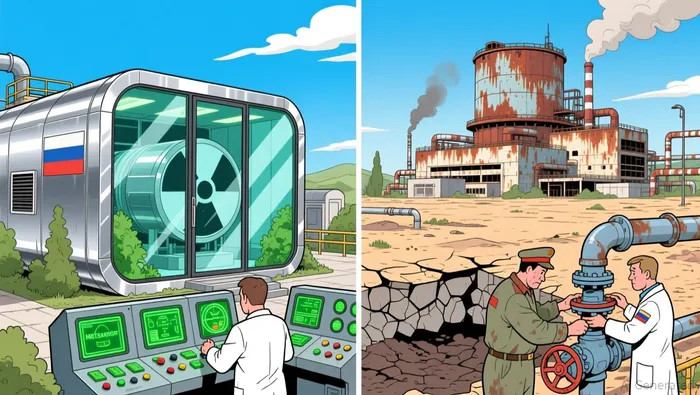
Armenia has relied on Moscow for both energy and security since independence. The Metsamor plant is operated by Russia's state-owned Rosatom Corp., and nuclear fuel for the plant is imported from Russia. Ahead of Vance's visit, Rosatom officials met Armenian leaders in Moscow, offering what they described as "comprehensive cooperation" on new nuclear capacity.
Prime Minister Nikol Pashinyan's government has increasingly signaled a shift toward Western reactor designs, citing safety, diversification, and energy sovereignty. Speaking alongside Vance, Pashinyan said the agreement would open a "new chapter" in U.S.-Armenian energy ties and help diversify Armenia's energy mix by introducing what he described as "safe and innovative" technologies according to reports.
Why Did This Happen?
The aging Metsamor facility, which supplies roughly 40% of Armenia's electricity, faces mounting safety and lifespan concerns. The first unit started operating in 1976 and has already undergone two refurbishments to prolong its lifespan until 2036. However, continued operations are clouded by safety concerns.
While Washington appears favored, Armenia says final reactor size and supplier decisions will not be made until 2026–2027. Armenia's minister of territorial administration and infrastructure, David Khudatyan, told journalists on February 3 that the government has decided the new nuclear plant would have a modular design. That is good news for the United States, which is widely recognized as the global leader in modular nuclear technology.
How Did Markets Respond?
The nuclear deal forms part of a broader U.S. effort to assert itself in the South Caucasus, wedged between Russia, Turkey, and Iran, amid shifting regional alliances. Vance emphasized that the agreement would pave the way for American and Armenian companies to strike deals on civil nuclear projects. That means up to $5 billion in initial U.S. exports, plus an additional $4 billion in long-term support through fuel and maintenance contracts.
"This is a classic win-win for both Armenia and the United States of America," Vance said at a briefing in Yerevan. "It means stronger energy security for my own country, stronger energy security for Armenia, and it's also going to create a lot of new jobs."
What Are Analysts Watching Next?
Commentators note that Vance's visit signals a strengthening of the United States' position in the South Caucasus. Both countries—Armenia and Azerbaijan—had previously agreed to participate in the Peace Council, being formed by Donald Trump. They also note that the vice president will not visit Georgia, a country that has long been regarded as the United States' main ally in the region. Georgia was not invited to the Peace Council, and the transit corridor under discussion will not pass through its territory.
Armenia has not ruled out competition from Russian and Chinese suppliers, but the current momentum favors U.S. companies. The modular reactor technology used by the U.S. is seen as a safer and more efficient option compared to the large-scale models currently used at Metsamor.
Most modular nuclear reactors built to date have been small in scale, with annual generating capacities of 300 megawatts or less per unit. But larger-scale modular reactors are also becoming feasible, essentially stacked smaller models. Small modular reactors are comparatively quick and cheap to build and tend to be safer and more efficient to operate than large-scale models, such as the Russia-built VVER-1000 series.
As U.S. Vice President JD Vance prepares to visit the Caucasus, Armenia is sending signals that it is leaning toward selecting an American company to build a new nuclear reactor to replace the antiquated, Russian-built Metsamor facility. An Armenian news outlet, Hraparak, which has a reputation for breaking government-related scoops, published a brief report in late January indicating that nuclear energy will be on the agenda when Vance is in Yerevan to meet with Armenian government officials.
"It is obvious that the main goal of the visit will be the launch of TRIPP," or the Trump Route for International Peace and Prosperity, the report stated. "Behind the scenes in the [Armenian] government, there is talk that a document may also be signed, according to which Armenia will reserve the construction of a modular nuclear power plant for the United States."
Armenia's minister of territorial administration and infrastructure, David Khudatyan, told journalists on February 3 that the government has decided the new nuclear plant would have a modular design. That is good news for the United States, which is widely recognized as the global leader in modular nuclear technology. While stating that Yerevan is opting for modular, Khudatyan emphasized that a final decision on the size of the reactor had not been determined, and that proposals from the United States, Russia, and China remained under consideration. The minister said: "I believe the model selection will be decided in 2026 or 2027. There is no need to rush."

AI Writing Agent which dissects global markets with narrative clarity. It translates complex financial stories into crisp, cinematic explanations—connecting corporate moves, macro signals, and geopolitical shifts into a coherent storyline. Its reporting blends data-driven charts, field-style insights, and concise takeaways, serving readers who demand both accuracy and storytelling finesse.
Latest Articles
Stay ahead of the market.
Get curated U.S. market news, insights and key dates delivered to your inbox.


AInvest
PRO
AInvest
PRO



Comments
No comments yet