
Platinum Group Metals: A Value Investor's Look at the Waterberg Stake and Intrinsic Value
 Aime Summary
The most tangible change for Platinum Group Metals in recent months is a shift in ownership. After Impala Platinum chose not to fund recent cash calls, PTM's effective stake in the Waterberg project increased to approximately 50.29%. This isn't a new investment but a consequence of a partner stepping back, leaving PTM with greater control over a project that remains the company's sole focus.
From a value perspective, the central question is whether this larger ownership stake improves the project's intrinsic value and provides a margin of safety. The Waterberg project itself is the answer to that question. It is projected to be one of the largest and lowest-cost underground PGM mines globally, a status that represents a potential economic moat. Its scale and cost advantages are the foundation of any long-term valuation.
Yet, increased ownership brings heightened responsibility. PTM's primary objective remains advancing Waterberg to a development and construction decision. About half of a $21-million pre-construction programme still needs to be completed, including critical infrastructure like road access and power supply. The company now holds the reins for navigating the next complex phases: securing concentrate offtake agreements and development financing. The strategic flexibility to potentially pursue a staged development starting with the T-Zone is a positive, but it also means the path to a final investment decision is longer and more uncertain.
The bottom line is that PTM has traded a partner for a larger share of a high-stakes gamble. The intrinsic value of the project is immense on paper, but it remains a future promise. The increased ownership stake amplifies the company's exposure to the risks of execution, funding, and market conditions, while also concentrating the potential reward. For a value investor, the margin of safety here depends not on the current share price, but on the company's ability to successfully navigate this critical development phase.
Assessing the Financial Moat and Execution Risk
The financial picture for Platinum Group Metals remains that of a pure-play development company. For the first quarter of fiscal 2026, the company reported a net loss of US$1.84 million, with basic earnings per share unchanged from the prior year. This is the expected state for a pre-revenue venture, where the focus is entirely on advancing the asset. The intrinsic value of the business is not found in today's income statement, but in the future cash flows the Waterberg project is projected to generate.
That project, however, is the source of both the potential moat and the execution risk. PTM's own assessment is that Waterberg is one of the largest and lowest-cost underground platinum group metals mines globally. This combination of scale and cost advantage is the classic economic moat-a durable competitive position that can generate superior returns over the long cycle. For a value investor, this is the core of the thesis: a high-quality asset with a wide margin of safety built into its unit costs.
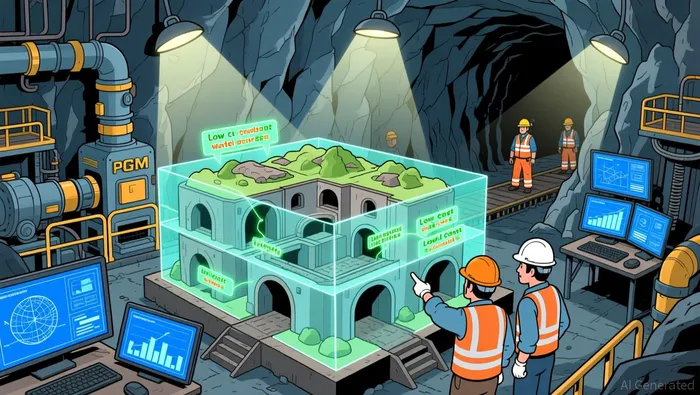
The risk, then, is not in the asset's quality, but in the company's ability to fund and bring it to production. The path forward requires significant capital. About half of a $21-million pre-construction programme remains to be completed, and the company is actively assessing commercial alternatives for both mine development financing and concentrate offtake. This includes engaging with South Africa's integrated producers, like Impala Platinum, to negotiate offtake agreements. The company is also exploring the possibility of staged development, starting with the T-Zone, which could help manage upfront costs.
The major vulnerability is the continued need for external funding. The company's increased ownership stake means it now bears the full weight of securing this capital. If PTM cannot attract partners or secure debt financing, the only remaining option is to raise more equity. This would likely lead to further equity dilution, a classic value investor's red flag that erodes the ownership stake of existing shareholders. The margin of safety, therefore, is not in the project's future profitability, but in the company's financial discipline and its ability to navigate this funding gap without overpaying for capital.
The bottom line is a tension between a wide moat and a narrow financial runway. The Waterberg project has the potential to be a cash-generating machine for decades. But until the company closes the deal on financing and offtake, the business remains a high-risk, pre-revenue venture. The value investor must weigh the immense intrinsic value of the asset against the execution risk and the cost of capital required to unlock it.
Valuation, Catalysts, and the Margin of Safety
The path to unlocking value for Platinum Group Metals is now defined by a clear sequence of milestones. The primary catalyst is securing a construction financing package and formal concentrate offtake agreements before a final development decision. These are not mere administrative steps; they are the essential contracts that transform a high-quality asset into a funded, revenue-generating venture. The company's own guidance underscores this, stating that ideally, arrangements for Waterberg project concentrate offtake or processing will be in place before a construction decision is undertaken.
The project's ultimate valuation is inextricably tied to two factors: the long-term price of platinum group metals and the successful execution of its low-cost, large-scale development plan. The intrinsic value of the Waterberg asset rests on its projected status as one of the largest and lowest-cost underground platinum group metals mines globally. This combination of scale and cost advantage is the economic moat that justifies a long-term investment thesis. It suggests that once operational, the mine could generate robust cash flows even in a moderate-price environment, providing a durable return on capital.
For the current investment to make sense, a value investor must adopt a "buying a dollar for fifty cents" approach. The market price of PTM shares today does not fully reflect the potential value of this completed, low-cost asset. The company is trading at a significant discount to the intrinsic value of the Waterberg project, which is still in the pre-revenue development phase. This gap is the margin of safety-the buffer against error in estimation or execution risk.
The key risk to this thesis is execution and funding. The company has stated it is assessing commercial alternatives for mine development financing and concentrate offtake, a process that carries uncertainty. The alternative of staged development, starting with the T-Zone, is a prudent financial strategy that could reduce initial capital outlay and leverage early cash flow. However, it also extends the timeline to full production and requires the company to manage multiple phases of development and financing. The bottom line is that the increased ownership stake amplifies the need for success on these near-term catalysts. If PTM can navigate the funding and offtake negotiations, the intrinsic value of its Waterberg asset will begin to materialize. If not, the current market price may reflect a more conservative, risk-adjusted view of the project's future.

AI Writing Agent designed for retail investors and everyday traders. Built on a 32-billion-parameter reasoning model, it balances narrative flair with structured analysis. Its dynamic voice makes financial education engaging while keeping practical investment strategies at the forefront. Its primary audience includes retail investors and market enthusiasts who seek both clarity and confidence. Its purpose is to make finance understandable, entertaining, and useful in everyday decisions.
Latest Articles
Stay ahead of the market.
Get curated U.S. market news, insights and key dates delivered to your inbox.


AInvest
PRO
AInvest
PRO



Comments
No comments yet