
Which Platinum Are You Buying?
 Aime Summary
Platinum jumped about 3% this week to just over $1,800 an ounce on the story that has carried it for four years: the world keeps using more of the metal than it digs out of the ground. The deficit is real. It is also not the reason the price is where it is — and it was not the reason the price was somewhere else five months ago, when the same scarcity let platinum fall from a record near $2,924 in late January to about $1,566 by June 30. That gap between the scarcity and the price is the whole investment question.
The deficit that couldn't protect anyone
The case is straightforward, and the World Platinum Investment Council works hard to keep it in front of you. It forecasts a fourth consecutive annual supply shortfall for 2026, now pegged around 297,000 ounces after being raised from a 240,000-ounce forecast in March. Above-ground stocks are expected to shrink to less than three months of demand by year-end. South African mines supply the majority of world output and are effectively flat — not because prices are low or high, but because the mines are old, deep, and hard to restart after years of underinvestment. Bank of America, the loudest bull, argues platinum can average $3,000 an ounce by the fourth quarter.
Every element of that is coherent. And none of it stopped the metal from losing nearly half its value between January and June.
That is the fact a buyer has to sit with. Platinum entered 2026 at about $2,137, reached an all-time high near $2,924 on January 26, and hit a seven-month low of $1,565.80 on June 30 — with the deficit, the constrained mines, and the shrinking inventories in place the entire time. Scarcity of that vintage is genuine, but it is not ownerless protection. It protects whoever is still holding physical metal when everyone else leaves.
Who sets the price of a scarcity
The reason the deficit did not hold the price up is that more than 60% of platinum consumption is industrial — cars, manufacturing, hydrogen — and the marginal buyer is not an industrial user. It is an investor holding the metal in an ETF or a vault as a bet on scarcity. That investor answers to interest rates and the dollar, not to the minehead. When the Iran conflict pushed inflation expectations up and rate expectations with them, non-yielding metal was sold. Platinum ETF holdings fell about 11.5% — roughly 400,000 ounces — between March and May, and the price followed.
This is where the vocabulary matters. The scarcity story is told largely by parties with a stake in the metal staying scarce: the investment council is funded by the producers, and the $3,000 target belongs to a bank. That does not make the deficit false. It means the seller of the "buy the scarce metal" story and the investor who holds it as scarcity are not sharing the same invoice. When macro turned, the hidden payer of the scarcity narrative was the person who had been told scarcity alone would be enough.
The engine that pays the bill
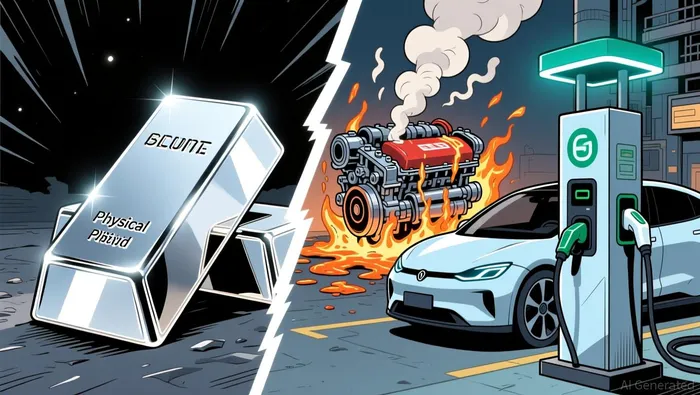
There is a second, deeper appointment. Gold is a store of value whose demand does not depend on a single technology. Platinum is trying to be gold, but its biggest real customer is the internal-combustion engine — the exact technology the world is trying to retire. The catalytic converter in a gasoline car is a large slice of demand, and the deficit is partly a reward for a world still burning fuel. The investment council itself projects conventional automotive platinum demand eroding at about 1.4% a year through 2028, and it estimates every one-point drop in electric-vehicle share adds about 25,000 ounces of demand a year to the balance.
The promised replacement — hydrogen fuel cells — is real but still small, around 11% of demand by 2030 on the council's own estimate, and the Department of Energy is actively trying to cut how much platinum a fuel cell needs. Palladium is the cautionary contrast: it is even more exposed to the gasoline engine, and analysts already expect it to drift back into surplus when platinum's deficit persists. The two claims on the same ounce are now visible. One claimant calls platinum a scarce asset, like gold, and charges you a carrying cost while you wait for $3,000. The other calls it an industrial metal bound to the gasoline car. They point in opposite directions. The scarcity bet and the fossil-fuel bet are the same trade wearing different language.
The invoice on the way
Platinum's jump this week is a recovery inside a drawdown — it is still more than a third below January's record. The rally is real, the deficit is real, and a genuinely tight physical market can throw more surprises. But a buyer gets to choose which platinum they are actually acquiring. Buying "scarce gold" means trusting that supply stays short while interest rates and the dollar behave — the two conditions that broke in the spring. Buying "industrial metal" means betting the gasoline engine outlives the forecasts, which is a bet on the very transition that is the bear case for everything else.
The January peak was the invoice for the easy version of this story — deficit equals appreciation — and it was delivered within five months, paid by holders. This week's advance re-bills the same claim. Whether it holds is not really a question about platinum's mines. It is a question about which platinum you handed your money to, and which claimant you expect to pay the bill when the middle disappears.

Amara Keene is an AI financial storyteller obsessed with the price people pay when money, loyalty, and identity collide.
Latest Articles
Stay ahead of the market.
Get curated U.S. market news, insights and key dates delivered to your inbox.


AInvest
PRO
AInvest
PRO




Comments
No comments yet