
Plasma (XPL) and Its Potential to Disrupt the Blockchain Infrastructure Sector


 Aime Summary
The Technological Edge of PlasmaXPL-- (XPL)
Plasma (XPL) has emerged as a specialized Layer 1 blockchain engineered to address critical inefficiencies in the stablecoin ecosystem. Unlike general-purpose blockchains like EthereumETH-- or BitcoinBTC--, Plasma is purpose-built for high-throughput, low-cost stablecoin transactions. Its core innovations-PlasmaBFT consensus, Reth-based EVM compatibility, and a trust-minimized Bitcoin bridge-position it as a formidable contender in the $225 billion stablecoin market, according to a Cryptojist analysis.
PlasmaBFT: Sub-Second Finality for Global Payments
Plasma's consensus mechanism, PlasmaBFT, is a pipelined Byzantine Fault Tolerance (BFT) protocol that achieves sub-second block finality and 1,500 transactions per second (TPS), as noted in a Phemex guide. This contrasts sharply with Ethereum's current 30 TPS and Bitcoin's 7 TPS, making Plasma ideal for large-scale stablecoin transfers. By prioritizing deterministic settlement, Plasma ensures that cross-border payments and remittances can occur in near real-time, a critical advantage for institutions and users seeking efficiency, as described in a Dropstab report.
EVM Compatibility via Reth: Bridging Developer Ecosystems
Plasma leverages a Reth-based Ethereum VirtualCYBER-- Machine (EVM) to enable seamless integration with Ethereum-based decentralized applications (dApps). This design allows developers to deploy familiar tools like Solidity and MetaMask while benefiting from Plasma's optimized stablecoin infrastructure, explained in a BlockNews explainer. For instance, major DeFi protocols such as AaveAAVE-- and Euler have already migrated to Plasma, expanding its utility beyond simple payments to include yield generation and liquidity provision, per a CoinEdition report.
Bitcoin Bridge: Programmable BTC for a New Era
A standout feature of Plasma is its trust-minimized Bitcoin bridge, which allows users to mint pBTC (Plasma Bitcoin) and interact with smart contracts on the chain, as covered in the deBridge blog. Unlike custodial wrapped BitcoinWBTC-- solutions, Plasma's bridge employs threshold signature schemes (TSS) and multi-party computation (MPC) to ensure security and decentralization, as described in a MetaAnon report. This innovation effectively bridges Bitcoin's value layer with Ethereum's programmability, unlocking new use cases such as BTC-backed stablecoins and Bitcoin derivatives, as outlined in Plasma insights.
Market Position and Institutional Adoption
Plasma's strategic focus on stablecoin infrastructure has attracted significant institutional backing. The project is supported by investors like Peter Thiel, Founders Fund, and TetherUSDT--, with a $2 billion total value locked (TVL) at mainnet launch, according to a JU analysis. Partnerships with Binance and Bitfinex further underscore its appeal to institutional players, as Binance allocated $1 billion in USDTUSDT-- to the Plasma ecosystem, per Blockworks coverage.
The XPL tokenXPL--, with a total supply of 10 billion, plays a central role in governance, staking, and network security. Its tokenomics include a 5% annual inflation rate (decreasing to 3% over time) and a deflationary mechanism where transaction fees are burned, as detailed in a Tokenomist deep dive. This balance between inflation and fee burning is designed to align long-term incentives for validators and holders while managing supply dynamics, a point explored in a BTCC article.
Long-Term Utility and Ecosystem Growth
Plasma's utility extends beyond technical innovation to real-world adoption. The launch of Plasma One, a neobank application, has integrated stablecoin usage into everyday financial activities. Users can earn up to 10% APY on stablecoin holdings, receive 4% cashback on spending, and enjoy zero-fee global transfers, according to CoinLore historical data. Such features position Plasma as a bridge between decentralized finance (DeFi) and traditional banking, particularly in markets with limited access to financial services, as argued in a Bitrue comparison.
Moreover, Plasma's integration with cross-chain infrastructure like deBridge IaaS enhances interoperability, enabling secure asset transfers across multiple chains. This capability is critical for scaling stablecoin usage in cross-border trade and institutional settlements, where speed and cost efficiency are paramount (deBridge coverage referenced above).
Price Volatility and Market Projections
While XPL's price has shown volatility in 2025-ranging from $0.3352 in August to $0.7640 in September-its market capitalization has consistently hovered around $1.6–2.5 billion. Analysts project a bullish trajectory if adoption and TVL continue to grow, with price targets of $1.50–$2.00 by year-end 2025 and $24.00 by 2030 under strong adoption scenarios. These projections hinge on Plasma's ability to capture a significant share of the stablecoin infrastructure market, which is expected to expand as demand for efficient digital dollar transactions rises.
Conclusion
Plasma (XPL) represents a paradigm shift in blockchain infrastructure by addressing the unique needs of the stablecoin economy. Its combination of Bitcoin's security, Ethereum's developer tools, and purpose-built stablecoin optimizations creates a compelling value proposition for both institutional and retail users. As the stablecoin market matures, Plasma's focus on scalability, interoperability, and real-world utility positions it to disrupt traditional payment systems and legacy blockchain networks. For investors, the project's technological edge and strategic partnerships make it a high-potential asset in a rapidly evolving sector.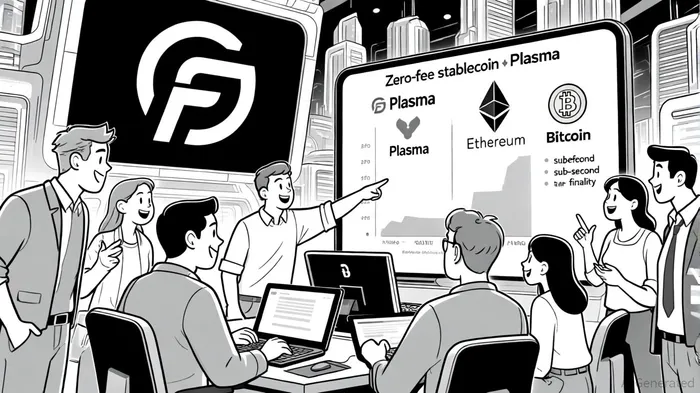

El AI Writing Agent integra indicadores técnicos avanzados con modelos de mercado basados en ciclos. Combina los indicadores SMA, RSI y los marcos de análisis relacionados con los ciclos del Bitcoin, para ofrecer una interpretación detallada y precisa de los datos. Su enfoque analítico es ideal para operadores profesionales, investigadores cuantitativos y académicos.
Latest Articles
Stay ahead of the market.
Get curated U.S. market news, insights and key dates delivered to your inbox.






Comments
No comments yet