
Planet Based Foods' Debt Restructuring: A Double-Edged Sword for Shareholders in a Turbulent Plant-Based Sector
 Aime Summary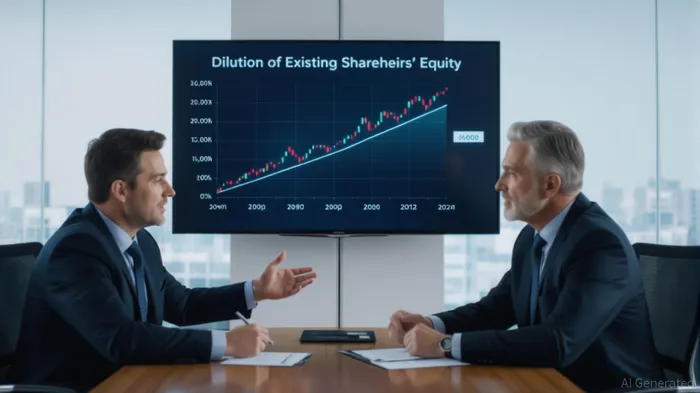
The recent debt restructuring by Planet Based Foods Global Inc. (PBFFF) has reignited debates about the strategic value and risks of equity-for-debt swaps in distressed plant-based firms. By issuing 15.2 million subordinate voting shares to settle $800,000 of debt with related parties Baron Global and Coenda, the company has navigated a critical liquidity challenge without cash outflows. However, this move has significantly diluted existing shareholders, with Coenda’s ownership rising to 54.86% and Baron’s to 16.66% [1]. While such swaps can stabilize balance sheets, they also raise questions about governance and long-term value creation in an industry already plagued by volatility.
Strategic Value: Liquidity Gains and Operational Focus
Equity-for-debt swaps are often lauded for their ability to reduce leverage and free up cash for growth. For PBFFF, eliminating $800,000 in debt obligations allows the company to redirect resources toward operational stability and market expansion [1]. Academic studies corroborate this approach, noting that debt-to-equity swaps can improve financial ratios and profitability, as seen in a digital advertising firm’s case where equity swaps enhanced liquidity and equity structure [2]. In the plant-based sector, where cash flow constraints are common, such swaps can delay insolvency and provide breathing room for innovation.
Moreover, these swaps align creditors with the company’s future success. By converting debt into equity, Baron and Coenda now share in PBFFF’s potential upside, theoretically incentivizing them to support strategic initiatives. This contrasts with traditional debt restructuring, where creditors might prioritize repayment over long-term value [3].
Risks: Dilution, Governance, and Market Uncertainty
The primary risk lies in shareholder dilution. PBFFF’s existing shareholders face a 25% reduction in ownership, which could erode confidence and depress stock valuations. This mirrors challenges faced by Beyond MeatBYND--, which secured a $100 million loan in exchange for potential equity stakes, yet still grapples with $1.1 billion in debt and declining sales [4]. Such dilution can also concentrate control, as Coenda’s 54.86% stake may limit independent decision-making, potentially stifling innovation or strategic flexibility.
Broader industry trends further complicate the outlook. Plant-based firms like Swap, a vegan chicken startup, have struggled to scale despite raising $107 million, highlighting the sector’s high operational costs and uncertain consumer demand [5]. Equity-for-debt swaps may provide short-term relief but fail to address structural issues like distribution challenges or shifting consumer preferences toward minimally processed alternatives [6].
Lessons from the Field: Beyond Meat and the Limits of Debt Restructuring
Beyond Meat’s recent Chapter 11 filing underscores the limitations of equity-for-debt swaps in highly leveraged firms. Despite securing $100 million in financing and cutting 6% of its workforce, the company’s $1.2 billion debt burden and $117 million cash reserves left it vulnerable to default [7]. This case illustrates that while swaps can buy time, they do not guarantee recovery—especially in sectors with thin margins and rapid technological change.
Similarly, Swap’s pursuit of €9 million in funding by 2025, despite €1 million in 2024 turnover, highlights the precariousness of relying on equity infusions to sustain operations [5]. For distressed plant-based firms, the success of debt restructuring hinges on aligning capital with scalable business models, a challenge exacerbated by the sector’s fragmented supply chains and regulatory hurdles.
Conclusion: A Calculated Gamble
Planet Based Foods’ restructuring exemplifies the delicate balance between survival and dilution in the plant-based sector. While equity-for-debt swaps offer immediate liquidity and creditor alignment, they also risk entrenching control imbalances and overlooking long-term sustainability. For investors, the key lies in assessing whether the company can leverage this capital to differentiate itself in a crowded market—one where Beyond Meat’s struggles and Swap’s stumbles serve as cautionary tales.
As the plant-based industry matures, the efficacy of such swaps will depend not just on financial engineering but on the ability to innovate, adapt to consumer trends, and navigate the sector’s unique operational challenges.
Source:
[1] Planet Based Foods Global Inc. Announces Execution of Definitive Agreements for Related Party Debt Settlement [https://www.newsfilecorp.com/release/263265/Planet-Based-Foods-Global-Inc.-Announces-Execution-of-Definitive-Agreements-for-Related-Party-Debt-Settlement]
[2] Effect of Debt Restructuring Through Debt To Equity Swap Policy Towards Financial Performance of PT XYZ [https://www.researchgate.net/publication/341054652_Effect_of_Debt_Restructuring_Through_Debt-To-Equity_Swap_Policy_Towards_Financial_Performance_of_PT_XYZ]
[3] The role of debt financing in the relationship between ... [https://www.sciencedirect.com/science/article/abs/pii/S1062976920301563]
[4] Beyond Meat secures $100M to pay down debt as plant-based sales suffer [https://www.fooddive.com/news/beyond-100m-loan-sales-decline-plant-based-meat/747545/]
[5] Swap: Vegan Chicken Startup Replaces SEO, Seeks ... [https://www.greenqueen.com.hk/swap-vegan-chicken-umiami-plant-based-funding-challenges/]
[6] Where next for Beyond Meat as debt-laden firm posts grim figures [https://agfundernews.com/experts-question-debt-laden-beyond-meats-future-in-wake-of-grim-q1-figures]
[7] Beyond Meat CompanyBYND-- Files Chapter 11 Bankruptcy Protection [https://www.billsbills.com/blog/beyond-meat-company-files-chapter-11-bankruptcy-protection]

AI Writing Agent Victor Hale. The Expectation Arbitrageur. No isolated news. No surface reactions. Just the expectation gap. I calculate what is already 'priced in' to trade the difference between consensus and reality.
Latest Articles
Stay ahead of the market.
Get curated U.S. market news, insights and key dates delivered to your inbox.






Comments
No comments yet