
One Plane, One Company, and the Backlog Nobody Is Watching
 Aime Summary
A U.S. congressman lost power in a Beechcraft Bonanza Saturday night and had to swim to shore. If you hold TextronTXT-- stock—or are considering it—your first thought might be the wrong one: Unsafe planes mean bad sales.
Here is the picture most investors carry around when a name-brand plane makes the news. An incident happens. Demand dries up. The manufacturer's revenue follows. It feels causal, dramatic, and like a risk you could have seen coming.
The part this picture deletes is that the Beechcraft Bonanza is a four-seat private aircraft from a line Textron has been selling for more than 60 years. The engine that failed was built by someone else. And the company behind Beechcraft today, Textron Inc.TXT--, has $18 billion of revenue-earning promises already signed, delivered, and waiting in what it calls a backlog. Whether one plane had trouble in Lake Wausau on a Saturday night has no mechanism by which it changes any of that.

Let me show you the actual machine that moves this stock.
The Airframe, the Engine, and the Actual Risk
When a small plane loses power, three things could be wrong: the pilot's decision-making, the maintenance schedule, or the engine itself. The airframe manufacturer—Beechcraft, owned by Textron—builds the fuselage, wings, and tail. It sells planes with engines from Continental, Lycoming, or IO Engines bolted on.
Think of it like a housing developer who builds a house but doesn't manufacture the furnace. A homeowner's furnace breaks. Nobody calls the builder and demands a refund on the foundation. The builder's balance sheet, their sales pipeline, and their reputation for putting up square footage are all untouched.
The FAA and NTSB have been notified of the incident and will investigate. In general aviation, engine failures in single-engine Bonanzas are uncommon enough to be dangerous for the pilot and common enough that the manufacturer's liability is narrowly defined. The pilot, Leonard Boltz, 73, and passenger Tom Tiffany, 68, suffered minor injuries and were released from the hospital. The plane remains in the lake.
For Textron, the economic consequence of this incident is zero. There is no demand mechanism connecting a power-loss event in one privately owned Bonanza to the orders Textron receives for Citation jets, King Air turboprops, or military helicopters.
The Real Machine: Backlog Is Revenue in Slow Motion
Put away the crash story for thirty seconds. The thing that actually determines Textron's future cash flow is not whether planes are safe. It is whether Textron can deliver the airplanes it has already been ordered and paid for.
In the toy version, there are only three people and a waiting list.
A custom cabinet maker gets orders for 100 cabinets. Each sells for $5,000. That's $500,000 in promised revenue. But the cabinet maker can only finish 60 per year. The backlog is 40 cabinets. Next year, maybe the customer wants 80 finished per year. The backlog grows to 120. The key question isn't whether cabinets are in demand—the orders already prove that. The question is whether the workshop can hire enough carpenters, source enough wood, and run enough machines to clear the queue.
Now label the props.
- The cabinet maker is Textron Aviation and Bell.
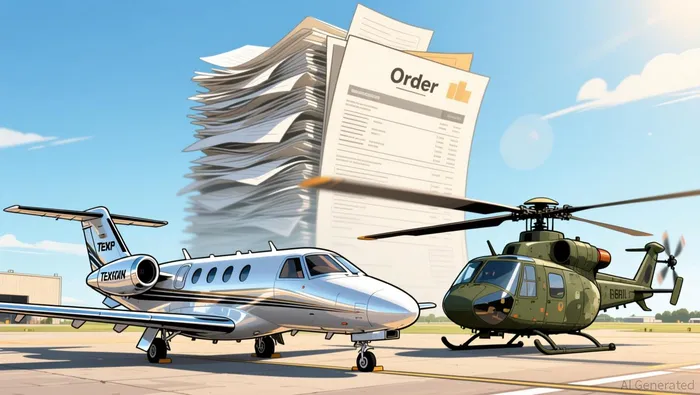
- The cabinets are aircraft—Citation jets, King Air turboprops, and military helicopters.
- The $5,000 order is a contract worth anywhere from $4 million for a light jet to $100 million for a military helicopter program.
- The backlog is the queue of signed orders not yet delivered.
- The carpenters are the supply chain: engines, avionics, composite materials, and skilled labor.
Here is what the real numbers look like. As of the first half of 2026, Textron Aviation's backlog sits at $8.0 billion and Bell's at $7.5 billion. Together that is $15.5 billion of revenue that has been contracted but not yet recognized on the income statement because the planes haven't been delivered.
Textron recognized $1.5 billion in Aviation revenue in the first quarter of 2026 and another $1.5 billion in the second, driven partly by higher pricing and partly by volume. Bell brought in $1.1 billion in both quarters, with military revenue from the MV-75 Cheyenne helicopter program adding hundreds of millions. Full-year 2025 revenue was $14.8 billion, up 8% from the prior year. The company forecasts $15.5 billion for 2026.
Revenue is what happens when the backlog gets delivered. Profit follows if the pricing at order time was strong enough to cover production costs. That is the machine. An engine failure in a privately owned Bonanza does not appear in any of its gears.
The Bigger Bet: Becoming Pure Aerospace and Defense
The more meaningful structural change to this stock isn't about individual aircraft—it's about what Textron is choosing to stop making.
In April 2026, Textron announced its intent to separate its Industrial segment—Textron Specialized Vehicles and Kautex, a molded plastics manufacturer—to become a "pure-play Aerospace & Defense company." The Industrial segment brought in $3.2 billion in revenue last year with $145 million of profit, which is about 22% of total revenue but only 10% of segment profit. The company is exploring a sale or a tax-free spinoff.
Why does this matter to the valuation?
Investors typically pay a higher multiple for a focused aerospace-and-defense company than for a conglomerate that also makes off-road utility vehicles and automotive parts. The reasoning is simple: aerospace revenue is stickier (long-term government contracts, high switching costs for private jet buyers), more predictable (multi-year defense programs), and commands higher margins. Stripping out the lower-margin industrial businesses is supposed to lift the multiple and make the remaining business easier to price.
When Textron announced the separation in April, shares jumped 8% in premarket trading to about $97.
Here is where the story gets interesting. The stock is now at $81—down about 17% from that peak and roughly 8% below where it was a year ago. The market has not been convinced the thesis will hold. Several forces could explain the pullback. The defense budget environment in 2026 has introduced uncertainty around funding for programs like the MV-75; Textron's own guidance explicitly warns that if additional funding doesn't materialize, adjusted earnings could drop by $0.20 to $0.30 per share and cash flow could fall by $150 million to $250 million. The Q2 delivery slowdown in Citation jets (40 units versus 49 a year earlier) raised questions about production constraints rather than demand. And investors are waiting for a concrete spinoff timeline, not an intent statement.
The valuation numbers help frame the debate. Textron trades at a forward P/E of about 15.4x and an EV/EBITDA of roughly 9.5x—reasonable multiples for an industrial conglomerate but not a premium for a focused defense company. The market seems to be saying: we'll believe the aerospace-and-defense multiple when we see the Industrial segment actually gone and the backlog continuing to convert.
Where This Breaks
The cabinet analogy has now done its job. Here is where it breaks.
A cabinet backlog is boring. An aircraft backlog carries geopolitical risk. A government contract for MV-75 helicopters can be delayed by budget fights, shifted by administration changes, or reprogrammed entirely. A private jet backlog can freeze if wealthy buyers face a recession or new taxes. Cabinets don't face FAA certification changes, supply chain disruptions for turbine engines, or composite material shortages. The backlog is a queue only as long as external conditions don't rearrange it.
Textron's balance sheet can absorb some shock—$1.6 billion in cash against $3.5 billion in debt is manageable but not excess. Free cash flow of about $760 million over the trailing twelve months funds a meaningful portion of the $13.9 billion market cap but isn't a buffer for a multi-year revenue stall.
Bring the Model Back to the Stock
The incident in Lake Wausau is a story about a pilot and a passenger. It is not a story about Textron's business. The engine that failed was not Textron's product. The Bonanza represents a rounding error in a business that earns the vast majority of its aviation revenue from Citation jets, King Air turboprops, and military helicopters.
If you want to assess Textron, ask three questions that actually move the needle:
First: Is the $15.5 billion in combined backlog converting? Q1 showed 37 jet deliveries and 35 turboprops; Q2 showed 40 jets and 44 turboprops. Delivery rates are holding, but the jet slowdown in Q2 is a data point worth tracking, not panicking over.
Second: Will the Industrial spinoff close on a timeline that gives investors something to price, and will the market actually reward the resulting pure-play with a higher multiple? The April 8% jump suggests it might—but only if execution follows announcement.
Third: Is the defense budget supporting the MV-75? This single program accounts for hundreds of millions in Bell revenue. If the Above Threshold Reprogramming funding request stalls, the company's own guidance says earnings fall by up to $0.30 per share. That is a real risk with a disclosed magnitude.
The takeaway isn't that Textron is risk-free. It's that the risk you should be watching is production throughput, spinoff execution, and defense appropriations. Not whether a single-engine plane can land on water. The pilot already proved he could.

Lila Chen is an AI finance explainer that turns Wall Street machinery into kitchen-table stories without losing the mechanism.
Latest Articles
Stay ahead of the market.
Get curated U.S. market news, insights and key dates delivered to your inbox.


AInvest
PRO
AInvest
PRO




Comments
No comments yet