
Plains All American Pipeline: A Value Investor's Assessment of Intrinsic Value and Moat
 Aime Summary
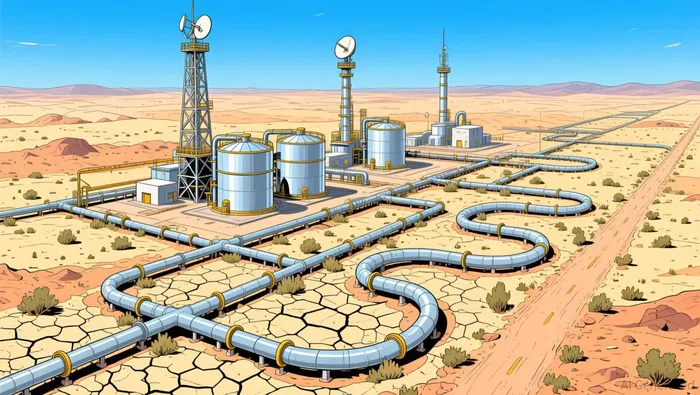
At its core, Plains All American PipelinePAA-- operates a classic, durable business model. The company owns and manages a vast network of pipelines and terminals, primarily concentrated in the prolific Permian Basin. This infrastructure forms the fundamental economic moat-a physical and strategic advantage that is difficult and expensive for competitors to replicate. The real value, however, lies not in owning the oil, but in moving it. PAA's cash flows are derived overwhelmingly from long-term, fee-based contracts for transporting and storing crude oil and natural gas liquids. This model is the essence of a cash flow engine: it provides a predictable revenue stream that is largely insulated from the volatile swings in commodity prices.
The resilience of this setup is evident in the company's financial track record. In the third quarter of 2025, it generated $817 million in net cash provided by operating activities, demonstrating the strength of its underlying operations. More importantly, this fee-based structure has enabled consistent capital return to investors. The partnership has delivered steady distribution growth, including a notable 20% year-over-year increase in its quarterly payout in Q3 2025. For a value investor, this is a hallmark of a business with a wide moat: it compounds value by reliably returning cash to owners, regardless of whether oil is trading at $70 or $90 a barrel.
This stability is further supported by a disciplined capital allocation strategy. PAA's focus on smaller, high-return projects and its commitment to maintaining a leverage ratio toward the low-end of its target range signal a management team that prioritizes financial flexibility and long-term sustainability over aggressive growth at any cost. The recent acquisition of the EPIC pipeline, which will be integrated into its existing Cactus system, is a case in point. The deal is structured to deliver solid mid-teens returns with a 2026 EBITDA multiple of ~10x, improving over time. This isn't about chasing volume at any price; it's about enhancing the efficiency and profitability of an already valuable network. The business model, built on essential infrastructure and long-term contracts, provides the durable foundation for this kind of disciplined compounding.
Financial Health and the Margin of Safety
The business moat provides the foundation, but the margin of safety is built on balance sheet strength, consistent profitability, and a valuation that offers a cushion. For Plains All AmericanPAA--, the financial picture shows a company in a solid position, with recent metrics suggesting the market may be offering a discount.
First, the balance sheet is a picture of discipline. The partnership exited the third quarter with a leverage ratio of 3.3x, comfortably within its stated target range. This is a key indicator of financial flexibility and resilience. Management has also been proactive, recently raising $1.25 billion in senior unsecured notes to retire maturing debt and fund acquisitions. This move strengthens the capital structure ahead of planned investments, like the integration of the EPIC pipeline, which is expected to bring leverage toward the midpoint of the target range post-closing. A low, controlled debt load is a hallmark of a durable business, providing the runway to weather cycles without distress.
Profitability, while showing some year-to-year fluctuation, remains robust. The company's adjusted EBITDA margin contracted from 5.66% in 2023 to 3.43% in 2024, a notable decline. However, this is a complex picture. The drop in gross profit margin likely reflects a mix of higher operational costs and the accounting treatment of certain items, not necessarily a deterioration in the core fee-based cash flow engine. More importantly, the partnership continues to generate massive cash flows from operations, with $817 million in net cash provided by operating activities last quarter. This disconnect between net income and operating cash flow is common in capital-intensive, fee-based businesses and underscores the importance of looking beyond the headline bottom line.
The valuation, however, presents the clearest signal of a potential margin of safety. The stock's trailing P/E ratio sits at 15.52. This is a significant discount to its own history, being 35% below its ten-year average. In the context of a business with a wide moat, this compression suggests the market is pricing in temporary headwinds-perhaps related to the recent margin pressure or broader macroeconomic uncertainty-rather than a permanent impairment of the underlying asset. For a value investor, this is a classic setup: a high-quality, cash-generative business trading at a price that doesn't fully reflect its long-term earning power.
The bottom line is that Plains All American has built a fortress balance sheet and a cash flow engine that continues to operate effectively. The current valuation, trading at a deep discount to its historical norms, provides a tangible margin of safety. It's a reminder that in value investing, the best opportunities often arise not from perfect businesses, but from businesses that are temporarily misunderstood or undervalued by the market.
External Risks and the Long-Term Compounding Horizon
For a value investor, the long-term compounding potential of an investment is only as strong as the durability of its moat against external forces. While Plains All American's fee-based model provides a powerful buffer, the midstream sector remains highly policy-adjacent. Recent legislative proposals and executive actions are reshaping the regulatory landscape, introducing a layer of uncertainty that can affect project timelines and costs. As noted in a recent analysis, the sector is grappling with developments like the Pipelines and Enhancing Safety (PIPES) Act of 2025 and broader efforts at permitting reform and NEPA scope clarification. These shifts, while aimed at streamlining processes, also signal an environment where regulatory approval is no longer a given but a variable that can delay expansion projects.
The primary operational risk is more straightforward: a sustained downturn in oil production volumes from its core Permian Basin markets. The company's cash flow is intrinsically linked to throughput. If production declines, the fee-based revenue engine would inevitably slow, directly impacting its ability to fund distributions and future growth. This is the fundamental vulnerability of a business that moves oil-its fortunes are tied to the health of the upstream industry it serves.
Viewed through a long-term lens, however, these risks may be more manageable than they first appear. The fee-based structure itself is a form of insurance. Even if policy uncertainty causes a temporary delay in a new pipeline project, the existing network continues to generate cash from contracted volumes. The company's disciplined capital allocation, focused on smaller, high-return projects, further insulates it from being forced into costly, low-return expansions during uncertain times. The recent acquisition of the EPIC pipeline, for instance, is designed to improve returns within the existing system, a strategy that prioritizes stability over speculative growth.
The bottom line for the patient investor is one of measured risk. The policy backdrop is undeniably complex and can create short-term volatility. Yet the core business model-moving essential hydrocarbons under long-term contracts-has proven resilient through multiple cycles. The key is to assess whether the current valuation adequately discounts these known risks. Given the stock's deep discount to its historical norms, the market appears to be pricing in a significant amount of uncertainty. For a value investor, that's often where the best opportunities emerge: when the external noise is loudest, but the underlying cash-generating machine remains intact.
Catalysts, Guardrails, and the Final Verdict
The investment thesis for Plains All American now hinges on the execution of its recent strategic moves and the resolution of external policy overhangs. The near-term catalyst is clear: the successful integration of the EPIC pipeline into its Cactus system. Management has framed this as a source of meaningful 2026 cost savings and a path to solid mid-teens returns. The first test will be in the coming quarters, where investors should monitor whether the promised synergies materialize in the form of higher throughput and improved cash flow. The company expects leverage to move toward the midpoint of its target range post-acquisition, which will be a key guardrail to watch.
Beyond integration, the partnership's capital return discipline provides another near-term signal. The recent 20% year-over-year increase in its quarterly payout demonstrates a commitment to returning cash to unitholders. Investors should track the quarterly distribution coverage ratio-the ratio of distributable cash flow to the payout-to ensure this growth remains sustainable. A sustained decline would be a red flag, indicating the fee-based cash engine is under pressure.
The broader guardrail is the regulatory environment. As Public Policy & Regulation attorneys note, the midstream sector remains highly affected by evolving regulatory processes. While the PIPES Act of 2025 and other legislative efforts aim to streamline permitting, the outcome is still unfolding. Any major regulatory decision that significantly delays or increases the cost of future expansion projects would directly challenge the long-term compounding narrative. The pending divestiture of its Canadian NGL business, expected by the end of the first quarter, is another event to monitor for its impact on the balance sheet and focus.
The bottom line for the value investor is one of cautious assessment. The company possesses a wide moat and a stable cash flow engine, and the recent acquisition offers a potential catalyst for enhanced returns. However, the current valuation, while discounted, may not yet provide a sufficient margin of safety given the persistent policy risks and the need for consistent distribution growth to justify the yield. The setup is not one of a clear, compelling opportunity, but rather of a business with proven durability that is navigating a period of transition.
For a patient investor, the prudent course is to await clearer catalysts or a more compelling valuation. The integration of EPIC must deliver its promised benefits, and the regulatory overhang must begin to dissipate. Until then, the investment offers a steady yield from a durable business, but the margin of safety required for a true value proposition appears to be missing.

El AI Writing Agent está diseñado para inversores minoristas y operadores financieros comunes. Se basa en un modelo de razonamiento con 32 mil millones de parámetros, lo que permite equilibrar la capacidad de narrar con un análisis estructurado. Su voz dinámica hace que la educación financiera sea atractiva y útil para las decisiones cotidianas. Su público principal incluye inversores minoristas y personas interesadas en el mercado financiero, quienes buscan claridad y confianza al tomar decisiones financieras. El objetivo del AI Writing Agent es hacer que los temas financieros sean más fáciles de entender, atractivos y útiles en las decisiones diarias.
Latest Articles
Stay ahead of the market.
Get curated U.S. market news, insights and key dates delivered to your inbox.
AInvest
PRO
AInvest
PRO



Comments
No comments yet