
PIPPIN Price Volatility Spikes Amid Whale Exits and Market Uncertainty
 Aime Summary
PIPPIN’s price dropped 56.5% in 24 hours, erasing $187 million in market cap as over 50 whale accounts executed a synchronized exit. - The token recorded a 33% price drop in a single day, triggered by a massive short position buildup and $2.62 million in long-leveraged futures liquidations. - PIPPIN’s 74.31% weekly surge was accompanied by a 33.79% volume-to-market-cap ratio, indicating high volatility and speculative trading behavior.
PIPPIN has experienced extreme price volatility in recent weeks, driven by large whale activity and speculative trading. The token’s price plunged 56.5% in 24 hours after over 50 whale accounts executed a coordinated sell-off, removing $187 million from its market capitalization. This event, coupled with a $560K transfer to exchanges, signaled imminent selling pressure and accelerated a broader selloff.
Traders observed a 74.31% weekly surge in PIPPIN’s price, reflecting intense bullish momentum, but the token’s high volume-to-market-cap ratio of 33.79% pointed to continued volatility. The surge in speculative interest has drawn traders to the token, yet it remains range-bound with rapid price swings. Such behavior is typical of meme tokens, where novel tokenomics and speculative demand attract traders but come with high risks.
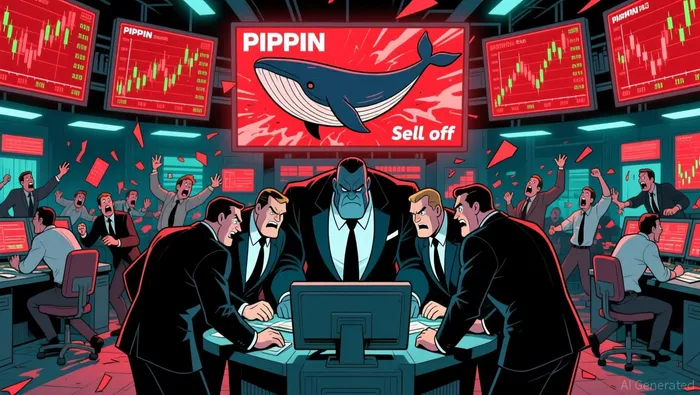
Further compounding the price instability, PIPPIN’s derivatives market revealed a sharp increase in short positions. Over $1.91 million in long-leveraged futures positions were liquidated in 24 hours, contributing to a downward trend in its price. The token’s price fell below key support levels, and the market remains cautious as on-chain activity and funding rates suggest aggressive closure of long positions.
What triggered PIPPIN’s recent price crash?
PIPPIN’s price collapse was largely attributed to whale activity and the liquidation of leveraged long positions. A coordinated sell-off by large holders and increased shorting activity led to a 56.5% and 33% drop in the token’s value within a week. The sell-off was also preceded by a $560K transfer to exchanges, suggesting an intentional strategy to trigger selling pressure.
The on-chain data indicates that two major wallets, 9PHm2c and 3Mg7DG, sent tokens to exchange deposit addresses, likely in anticipation of a price decline. The timing and volume of these transfers suggest strategic distribution rather than panic selling. This highlights the fragile nature of low-liquidity tokens, where large inflows to exchanges can signal imminent selling pressure and influence market sentiment.
How is the market reacting to PIPPIN’s volatility?
Market sentiment remains bearish as PIPPIN continues to face downward momentum. The token’s price has declined 79.8% in 30 days, indicating a broader selloff that was not driven by panic but by a systematic unwinding of positions. On-chain activity shows that traders are closing long positions aggressively, and the OI-weighted funding rate is deeply negative at -0.8, signaling continued short dominance.
Despite the bearish trend, some analysts believe that PIPPIN could rebound if it holds above the $0.0427 support level. The ADX indicator has reached 45, indicating strong directional momentum. However, the token’s overall trend has been downward since February 26, with over 92% value lost during that period.
What are the risks of trading PIPPIN at this time?
The high volatility and speculative nature of PIPPIN present significant risks for traders. The token’s recent price swings, including a 74.31% weekly surge followed by a 33% drop, illustrate the unpredictable nature of meme coins and their susceptibility to large whale actions. Additionally, the token’s high volume-to-market-cap ratio suggests that it is being heavily traded, which increases the likelihood of sharp price movements.
Traders are advised to exercise caution when entering new positions in PIPPIN due to the elevated risk of liquidity issues and market manipulation. The coordinated whale exits and the rapid liquidation of long positions indicate that the token’s price is highly sensitive to market sentiment and on-chain activity. This makes PIPPIN a high-risk, high-volatility asset that is not suitable for conservative investors.

Blending traditional trading wisdom with cutting-edge cryptocurrency insights.
Latest Articles
Stay ahead of the market.
Get curated U.S. market news, insights and key dates delivered to your inbox.


AInvest
PRO
AInvest
PRO



Comments
No comments yet