
PIPPIN CRASHES 50% IN 24 HOURS AMID WHALE SELLOFF AND DERIVATIVES IMBALANCE
 Aime Summary
PIPPIN declined 49.7% in 24 hours with a 2.48x volume-to-market-cap ratio, indicating coordinated selling or aggressive counter-trend accumulation according to market analysis.
Whale holders reduced 25% of their holdings in 24 hours, increasing bearish pressure as derivatives data showed $4.69M in shorts versus $2.57M in longs according to CoinMarketCap.
PIPPIN, an AI agent token created by Yohei Nakajima, experienced a sharp decline of nearly 50% in a single trading session on April 3, 2026. The token's market capitalization of $31.2 million was dwarfed by a 24-hour trading volume of $77.5 million, resulting in a volume-to-market-cap ratio of 2.48x. This anomaly suggests either systematic deleveraging by overleveraged positions or speculative accumulation by contrarian traders. The price drop was uniform across all 62 tracked currency pairs, ranging from 49.29% against ETH to 51.76% against EOS. This consistency in percentage losses points to coordinated selling rather than isolated regional panic. Additionally, the Bitcoin-denominated price decline mirrored the USD performance, indicating PIPPIN-specific selling pressure rather than broad market contagion.
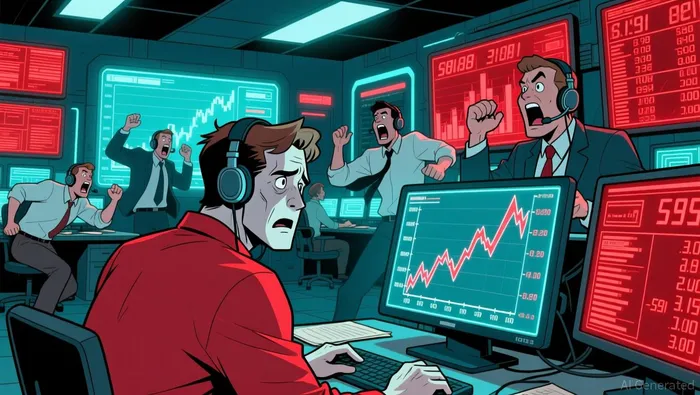
Whale activity has intensified the bearish pressure on PIPPIN. On-chain analytics revealed that large holders sold 25% of their holdings in 24 hours, signaling a loss of conviction and increased sell-side pressure. This whale activity coincided with capital rotating out of PIPPIN into other tokens, weakening its upside momentum. The derivatives market reflects further bearish sentiment, with short positions totaling $4.69 million and long positions at $2.57 million. This imbalance suggests that traders are positioning for further downside, creating a feedback loop of selling.
PIPPIN's volatility is rooted in its position as an AI agent token. The AI agent token category attracted over $2.3 billion in aggregate market cap during Q1 2026, representing a 340% increase from Q4 2025. This rapid expansion led to unsustainable valuation multiples, with PIPPIN trading at approximately $0.062 at its peak. The current correction brings valuations more in line with similar AI agent projects but still remains elevated compared to fundamental metrics like active users or on-chain transaction volume. PIPPIN's rank of #611 on CoinGecko places it in a precarious middle tier, historically associated with 60-80% drawdowns during bear phases. The token's technical structure and liquidity dynamics mean that even modest institutional or whale-sized orders of $500K-$1M can move the market by 5-10%, creating a feedback loop during volatile periods.
Why Does PIPPIN's Volatility Matter for Investors?
The sharp price decline and liquidity dynamics associated with PIPPIN highlight the risks of speculative positioning without clear fundamentals. PIPPIN is currently consolidating near a critical support level at $0.0427. Analysts suggest a break above $0.06522 could trigger a 30% bounce, offering a cautious short-term trading opportunity. However, the broader market structure remains bearish below the $0.059 equilibrium. The absence of detailed tokenomics or vesting schedules in public documentation creates uncertainty around potential supply-side pressure. AI agent tokens frequently face selling from early participants during volatility spikes, and without transparent unlocking schedules, this risk remains unquantifiable.
The volatility of PIPPIN also reflects broader weaknesses in the AI agent token sector. PIPPIN's single-day 50% decline exceeds the sector average 24-hour volatility of 15-20%, indicating higher beta and risk profile. The price action reinforces the importance of robust tokenomics and liquidity depth for tokens operating in niche or speculative niches. The AI agent token narrative, while innovative, has not yet demonstrated sufficient utility or defensibility to justify high valuations during bear phases. The current correction appears less exceptional when benchmarked against the broader AI agent token category, where leading tokens experienced average 30-day declines of 38% during March 2026. This suggests sector-wide weakness rather than PIPPIN-specific issues.
What Could Signal a Recovery for PIPPIN?
PIPPIN's recovery depends not only on project-specific developments but also on the return of sector-wide momentum in AI agent tokens. Historical analysis shows that individual projects rarely decouple from sector trends during bear phases, regardless of fundamental strength. Contrarian signals exist, however, as Yohei Nakajima's backing provides credibility that most memecoins lack. His continued engagement with the project could catalyze renewed interest. Additionally, high volume during capitulation often marks local bottoms, with the 2.48x volume-to-market-cap ratio suggesting potential exhaustion of sellers. If the volume stabilizes and the market consolidates, it could signal a short-term bounce. However, without new fundamental catalysts, any recovery is likely to be measured in 10-20% rather than full retracement. For speculative positions, stop-losses below $0.020 would align with typical support levels for tokens in this category. Position sizing should not exceed 1-2% of portfolio for speculative allocations. The token's dependence on social narrative and limited fundamental value drivers means valuation becomes largely subjective below certain thresholds.

Blending traditional trading wisdom with cutting-edge cryptocurrency insights.
Latest Articles
Stay ahead of the market.
Get curated U.S. market news, insights and key dates delivered to your inbox.


AInvest
PRO
AInvest
PRO



Comments
No comments yet