
PIPPIN Crashes 20% in 24 Hours Amid Profit-Taking and Insider Concerns
 Aime Summary
- PIPPIN's price dropped 20.1% in 24 hours, reaching $0.580478 on February 17, 2026, wiping $143.75 million from its market cap.
- Whale activity supported the prior 185.7% price surge in a week, with large holders increasing balances by 5.5% and one whale securing a $3.6 million profit.
- PIPPIN, developed by Yohei Nakajima, combines meme culture with AI agent utilities on SolanaSOL--, allowing developers to create AI agents capable of interacting on blockchain, Slack, or custom APIs.
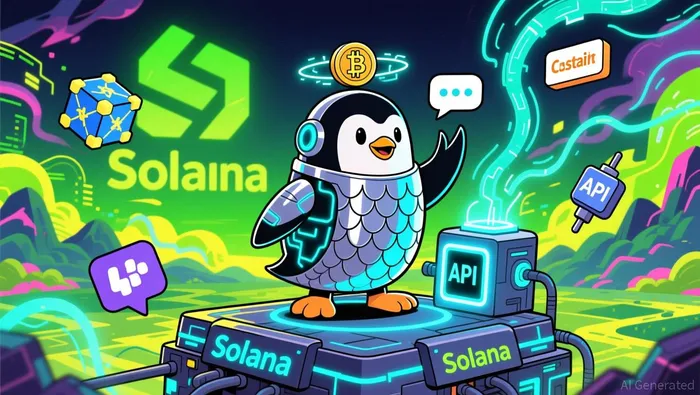
The sharp sell-off follows a significant price rally driven by derivatives activity and a short squeeze, with open interest increasing by 62% and prices breaking through key resistance levels. Analysts warn of potential further declines and market instability, especially given the token's lack of a staking or governance model. PIPPIN currently trades with an overbought RSI between 72 and 85, indicating high volatility.
Concerns about market manipulation and insider control have intensified, with insiders reportedly owning 80% of the supply across 27 wallets. This concentration of control raises questions about the token's long-term sustainability and resistance to potential collapses. PIPPIN has also faced criticism for its lack of real-world utility and its reliance on speculative momentum.
What Caused PIPPIN's Sharp Price Drop?
PIPPIN's 20.1% decline in 24 hours coincided with a surge in trading volume to $51.36 million. The drop is attributed to profit-taking from the token's prior 61.4% weekly rally and 77.5% monthly gain. The price has fallen to $0.58, a 23.3% drop from its February 15 all-time high of $0.759327.
The sell-off has been particularly concentrated in the last hour, with PIPPIN dropping an additional 5.4%. Despite this, the token remains 61.4% above its price from a week ago, suggesting a possible retracement rather than a structural bearish trend.
What Are the Long-Term Risks for PIPPIN?
PIPPIN faces several long-term risks due to its current structure. The token is controlled by insiders who reportedly own 80% of the supply, raising concerns about potential manipulation and market stability. Unlike more traditional tokens, PIPPIN lacks a governance mechanism or staking utility, which could make it vulnerable to price swings and speculative trading.
Additionally, the token's lack of a monetization model linking its AI utility to token value is a concern for investors seeking sustainable growth. While PIPPIN has gained traction through its integration with Solana and AI agent capabilities, it must demonstrate broader adoption and real-world use cases to justify its valuation.
Why Are Analysts Wary of PIPPIN's Future?
Analysts have raised concerns about PIPPIN's exposure to market manipulation and the likelihood of further declines. Some suspect a coordinated CEX play similar to the Mantra (OM) case, where the token collapsed by 99% after a short squeeze. PIPPIN's RSI is currently in overbought territory, indicating a possible oversold rebound, but this does not negate the fundamental skepticism surrounding the token.
The token's recent listing on exchanges like Binance AlphaALPHA-- and KuCoin has improved liquidity but also increased its exposure to broader market sentiment. While this could benefit traders, it also raises the risk of a coordinated sell-off by large holders or whale activity.
For PIPPIN to succeed long-term, it must reduce insider control and establish a clear utility model. Until then, investors are advised to monitor key support levels around $0.58 and be cautious about the token's volatility and market sentiment.

Blending traditional trading wisdom with cutting-edge cryptocurrency insights.
Latest Articles
Stay ahead of the market.
Get curated U.S. market news, insights and key dates delivered to your inbox.


AInvest
PRO
AInvest
PRO



Comments
No comments yet