
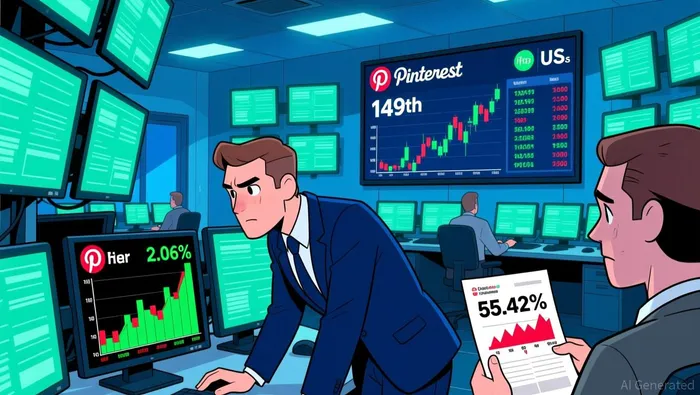
Pinterest Shares Climb 2.06% Amid 55.42% Volume Drop Rank 149th in U.S. Trading Activity
 Aime Summary
Market Snapshot
Pinterest (PINS) experienced a mixed trading session on November 6, 2025, . , , ranking it 149th in trading activity among U.S. equities. This divergence between price and volume highlights investor uncertainty following a series of earnings-related developments. While the stock’s price gained ground, the reduced liquidity suggests a cautious market sentiment, with traders potentially reassessing their positions ahead of the company’s Q4 guidance and broader macroeconomic concerns.
Key Drivers
Pinterest’s recent stock volatility stems from a combination of earnings underperformance, weak forward guidance, and macroeconomic pressures, which collectively overshadowed its long-term strategic initiatives. The company reported Q3 earnings per share of $0.38, falling short of the $0.42 estimate, . This earnings miss, , signaled investor skepticism about Pinterest’s ability to translate revenue growth into profitability. The stock’s sharp decline—its steepest drop since April 2023—reflected concerns over near-term monetization challenges, particularly in its core U.S. and Canadian markets, where user growth has plateaued.
, which fell below the midpoint of analyst expectations. The company attributed this to ad budget moderation, particularly among large retailers and China-based cross-border sellers, driven by recent U.S. tariff changes. CFO highlighted that these policy shifts have created uncertainty, dampening holiday-season ad spending. This guidance contrasted with stronger performance from competitors like Meta and Google, which reported robust Q3 ad revenue, further intensifying competitive pressures. Analysts from Monness Crespi & Hardt and RBC Capital downgraded the stock, citing “uninspiring” results and tariff-linked ad weakness, while price targets were trimmed to reflect reduced growth expectations.
Despite the near-term headwinds, Pinterest’s CEO emphasized long-term optimism, citing advancements in AI-driven visual search and product innovation. The company’s new PinterestPINS-- Assistant, designed to enhance user engagement through AI-powered shopping tools, was positioned as a strategic differentiator. However, investors appear to be discounting these initiatives in favor of immediate financial metrics. , backed by a “Moderate Buy” consensus, suggests analysts remain cautiously optimistic about Pinterest’s potential to regain momentum. Notably, ’s Ark Invest capitalized on the selloff, , signaling confidence in the company’s AI-driven transformation.
The interplay between Pinterest’s operational progress and external challenges underscores a broader market dynamic. , monetization in high-margin regions remains a bottleneck. Analysts from Guggenheim and Barclays have cited Pinterest’s cost discipline and AI efficiency as potential tailwinds, but these factors must offset near-term ad spending pressures. The company’s ability to balance innovation with profitability—particularly in the face of rising competition from Meta’s Instagram and TikTok—will be pivotal in determining whether the recent selloff represents a cyclical correction or a structural reassessment of its growth trajectory.
In summary, Pinterest’s stock performance reflects a tug-of-war between short-term earnings disappointments and long-term strategic ambitions. The market’s focus on Q4 monetization, coupled with macroeconomic headwinds, has overshadowed the company’s AI-driven initiatives. However, institutional buying by firms like Ark Invest and a range of analyst ratings suggest that Pinterest remains a high-conviction play for investors willing to navigate near-term volatility. The coming months will likely hinge on Pinterest’s ability to stabilize its ad revenue growth and demonstrate the scalability of its AI-powered shopping ecosystem.

Stay ahead of the market.
Get curated U.S. market news, insights and key dates delivered to your inbox.
AInvest
PRO
AInvest
PRO



Comments
No comments yet