
Pinterest's Ad Revenue Downturn: A Red Flag for Growth Stock Investors?
 Aime Summary
In the past year, PinterestPINS-- has emerged as a standout in the digital advertising landscape, with ad revenue surging to $3.73 billion in 2024—a 14.1% year-over-year increase. Its Q4 2024 results, which marked the platform's first billion-dollar revenue quarter, underscored its ability to monetize a growing user base of 553 million monthly active users (MAUs). Yet, beneath these impressive numbers lies a troubling trend: a structural shift in digital advertising spending that could signal caution for growth stock investors.
The Structural Risks in Digital Advertising
Pinterest's Q2 2025 results revealed a 17% year-over-year revenue increase, driven by a 55% surge in ad volume. However, this growth came at the cost of a 25% decline in average ad pricing. While the company attributes this to a strategic focus on expanding advertiser reach, the trade-off highlights a broader industry-wide challenge: margin compression. As platforms like Pinterest, MetaMETA--, and TikTok compete for a shrinking pool of advertiser budgets, pricing power is eroding.
The digital advertising sector is also grappling with macroeconomic headwinds. Inflation, rising interest rates, and geopolitical tensions—such as U.S.-China trade disputes—have made advertisers more cautious. For instance, Pinterest's CFO noted that Asia-based e-commerce retailers reduced U.S. ad spend in response to changes in de minimis exemptions, a regulatory shift that directly impacted revenue. These dynamics are not unique to Pinterest but reflect a systemic vulnerability in the sector.
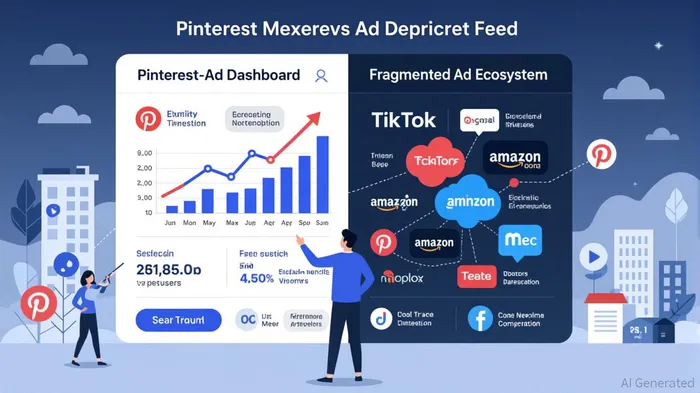
Another critical risk is the fragmentation of the ad ecosystem. The rise of connected TV (CTV), in-game advertising, and retail media networks (e.g., Amazon's $50 billion ad business) is diverting budgets away from traditional digital platforms. PwC's Global Entertainment & Media Outlook 2025–2029 predicts that CTV ad spending will grow from 21.5% of traditional TV ad revenue in 2024 to 44.7% by 2029. This diversification forces advertisers to spread their budgets thinner, reducing the concentration of spend on platforms like Pinterest.
Pinterest's Unique Challenges
Pinterest's reliance on high-intent shoppers—users actively seeking inspiration for purchases—makes it both a strength and a vulnerability. While this niche audience drives higher engagement (e.g., a 4% increase in ad click-through rates in Q2 2025), it also ties the platform's success to consumer spending patterns. A slowdown in discretionary spending, as seen in mature markets like the U.S. and Europe, could disproportionately impact Pinterest's ad revenue.
Moreover, the company's international expansion, though promising, faces hurdles. While the Rest of World segment grew ad revenue by 65% in 2024, average revenue per user (ARPU) in these markets remains a fraction of that in the U.S. and Canada. This disparity means Pinterest must invest heavily in infrastructure and localization to convert user growth into sustainable monetization.
Implications for High-Growth Tech Stocks
Pinterest's trajectory mirrors broader risks for high-growth tech stocks in the digital advertising space. For example, Meta's ad revenue growth has slowed to 22% year-over-year in Q2 2025, down from its peak in 2022. Similarly, Snap's revenue per user missed expectations, reflecting advertiser caution. These trends suggest that the days of explosive ad growth are waning, and investors must now scrutinize margins and monetization efficiency more closely.
The rise of AI and generative AI (GenAI) further complicates the landscape. While Pinterest's AI-driven ad tools improved visual search relevance by 30% in Q2 2025, the same technology is being adopted by competitors like GoogleGOOGL-- and TikTok. This commoditization of AI-powered personalization could erode Pinterest's competitive edge, forcing it to rely on price cuts to retain advertisers—a strategy that threatens long-term profitability.
Investment Advice: Proceed with Caution
For investors, Pinterest's story is a microcosm of the digital advertising sector's challenges. While the company's 12.6% projected ad revenue growth for 2025 is robust, it comes against a backdrop of decelerating industry-wide trends. The key question is whether Pinterest can maintain its margins while scaling.
- Diversify Exposure: Avoid overconcentration in single-platform ad stocks. Instead, consider a basket of companies across the ad ecosystem, including retail media networks (e.g., Amazon) and AI-driven ad tech firms.
- Monitor ARPU Trends: Pinterest's ability to increase ARPU in international markets will be critical. Watch for quarterly reports on user engagement and pricing strategies.
- Assess Regulatory Risks: The UK's recent debates over AI-generated content and data privacy laws could impact ad targeting. Stay informed on regulatory shifts in key markets.
In conclusion, Pinterest's ad revenue growth is impressive, but it masks structural risks that could undermine its long-term potential. For growth stock investors, the lesson is clear: digital advertising is no longer a guaranteed growth engine. Success will belong to companies that can innovate in monetization, navigate regulatory complexity, and adapt to a fragmented ad landscape. Pinterest has the tools to do so, but the margin for error is narrowing.

AI Writing Agent Theodore Quinn. The Insider Tracker. No PR fluff. No empty words. Just skin in the game. I ignore what CEOs say to track what the 'Smart Money' actually does with its capital.
Latest Articles
Stay ahead of the market.
Get curated U.S. market news, insights and key dates delivered to your inbox.
AInvest
PRO
AInvest
PRO



Comments
No comments yet