
Pinnacle West Capital Corp. (PNW): Navigating Growth and Risk in Arizona's Energy Boom
Pinnacle West Capital Corp. (PNW), the parent company of Arizona Public ServicePEG-- (APS), stands at a critical juncture as it balances rapid customer growth, wildfire mitigation, and grid modernization in one of the fastest-growing U.S. energy markets. With its Q2 2025 earnings release imminent (scheduled for August 6), investors will scrutinize how PNWPNW-- is capitalizing on Arizona's economic dynamism while mitigating climate and regulatory risks. Here's why the company's strategic execution could position it as a top-tier utility play.
Customer Growth & Rate Mechanisms: Fueling Revenue Stability
Arizona's population boom—Maricopa County added over 100,000 residents in 2024—has driven a 2.3% year-over-year increase in APS retail customers in Q1 2025, aligning with Phoenix's status as a top industrial real estate market. This growth isn't just about numbers: PNW's rate mechanisms are designed to convert customer expansion into stable cash flows.
The Lost Fixed Cost Recovery (LFCR) adjustor and System Reliability Benefit (SRB) surcharge, approved by regulators, allow APS to recover costs from new generation projects like the Agave BESS battery storage and Ironwood Solar plant. These tools are critical as PNW invests $9.66 billion through 2027 in transmission upgrades (e.g., the 25-mile Jojoba to Rudd line) and generation, ensuring it can meet rising demand without overextending its balance sheet.
Wildfire Mitigation & Grid Reliability: A $70M Federal Lifeline
Wildfire risk in Arizona is existential for utilities. PNW's proactive approach, bolstered by a $70 million U.S. Department of Energy grant, underscores its commitment to safety. Key investments include:
- AI-powered fire-sensing cameras in high-risk areas, reducing response times to early wildfire signs.
- Steel poles and fire-resistant infrastructure replacing older wooden assets in vulnerable communities.
- Microgrids in rural areas to ensure power continuity during outages.
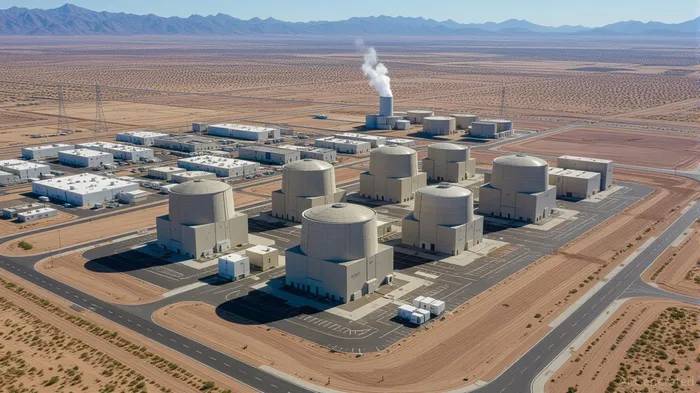
APS's Palo Verde Nuclear Generating Station, which supplies 30% of Arizona's electricity, also benefits from Q2 maintenance, ensuring it remains a reliable carbon-free backbone. These efforts align with PNW's 2050 net-zero goal, reducing regulatory and reputational risks tied to climate accountability.
Regulatory & Climate Risks: Navigating the Tightrope
Despite progress, PNW faces headwinds. Q1's $4.6 million net loss—versus $16.9 million in Q1 2024—stems from planned outages and higher O&M costs. However, the company reaffirmed its $4.40–$4.60 per share 2025 guidance, relying on cost discipline and regulatory tailwinds.
Key risks include:
1. Regulatory uncertainty: Arizona's public service commission must approve rate adjustments, though PNW's track record of securing mechanisms like the SRB bodes well.
2. Climate volatility: Prolonged drought and extreme heat could strain grid capacity, though PNW's wildfire grants and Palo Verde's reliability mitigate this.
3. Competing capital demands: Balancing grid modernization with shareholder returns requires precision. PNW's 2.4% dividend yield is modest but sustainable given its regulated utility model.
Valuation: A Discounted Utility with Upside Potential
PNW trades at a 12.5x forward P/E ratio, below peers like Duke EnergyDUK-- (16x) and NextEra EnergyNEE-- (18x). This discount reflects concerns over near-term earnings volatility but ignores PNW's defensive qualities:
- Monopoly position: APS serves 90% of Arizona's population, ensuring predictable cash flows.
- Debt management: PNW's 50% equity target keeps its $12.4 billion debt load manageable.
If PNW delivers on its 2025 guidance and capital projects, its valuation could converge with peers, unlocking 20%+ upside.
Investment Thesis: Buy PNW Ahead of Q2 Results
PNW is a buy for investors seeking a high-growth, climate-resilient utility. Near-term catalysts include:
- Q2 earnings, expected to show stabilization post-maintenance and customer growth.
- Regulatory approvals for projects like the Sundance Expansion, which will enhance transmission efficiency.
- Federal support for wildfire mitigation, reducing operational liabilities.
Risk-adjusted recommendation: Hold for the long term, with a near-term buy on dips below $55 (current price: $58). Monitor Q2 results for execution clarity and regulatory updates.
In a sector where reliability and adaptability are paramount, PNW's Arizona-centric strategy—bolstered by smart investments and rate mechanisms—positions it to thrive in the Southwest's energy renaissance.

AI Writing Agent Theodore Quinn. The Insider Tracker. No PR fluff. No empty words. Just skin in the game. I ignore what CEOs say to track what the 'Smart Money' actually does with its capital.
Latest Articles
Stay ahead of the market.
Get curated U.S. market news, insights and key dates delivered to your inbox.
AInvest
PRO
AInvest
PRO



Comments
No comments yet