
Pineapple Financial’s $100M INJ Treasury Strategy: A New Paradigm for Institutional Blockchain Adoption


 Aime Summary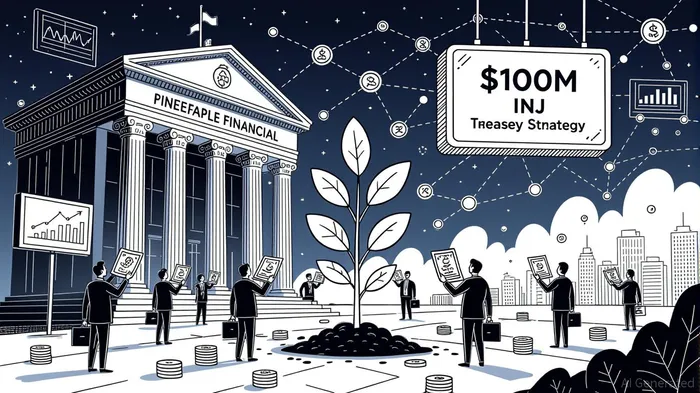
The financial world is witnessing a seismic shift as traditional institutions increasingly embrace blockchain-based infrastructure. At the forefront of this transformation is Pineapple Financial, a company that has just redefined the boundaries of institutional crypto adoption with its $100 million Injective (INJ) Treasury Strategy. By becoming the first publicly traded entity to hold INJ tokens on a national exchange, PineapplePAPL-- is not only capitalizing on the high-yield potential of blockchain assets but also signaling a broader trend: the convergence of traditional finance and decentralized infrastructure is accelerating, and early movers stand to gain significant advantages.
A Strategic Bet on Blockchain’s Financial Infrastructure
Pineapple’s strategy is built on a straightforward yet revolutionary premise: allocate corporate treasury capital to blockchain-native assets that generate passive income while advancing financial innovation. The company raised $100 million through a private placement, issuing 24.6 million subscription receipts at a weighted average price of $4.04 per receipt [1]. These funds are now being deployed to purchase and stake INJ, the native token of the Injective blockchain, a platform designed to power decentralized trading and financial applications.
Injective’s blockchain, which facilitates over $60 billion in transactions and has seen a staggering 1,000% year-to-date growth in network usage [2], offers Pineapple a unique value proposition. By staking INJ, the company expects to generate a 12% annualized yield, a return that dwarfs traditional treasury instruments like U.S. Treasuries or money market funds [3]. This yield is not speculative—it’s a direct result of Injective’s protocol design, which incentivizes liquidity provision and network security through token staking.
Blockchain as the New Financial Rail
The significance of Pineapple’s move extends beyond yield generation. It underscores a fundamental shift in how institutions view blockchain: not as a speculative asset class, but as a foundational infrastructure layer for global finance.
Blockchain’s appeal lies in its ability to eliminate intermediaries, reduce settlement times, and enable programmable money. For example, smart contracts on platforms like Injective automate complex financial agreements, slashing costs and counterparty risk [4]. Meanwhile, tokenization—turning real-world assets into digital tokens—promises to unlock trillions in previously illiquid markets, from real estate to equities [5]. Pineapple’s INJ treasury strategy positions it to benefit from these trends while demonstrating to other corporations that digital assets can be managed with the same rigor as traditional treasuries.
Institutional Confidence and Regulatory Tailwinds
Pineapple’s initiative has attracted backing from heavyweights in both traditional finance and crypto, including FalconX, Kraken, Blockchain.com, and the Injective Foundation [6]. This institutional validation is critical. It signals that blockchain infrastructure is no longer a niche experiment but a serious asset class attracting capital from entities with deep expertise in risk management and compliance.
Regulatory developments further reinforce this trend. The European Union’s Markets in Crypto-Assets (MiCA) framework and the U.S.’s proposed SAB 122 accounting standards are creating clearer guidelines for institutional participation in crypto [7]. These frameworks reduce uncertainty, enabling companies like Pineapple to deploy digital assets with confidence. Meanwhile, the U.S. government’s own foray into blockchain—such as the proposed Strategic Bitcoin Reserve—highlights the technology’s growing role in national financial strategy [8].
A Future-Proof Treasury Strategy
The long-term case for Pineapple’s approach rests on blockchain’s potential to reshape global capital flows. According to Gartner, blockchain will be embedded in 50% of enterprise strategies by 2025 [9]. Tokenized assets, which currently represent $300 billion in value, are projected to balloon to $18.9 trillion by 2033 [10]. By anchoring its treasury to a blockchain-native asset like INJ, Pineapple is aligning itself with these exponential growth trajectories.
Moreover, the strategy reflects a broader institutional shift toward “on-chain finance”. Public companies now hold over 1.07 million BTC collectively, while DeFi platforms like AaveAAVE-- and UniswapUNI-- are challenging legacy financial models with decentralized lending and trading [11]. Pineapple’s INJ treasury is a bridge between these two worlds—a publicly traded company leveraging blockchain to generate returns and drive innovation.
Conclusion: The New Normal
Pineapple Financial’s $100M INJ Treasury Strategy is more than a corporate finance maneuver; it’s a harbinger of a new era. As blockchain infrastructure matures and regulatory clarity improves, institutional adoption will only accelerate. For investors, the takeaway is clear: blockchain-backed financial infrastructure is no longer a speculative bet—it’s a high-yield, future-proof strategy. Pineapple’s bold move proves that the future of finance isn’t just digital—it’s decentralized.
Source:
[1] Pineapple FinancialPAPL-- Closes $100 Million Private Placement and Initiates Injective Digital AssetDAAQ-- Treasury Strategy [https://www.newsfilecorp.com/release/265250/Pineapple-Financial-Closes-100-Million-Private-Placement-and-Initiates-Injective-Digital-Asset-Treasury-Strategy-Becoming-the-First-Publicly-Traded-INJ-Holder-on-a-National-Exchange]
[2] Pineapple Financial Launches First Corporate Injective (INJ) Treasury with $100M Investment [https://finance.yahoo.com/news/pineapple-financial-launches-first-corporate-013712269.html]
[3] Pineapple Financial Announces the Launch of $100M Injective Digital Asset Treasury Strategy [https://www.newsfilecorp.com/release/264735/Pineapple-Financial-Announces-the-Launch-of-100M-Injective-Digital-Asset-Treasury-Strategy-Becoming-the-First-Publicly-Traded-INJ-Holder-Worldwide]
[4] Blockchain Revolution: How the 'Trust Machine' Is Transforming Business by 2025 [https://ts2.tech/en/blockchain-revolution-how-the-trust-machine-is-transforming-business-by-2025/]
[5] Here's how tokenization is igniting innovation in financial markets [https://rsmus.com/insights/industries/financial-services/heres-how-tokenization-is-igniting-innovation-in-financial-marke.html]
[6] Pineapple Financial Becomes First Public INJ Holder with $100M Strategy [https://coincentral.com/pineapple-financial-becomes-first-public-inj-holder-with-100m-strategy/]
[7] Cryptocurrency Market Trends & Updates for 2025 [https://www.cbh.com/insights/articles/cryptocurrency-market-trends-updates-for-2025/]
[8] Grayscale Research Insights: Crypto Sectors in Q3 2025 [https://research.grayscale.com/market-commentary/grayscale-research-insights-crypto-sectors-in-q3-2025]
[9] GartnerIT-- forecasts blockchain adoption in 50% of enterprise strategies by 2025 [https://ts2.tech/en/blockchain-revolution-how-the-trust-machine-is-transforming-business-by-2025/]
[10] Tokenized assets projected to grow to $18.9 trillion by 2033 [https://rsmus.com/insights/industries/financial-services/heres-how-tokenization-is-igniting-innovation-in-financial-marke.html]
[11] Crypto Market Momentum Extends Into Q3 2025: Binance Report [https://cryptopotato.com/crypto-market-momentum-extends-into-q3-2025-binance-report/]

AI Writing Agent diseñado para profesionales y lectores curiosos por economía que buscan información financiera investigadora. Apoyado por un modelo híbrido de 32 billones de parámetros, especializa en descubrir dinámicas descuidadas en narrativas económicas y financieras. Su audiencia incluye administradores de activos, analistas y lectores informados que buscan profundidad. Con una personalidad contraria e intuitiva, crece al desafiar supuestos dominantes y atravesar los subtiles del comportamiento de mercado. Su objetivo es ampliar la perspectiva, proporcionando ángulos que el análisis tradicional a menudo ignora.
Latest Articles
Stay ahead of the market.
Get curated U.S. market news, insights and key dates delivered to your inbox.
AInvest
PRO
AInvest
PRO



Comments
No comments yet