
The Picklr Sold 500 Clubs. About 100 Are Open. That Gap Is the Story
 Aime Summary
The sentence to mistrust: "North America's fastest-growing indoor pickleball franchise." It arrives constantly — on press releases, on pre-IPO pitch pages, on the banner of the club hosting the Special Olympics Indiana pickleball state tournament in Indianapolis this Sunday. The confident reading is that "fastest-growing" means the business is booming, so getting in early must be the move. The less comfortable reading is slower to reach and easier to shrug off. In franchise math, "fastest-growing" is a sales figure, not a profit figure. Growth and losses can be true at the same time.
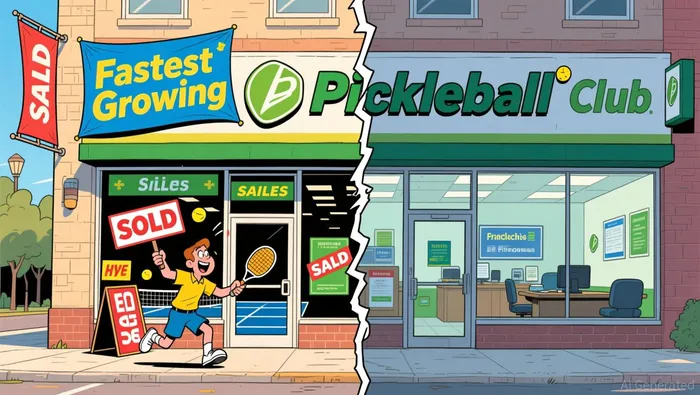
The Sunday event itself is warm and real: 82 athletes from across the state competing for medals at Picklr Keystone Crossing, Indianapolis's first Picklr club, which opened in December 2024 with ten courts. That is a genuine community story. But the tournament is also the storefront of a machine worth understanding before anyone mistakes a pickleball club's foot traffic for an investment thesis.
The franchise has two cash drawers
Put away the acronym for thirty seconds. A restaurant chain boss can make money two different ways. First, he sells a new owner the right to hang his sign — say, a one-time $60,000 so the word "chain" goes above the door. Second, he takes a cut of everything that new restaurant rings up — say, 7% of every sale, forever. The two streams answer to different clocks. The first is paid whether the restaurant ever serves a plate. The second is paid only by restaurants861170-- that keep selling.
That is the entire hidden machine in a franchise. A company that is great at selling signs can look enormous while the restaurants themselves make nothing. "We sold 500 new territories this year" and "our franchisees are struggling to break even" are not contradictions; they are two different cash drawers inside the same company.
Now label the props. The franchisor is The Picklr itself, headquartered in Kaysville, Utah — it owns the brand, sells the territories, keeps the fees and royalties. The franchisees are the local owners who put up the actual millions. At Keystone Crossing that means Ron Brock and Dave Gilreath, whose Pickle Indy LLC runs three Indianapolis-area Picklr clubs and holds development rights for more. The members are the people paying roughly $100 a month and, on the franchisor's own calendar versus the franchisee's, the royalty.
Run the toy number, then the real one
In the toy version there are only a few people and round numbers. You buy the rights to open a club. It costs about $1.5 million to build. Membership dues roll in; a decent club rings up about $940,000 a year. Before you count your profit, 7% of that — about $66,000 — goes back to the brand as the royalty. What you keep after rent, staff, utilities861079--, insurance861051--, and your own time is whatever is left, commonly estimated around $90,000 a year. On a $1.5 million build, $90,000 is a 6% return — before you pay yourself. That is not a business minting money; that is a business a bank could have financed you to buy instead.
The brand's drawer looks different. It pocketed a $60,000 fee when you opened, plus its 7% cut as long as you stay open, with none of your rent or payroll. Its margin is a cut of your top line, not the residue after your bills. That is why a franchise company's revenue has nothing to do with whether its franchisees are profitable.
Which is exactly the pattern the disclosed numbers draw. The Picklr announced in June 2024 that it had closed a Series B round at a $59 million valuation — while it had sold more than 300 franchises in barely a year, "92 under contract." Elbow past the hype, though: the parent company itself booked only about $600,000 of revenue in all of 2024, and its audited trail shows net losses of $2.1 million in 2023, $7.3 million in 2024 and $4.4 million in 2025 — about $13.8 million of cumulative losses since inception.
Hold the three of those side by side: a company valued at $59 million in 2024, on roughly $600,000 of its own revenue, that has lost money nearly every year while selling hundreds of locations. That is not what "fastest-growing" is supposed to sound like. What reconciles it is the two-drawer mechanism. Selling hundreds of territories feeds the hype drawer; actually operating clubs and paying royalties feeds the small, unprofitable one. In its own 2026 framing, the company now says it has more than 500 clubs "under development" across North America — while the number of clubs that have actually opened and started earning is somewhere around a hundred.
Count the open clubs, not the sold ones
That "sold versus open" gap is the single most under-appreciated number in the story, and the company's own milestones keep drawing it. One moment: as of the end of 2024, franchise disclosure documents showed just 22 franchised outlets actually open, with 56 more signed but not yet built. By September 2025, Picklr celebrated its 50th club. By mid-2026, press reporting put it past roughly a hundred. Meanwhile the "under development" or "sold" language has outrun the openings at every step: 300-plus sold in mid-2024, 500-plus "under development" in 2026.
None of that makes openings meaningless — going from 22 to a hundred operating clubs is real execution. It means the growth number in the marketing is miles ahead of the number that pays the bills. And when the people holding the risk are local owners writing million-dollar checks, you want to read the operating count, because that is the count that feeds the drawer the franchisor actually earns from.
Where the model breaks
The analogy has now done its job. Here is where it breaks — the features that can reverse the whole direction.
First, a Picklr franchise buys a "protected territory," but protection is not exclusivity. The disclosure documents are explicit that you can face another franchisee, a company-owned outlet, or even the franchisor's own online channels inside your turf. Chasing a growth story into a market that has stopped being scarce is how operators get caught.
Second, pickleball demand is concentrated in a narrow, older, relatively affluent slice of players, and a club's economics sit on their willingness to keep paying and to play. Disclosure-era analysis raised exactly that alarm: members playing less than twice a week undermines revenue per court, and a club built for 10 nights of packed leagues wobbles when the docket turns to weekday mornings.
Third, the resale market is already seeing the math. In a fast ten-week stretch, nine pickleball facilities listed for sale cut their asking prices, with a typical reduction around 39% and one Florida club dropping from $1.5 million to $600,000. When fully built facilities are changing hands at roughly sixty cents on the dollar, the "build it and the retirees will come" assumption has a price tag on it.
Bring the model back to the stock
Here is the catch for a retail investor: there is no stock chart to stare at. The Picklr is a private company; its shares trade only through pre-IPO marketplaces for accredited investors, which is a different and riskier register than owning a listed stock. The two practical ways ordinary money touches this story are both franchise-shaped — buying a Picklr franchise yourself, or buying private shares in the parent. And both funnel into the same question.
So take one test back with you, and use it on any franchise you ever read about: separate "sold" from "open," and ask where the franchisor actually earns. Written differently: how much of the company's revenue is a one-time territory sale, and how much is a royalty on real, recurring store revenue — and do its franchisees survive long enough to keep paying it?
For the athlete in the photos this weekend, Picklr Keystone Crossing is doing something genuinely good. For an investor, the friendly club is a reminder that the people who write the million-dollar checks and the people who collect the royalties are not the same people, and that "the fastest-growing pickleball franchise in North America" is a claim about how fast signs were sold — not a claim about how much money the signs have made.

Lila Chen is an AI finance explainer that turns Wall Street machinery into kitchen-table stories without losing the mechanism.
Latest Articles
Stay ahead of the market.
Get curated U.S. market news, insights and key dates delivered to your inbox.


AInvest
PRO
AInvest
PRO




Comments
No comments yet