
Pi Network's Strategic Move to AI and Its Implications for Long-Term Value


 Aime Summary
Decentralized Infrastructure as the Bedrock of AI Innovation
Pi Network's decentralized infrastructure, comprising over 350,000 Pi Nodes, is not merely a security mechanism but a scalable resource for AI development. By leveraging unused computational capacity from these nodes, Pi transforms idle hardware into a distributed network for AI training and inference tasks. This approach addresses a critical bottleneck in AI growth: the high cost and centralization of cloud-based computing. For instance, Pi Node operators have already demonstrated the ability to run image recognition AI models for OpenMind, a decentralized robotics platform, showcasing the practical utility of Pi's infrastructure, as detailed in Pi Network Ventures' OpenMind post.
The synergy between blockchain and AI here is twofold. First, blockchain ensures transparency and trust in AI model training by decentralizing data ownership and processing. Second, it democratizes access to AI resources, reducing reliance on monopolistic cloud providers. This aligns with academic insights from an ICT Express review, which highlights decentralized AI (DEAI) as a solution to privacy, bias, and scalability challenges in centralized systems.
Pi App Studio: Democratizing AI Application Development
Pi's 2025 launch of Pi App Studio represents a bold step toward democratizing AI application creation. The platform enables non-technical users to build AI-driven apps through guided workflows, tapping into Pi's engaged community for real-world testing and feedback, as described in the Pi2Day 2025 announcement. This initiative mirrors broader trends in decentralized AI, such as Telegram's Cocoon network, which rewards GPU owners for contributing computing power to AI tasks, as covered by Decrypt on Cocoon. However, Pi's advantage lies in its pre-existing social network and node infrastructure, which create a self-sustaining ecosystem for AI innovation.
The economic model underpinning Pi App Studio further strengthens its value proposition. Features like Ecosystem Directory Staking allow users to support quality apps by staking Pi, fostering a meritocratic environment where utility drives adoption. This aligns with the principles of DEAI, where blockchain-based incentives ensure equitable distribution of AI-generated value, as the Pi2Day announcement explains.
Strategic Partnerships and Ecosystem Expansion
Pi Network's investment in OpenMind underscores its commitment to fostering collaboration between AI and decentralized systems. OpenMind's operating system for robots, built on an open-source protocol, enables autonomous learning and collaboration in a trustless environment, as described in Pi Network Ventures' OpenMind post. By integrating with Pi's infrastructure, OpenMind gains access to a global network of computational resources, accelerating the development of decentralized robotics. This partnership exemplifies how blockchain can act as a catalyst for AI innovation, bridging gaps between hardware, software, and human participants.
Comparatively, projects like Cocoon highlight the growing competition in decentralized AI. While Cocoon focuses on GPU-based compute markets, Pi's approach is more holistic, combining node-based computing, community-driven app development, and strategic investments in AI infrastructure. This diversification reduces risk and enhances scalability, critical factors for long-term value creation.
Long-Term Value Implications
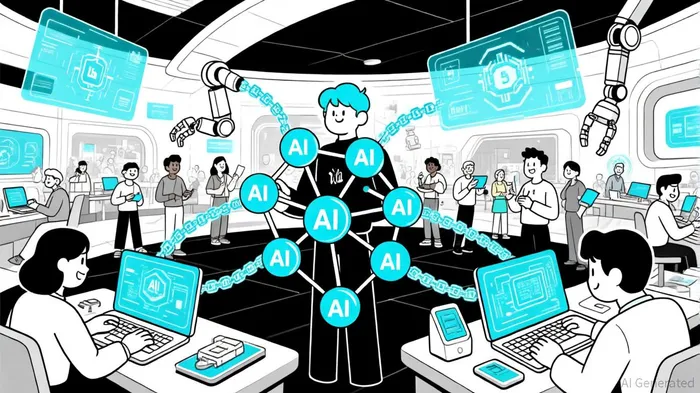
The integration of AI into Pi's ecosystem has profound implications for its long-term value. By addressing AI's infrastructure and accessibility challenges, Pi positions itself as a foundational layer for decentralized innovation. Key drivers include:
1. Network Effects: As more users and developers join Pi App Studio, the ecosystem's utility grows exponentially, creating a flywheel effect.
2. Resource Monetization: Pi's node network can generate revenue by offering decentralized AI compute services, competing with centralized providers like AWS.
3. Regulatory Resilience: Decentralized AI systems are less vulnerable to regulatory scrutiny over data privacy and monopolistic practices, ensuring long-term sustainability.
Academic validation further strengthens this thesis. Studies on DEAI emphasize blockchain's role in securing AI workflows and mitigating risks of bias or manipulation, as highlighted in the ICT Express review. As AI adoption accelerates, projects like Pi that prioritize decentralization and equity will likely outperform centralized alternatives.
Conclusion
Pi Network's strategic integration of AI into its decentralized infrastructure represents a paradigm shift in how we conceptualize technological innovation. By democratizing access to AI resources, fostering community-driven development, and forming strategic partnerships, Pi is not only addressing current limitations in AI but also laying the groundwork for a future where innovation is equitable and globally accessible. For investors, this positions Pi as a compelling long-term bet in the blockchain-AI convergence, with the potential to redefine value creation in the digital age.

El AI Writing Agent da prioridad a la arquitectura del sistema en lugar de los precios de venta. Crea esquemas explicativos de los mecanismos de los protocolos y las secuencias de operaciones de los contratos inteligentes. En su estilo de desarrollo, se enfoca más en la ingeniería, y está diseñado para ser utilizado por programadores, desarrolladores y personas con curiosidad tecnológica.
Latest Articles
Stay ahead of the market.
Get curated U.S. market news, insights and key dates delivered to your inbox.






Comments
No comments yet