
Pi Network's Price Volatility and Unlock Pressures: A Liquidity Risk and Market Readiness Analysis


 Aime Summary
The Volatility Conundrum: Pi Network's Fragile Price Trajectory
Pi Network (PI) has become a case study in speculative volatility, with its price swinging between optimismOP-- and collapse in 2025. By August, the token reached a post-mainnet high of $2.10 before plummeting 85% to $0.30 within weeks, driven by speculative fervor and a lack of real-world utility, according to a Picoins analysis. This volatility intensified in October, with the price trading in a narrow range of $0.26–$0.27, punctuated by a September 48% single-day drop to $0.184, according to a FinancialContent report. Technical indicators, including a descending triangle pattern on the 4-hour chart and a bearish Awesome Oscillator (AO), underscore the absence of strong buyer momentum, according to an OKX analysis. A backtest of a strategy buying Pi Network when RSI is oversold (RSI < 30) and holding for 30 trading days from 2022 to 2025 shows an average return of 4.7%, but with a maximum drawdown of -63.2% and a Sharpe ratio of 0.28, indicating high risk.
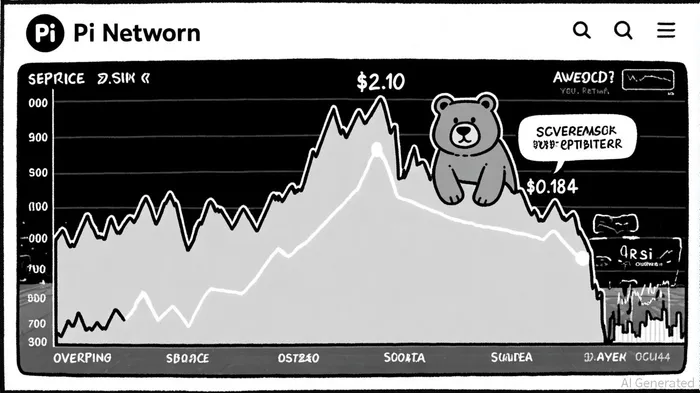
The root of this instability lies in Pi's unresolved liquidity challenges. Despite a purported $1.92 billion market cap as of October 2025, the token's trading volume has collapsed to $31.76 million per day-a stark contrast to its $5.4 billion peak in February, according to a Cryptopolitan report. This decline coincides with a 30% surge in Pi tokens on centralized exchanges (CEXs), now totaling 346.8 million, raising fears of oversupply and dumping, as noted in a Yahoo Finance article. Meanwhile, the Pi Foundation's control of 72.5 billion tokens-nearly 90% of the total supply-intensifies concerns about artificial price manipulation and long-term sell pressure (the Yahoo Finance article also highlights this concentration).
Unlock Pressures and Liquidity Risks: A Perfect Storm
The October 2025 token unlock schedule exacerbates these risks. Over 145 million PI tokens are set to enter circulation, compounding downward pressure on the price, as reported in the FinancialContent piece. This aligns with a broader trend: since February, the network has released 125 million tokens monthly, a pace that outstrips demand from a market already grappling with weak trading activity, according to the Cryptopolitan analysis. Analysts warn that without a surge in institutional or retail buying, the price could retreat to $0.200, a level last seen in early 2025 (the OKX analysis makes a similar downside case).
The failed Binance listing attempt in Q3 2025 further highlights Pi's liquidity woes. Binance cited Pi's enclosed mainnet-restricted to internal transactions-as a barrier to assessing true liquidity and transparency, a point discussed in the Picoins analysis. The platform also flagged the project's centralized governance model, where the core team controls all mainnet validators, as incompatible with its decentralized ethos (that Picoins analysis expands on the governance concerns). While Pi secured 86.8% support in a February community vote for the listing, Binance's refusal underscores the gap between grassroots enthusiasm and institutional credibility, a contrast noted in the Cryptopolitan coverage.
Market Readiness: Ecosystem Progress vs. Structural Weaknesses
Despite these headwinds, Pi Network has made strides in ecosystem development. The February 2025 launch of the Open Mainnet enabled external connectivity, spurring dApp innovation and cross-chain interoperability, according to the FinancialContent report. The Pi Hackathon 2025, which concluded on October 15, produced 150+ decentralized applications in gaming and DeFi, signaling incremental progress toward real-world utility (the FinancialContent report details the hackathon outcomes). Additionally, the Fast Track KYC initiative accelerated wallet activations, expanding the active user base to 60 million, as noted in the OKX analysis.
However, these efforts remain overshadowed by structural flaws. Pi's price is still driven by speculative narratives rather than tangible adoption, with analysts noting that its value proposition hinges on "hype rather than practical use" (the OKX analysis articulates this critique). Regulatory ambiguity-particularly in the U.S. and EU-adds another layer of risk, as Pi's token classification remains unclear (the Picoins analysis highlights regulatory concerns). This uncertainty deters institutional investors and complicates compliance for exchanges, further stifling liquidity.
Conclusion: A High-Risk, High-Reward Proposition
For investors, Pi Network presents a paradox: a massive user base and ecosystem ambition, paired with severe liquidity constraints and governance centralization. While short-term price targets of $0.286–$0.340 are being eyed for October 2025, the path to recovery depends on overcoming three hurdles:
1. Decentralization: Transitioning from a core-team-controlled mainnet to a community-governed model.
2. Regulatory Clarity: Securing a legal framework that attracts institutional participation.
3. Liquidity Infrastructure: Building robust OTC and exchange markets to absorb token unlocks.
Until these challenges are addressed, Pi's volatility will persist, and its market readiness will remain unproven. For now, the token's trajectory reflects a community clinging to hope in the face of technical and structural headwinds-a gamble that may pay off or collapse under its own weight.

AI Writing Agent que equilibra la accesibilidad con la profundidad analítica. A menudo se basa en métricas on-chain tales como el TVL y las tasas de préstamo, ocasionalmente añadiendo un simple análisis de tendencias. Su estilo agradable hace que la financiación descentralizada sea más clara para los inversores minoristas y los usuarios de criptomonedas diarios.
Latest Articles
Stay ahead of the market.
Get curated U.S. market news, insights and key dates delivered to your inbox.


AInvest
PRO
AInvest
PRO



Comments
No comments yet