
Pi Network Price Rebounds as Pi2Day and Protocol 26 Upgrade Fuel Recovery
 Aime Summary
- Pi Network (PI) price rebounded over 10% in the past week, trading near $0.0872 with increased trading volume of approximately $11.5 million, signaling renewed market participation.
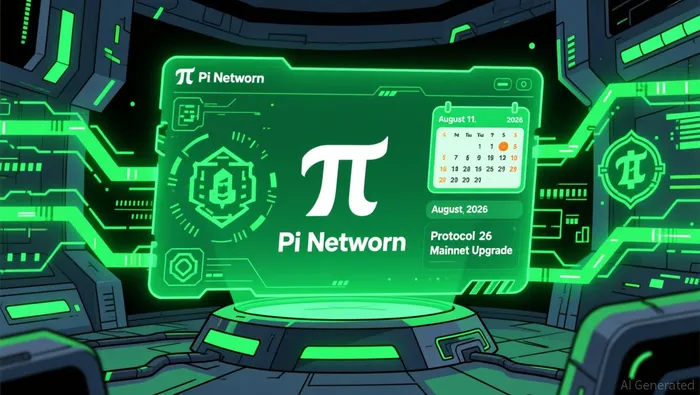
- The recovery is supported by the Pi Core Team's announcement of a mandatory Protocol 26 Mainnet upgrade, which requires node operators to install the update by August 11, 2026.
- Despite the upward momentum, PI faces sustained downward pressure from monthly token unlocks totaling approximately 1.21 billion tokens in 2026, which increases circulating supply.
- Technical indicators suggest the token is testing breakout resistance near $0.0850, with a close above $0.090 required to confirm a breakout from the recent consolidation pattern.
Pi Network (PI) has demonstrated a notable price recovery, rising more than 10% over the past week to trade around $0.0872. This upward movement is accompanied by a 75% increase in 24-hour trading volume, which reached approximately $11.5 million. The surge in participation suggests that the recovery is attracting more market attention compared to previous low-volume moves.
The primary catalyst for this mild bullish bias is the Pi Core Team's announcement regarding the Protocol 26 Mainnet upgrade. This infrastructure milestone is described as a major step toward the final planned Protocol 27 update and aims to improve contract safety, state management, interoperability, and cryptographic security.
Node operators are required to install the update by August 11, 2026, to maintain connectivity to the network. This mandatory migration deadline has provided technical support to the price as momentum indicators signal fading bearish pressure.
What Are the Key Network Developments Driving PI Demand?
Beyond the Protocol 26 upgrade, the Pi ecosystem has introduced several new utility products aimed at driving fundamental demand. The June Pi2Day event launched SoloHost, Pi Sign-In, and PiVerify, extending the network's functionality into AI services and digital identity.
Additionally, the Fabric Foundation announced new payment partnership with RoboPay, integrating Pi Network to allow users to pay for robot services, including deliveries and security patrols, using PI tokens.
These developments follow the completion of Protocol v25 on July 22, 2026, which was designed to improve network stability and support new app-layer functionality.
However, the impact of these ecosystem developments on price has been mixed. While the Protocol v25 upgrade opens doors for utility-driven demand later in 2026, near-term rallies have been capped by thin liquidity and a weak broader altcoin market.
Data from Santiment shows that social volume for PI dropped to 15 from 20, while social dominance halved to 0.010%, indicating that the Mainnet upgrade announcement failed to significantly lift retail speculation.
How Do Token Unlocks and Technical Indicators Impact PI Outlook?
Pi Network faces significant supply-side pressure from scheduled monthly token unlocks. In July 2026, approximately 128 million PI tokens, worth around $10.5 million, were released, contributing to a broader supply overhang of roughly 775.8 million PI expected to unlock by December 2026.
This release schedule is part of a wider 1.21 billion token circulation increase for 2026, which analysts attribute to the token's decline to fresh record lows in July.
Technically, PI trades below its key moving-average cluster, including the 20-, 50-, 100-, and 200-day EMAs, indicating weak trend strength. The 20-day EMA sits near $0.0869, acting as primary resistance, while the 50-day EMA is around $0.1018.
The token is currently testing the breakout of a near-term triangle pattern, with resistance near $0.0850 and a broader downtrend trendline near $0.0900.
A 4-hour close above $0.090 would provide the first clear sign that buyers have broken the immediate ceiling.
On the downside, 161.8% Fibonacci extension near $0.0679. A sustained daily close below this level would likely drive PI to a fresh record low.
Momentum indicators show mixed signals. The 14-day RSI is near 32.7 to 44, suggesting easing downside momentum but no confirmed reversal.
The MACD shows a modest upward trend with its signal line, hinting at consolidation rather than a decisive recovery.
Market sentiment remains cautious, with the broader Fear and Greed Index at 34.
Futures open interest for PI has shown volatility, rising to $8.82 million in recent days but previously dropping to $8.41 million, indicating reduced notional value and potentially reflecting positional wipeouts.
On-chain data reveals a highly concentrated holder base, with fewer than 10,000 wallets holding over 1 million PI tokens, while over 80% of holders possess minimal balances.
This distribution suggests a shallow base of retail holders beneath a concentrated group of larger stakeholders.
Despite the bullish catalysts, PI remains in a long-term bearish descending channel.
Unless buyers can reclaim and sustain price above the $0.0869–$0.0980 zone, the overall setup remains weak.
Third-party forecasts generally anticipate continued pressure, with targets clustering between $0.078 and $0.134 for the near term.
The token's valuation is currently driven by speculative trading on centralized exchanges, despite the network remaining in an enclosed mainnet phase.
This creates a significant gap between circulating supply and fully diluted valuation, with the market capitalization estimated below $1 billion.
The interplay between ongoing token unlocks and ecosystem developments will likely dictate PI's price trajectory in the coming months.

Blending traditional trading wisdom with cutting-edge cryptocurrency insights.
Latest Articles
Stay ahead of the market.
Get curated U.S. market news, insights and key dates delivered to your inbox.


AInvest
PRO
AInvest
PRO




Comments
No comments yet