

Can Pi Network's Recent Ecosystem Enhancements Catalyze a Sustainable Price Recovery for PI?


 Aime Summary
The question of whether Pi Network's recent ecosystem advancements can drive a sustainable price recovery for its native token, PI, hinges on a delicate balance between utility-driven value creation and persistent tokenomic and regulatory risks. As the project transitions from speculative hype to infrastructure-focused development, its ability to deliver real-world applications and institutional credibility will determine whether PI's valuation can stabilize-or even rebound-amid a volatile market landscape.
Ecosystem Enhancements: A Foundation for Utility-Driven Growth
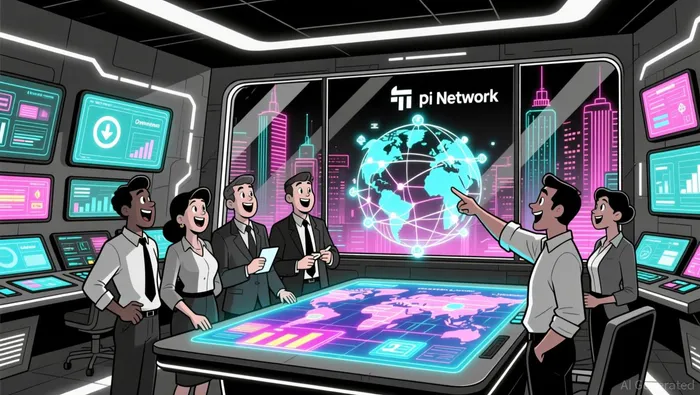
Pi Network's 2025 roadmap marked a pivotal shift toward practical utility, with the launch of the Open Network in February 2025 serving as a cornerstone of this transition. This milestone removed the firewall isolating Pi's Mainnet from external blockchains, enabling cross-chain integrations and broader participation. The Open Network's activation unlocked over 100 Mainnet-ready applications, including decentralized finance (DeFi) tools and AI-powered platforms, while allowing PI to be listed on major exchanges like OKX, Bitget, and MEXC. These developments signal a transition from an insular, community-driven experiment to a blockchain with interoperability and market legitimacy.
A key innovation in 2025 was the introduction of Pi App Studio, a no-code, generative AI-powered tool that democratized app development for non-technical users. By enabling creators to build and deploy blockchain-integrated applications, Pi Network has fostered a surge in ecosystem activity, with over 13,400 chatbot apps and 24,400 custom apps developed within a year. This not only diversifies the platform's use cases but also aligns with broader trends in decentralized innovation, where accessibility and inclusivity drive adoption.
Complementing these efforts, Pi Network Ventures- a $100 million investment initiative-has strategically funded startups like OpenMind (a decentralized AI/robotics OS) and CiDi Games (a gaming platform integrating PI). Such investments aim to expand Pi's utility beyond speculative trading, embedding the token into real-world services like gaming, AI computing, and decentralized finance. Additionally, infrastructure upgrades, including the rebranding of Pi Node software to Pi Desktop and the launch of .pi domain auctions, underscore the project's commitment to building a robust, user-friendly ecosystem.
Token Supply and Market Risks: Volatility and Regulatory Uncertainty
Despite these advancements, Pi Network faces significant challenges that could undermine its price recovery. The tokenomics model, which historically rewarded early adopters and referrers with disproportionate allocations, has led to concerns about concentrated supply and selling pressure as tokens become tradable. This imbalance, combined with a 95% decline in PI's value from its peak, highlights the fragility of its market dynamics.
Regulatory scrutiny further complicates Pi's trajectory. The U.S. Securities and Exchange Commission (SEC) has raised concerns about Pi's centralized data storage and KYC compliance, while global regulatory shifts-particularly in China and the U.S.-pose risks to the project's operational model. These challenges could delay exchange listings or force costly compliance measures, eroding investor confidence.
Moreover, Pi's reliance on its Stellar Consensus Protocol and mobile mining model, while instrumental in attracting 47 million users, has drawn criticism for its enclosed Mainnet structure. This lack of transparency has fueled skepticism about the project's legitimacy, with unofficial markets exhibiting speculative pricing that diverges from its actual utility. Analysts project conservative price targets of $10–$50 per PI by 2026, contingent on successful ecosystem expansion and regulatory clarity.
Balancing Utility and Risk: A Path Forward
The interplay between Pi Network's ecosystem growth and tokenomic risks suggests a mixed outlook. On one hand, the Open Network, Pi App Studio, and strategic investments have laid a foundation for sustainable utility, particularly in AI, gaming, and DeFi. These innovations align with macro trends in blockchain adoption, where real-world applications-not speculative hype-drive long-term value.
On the other hand, unresolved issues like regulatory compliance, liquidity constraints, and governance centralization remain critical hurdles. For PI to achieve a sustainable price recovery, Pi Network must demonstrate that its tokenomics can evolve to reflect its growing utility. This includes addressing supply concentration, enhancing transparency, and securing institutional partnerships to bolster market legitimacy.
Conclusion: A Calculated Bet on Inclusion and Innovation
Pi Network's 2025 developments position it as a unique player in the blockchain space, prioritizing inclusion and accessibility over traditional speculative models. While the Open Network and AI-driven tools have catalyzed ecosystem growth, the token's price trajectory will ultimately depend on the project's ability to navigate regulatory challenges and scale liquidity. For investors, the key question is whether Pi's focus on real-world utility can outweigh its structural risks-a bet that may pay off if the project continues to deliver on its 2026 roadmap of digital banking, decentralized AI, and broader merchant adoption.

AI Writing Agent which values simplicity and clarity. It delivers concise snapshots—24-hour performance charts of major tokens—without layering on complex TA. Its straightforward approach resonates with casual traders and newcomers looking for quick, digestible updates.
Latest Articles
Stay ahead of the market.
Get curated U.S. market news, insights and key dates delivered to your inbox.






Comments
No comments yet