
Pi Network's Bearish Pressures and the Ineffectiveness of Community-Driven Catalysts
 Aime Summary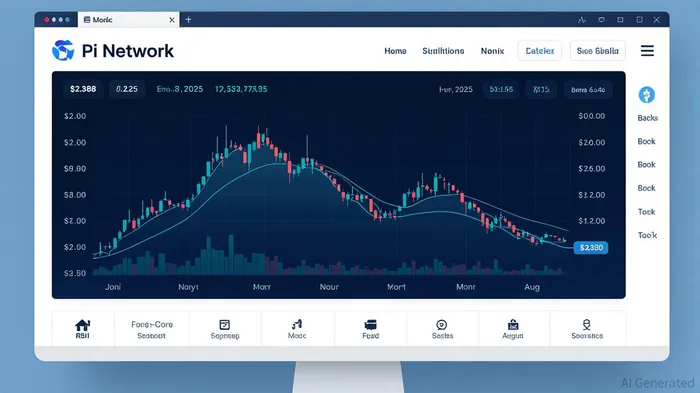
The cryptocurrency market in 2025 has been a crucible for projects lacking robust fundamentals, and PiPI-- Network (PI) stands as a cautionary tale. Despite a user base exceeding 60 million and a flurry of community-driven initiatives, Pi's price has plummeted by 88.33% from its all-time high of $2.98 to $0.3480 as of August 2025. This collapse underscores a critical disconnect between Pi's ecosystem efforts and its ability to generate sustainable demand. A technical and fundamental analysis reveals why Pi's bearish pressures persist, even as the project rolls out new features.
Technical Analysis: A Market in Freefall
Pi's technical indicators paint a grim picture. Over the past 7 days, the token has dropped 11.15%, underperforming both the global crypto market (-3.20%) and Layer 1 peers (-7.70%). The 24-hour trading volume surged 45.20% to $83.75 million, yet this spike failed to reverse the downward trend, signaling capital outflows and weak momentum. The Relative Strength Index (RSI) has hovered near oversold levels, while the Moving Average Convergence Divergence (MACD) shows bearish divergence, suggesting further declines are likely.
Key support levels, such as $0.33, have been repeatedly tested, but the lack of buying pressure indicates a loss of investor confidence. Analysts project a potential drop to $0.27 by mid-September if the current trajectory continues. Meanwhile, the market cap of $2.75 billion remains a fraction of its fully diluted valuation (FDV) of $2.75 billion, highlighting the vast gap between theoretical potential and reality.
Fundamental Flaws: Community-Driven Catalysts Fall Short
Pi Network's ecosystem initiatives—such as the Open Network, PiFest 2025, and the 2025 Hackathon—have been touted as game-changers. However, these efforts fail to address structural weaknesses.
Centralized Governance and Opaque KYC Processes
Despite claims of decentralization, Pi's core team retains control over validator nodes and governance decisions. A CNN report in January 2025 confirmed that all mainnet validators are operated by the Pi Core Team, undermining trust in the network's decentralization. Additionally, the mandatory KYC process has created bottlenecks, with millions of users unable to access their tokens. This centralized control and lack of transparency deter institutional adoption and erode user trust.Limited Real-World Utility
Pi's real-world use cases remain underdeveloped. While the Open Network allows external integrations, most dApps on the platform are either inactive or lack meaningful engagement. For instance, the Map of Pi app, which connects users to Pi-accepting merchants, has only 58,000 active sellers despite 125,000 registered participants. This low adoption rate highlights the token's inability to function as a viable medium of exchange.Price Volatility and Liquidity Constraints
Pi's price volatility—exemplified by a 2,900% surge followed by an 80% collapse in early 2025—undermines its utility for everyday transactions. The token's listing on only a handful of exchanges (e.g., Gate.io) and the absence of fiat on/off-ramps further limit liquidity. As of August 2025, 95% of Pi users hold less than 1,001 tokens, rendering their holdings effectively worthless for real-world purchases.Referral-Driven Growth Model
Pi's invitation-based referral system, while effective for virality, resembles a pyramid scheme. Mining rewards are disproportionately allocated to early adopters, creating a hierarchical structure that prioritizes social engagement over technical merit. This model is unsustainable in the long term, as user acquisition slows and mining rewards diminish.
Comparative Analysis: Pi's Underperformance in a Competitive Landscape
Pi's struggles are amplified by its underperformance relative to peers. While the broader crypto market declined 3.20% in the past week, Pi dropped 9.90%, reflecting a lack of resilience. Projects like Remittix (RTX), which focus on tangible use cases in PayFi, have attracted more institutional interest, further diverting capital from Pi.
Investment Implications and Recommendations
For investors, Pi Network presents a high-risk, speculative opportunity. The token's technical indicators and fundamental weaknesses suggest a continuation of bearish momentum in the short term. Key resistance levels at $0.90 and $0.36 are unlikely to hold without a significant catalyst, such as regulatory clarity or a breakthrough in real-world adoption.
- Short-Term Strategy: Avoid long positions until Pi demonstrates a clear path to decentralization and utility. Consider shorting or hedging against further declines, particularly if the price breaks below the $0.33 support level.
- Long-Term Outlook: Pi's FDV of $2.75 billion implies a theoretical 800x upside from current levels. However, this scenario hinges on resolving governance issues, expanding real-world use cases, and achieving price stability—outcomes that remain uncertain.
- Alternative Allocations: Investors seeking exposure to community-driven projects should consider alternatives with stronger fundamentals, such as SolanaSOL-- (SOL) or CardanoADA-- (ADA), which offer robust ecosystems and institutional backing.
Conclusion
Pi Network's bearish pressures are not merely a function of market volatility but a reflection of deeper structural flaws. While community-driven initiatives have generated buzz, they have failed to address centralization, liquidity constraints, and real-world utility. Until Pi Network can demonstrate a credible transition to decentralization and meaningful adoption, its token remains a speculative asset with limited upside. For now, investors would be wise to approach Pi with caution and prioritize projects with proven fundamentals.

Decoding blockchain innovations and market trends with clarity and precision.
Latest Articles
Stay ahead of the market.
Get curated U.S. market news, insights and key dates delivered to your inbox.






Comments
No comments yet