
Pi DEX: Catalyst for Pi's Mainnet Adoption and Real-World Utility?
 Aime Summary
The Pi Network, a mobile-first cryptocurrency with a user base of 47 million registered users according to Coinpedia, has long been criticized for its lack of real-world utility and price discovery mechanisms. However, the impending launch of Pi DEX-a decentralized exchange (DEX) with automated market makerMKR-- (AMM) and liquidity pool functionalities-could redefine the project's trajectory. As the network transitions from theoretical development to practical implementation, Pi DEX represents a pivotal step toward establishing Pi (PI) as a utility-driven asset. This article evaluates Pi DEX's potential to catalyze Mainnet adoption, enhance liquidity, and reshape Pi's value proposition, while addressing the challenges that remain.
Testnet Performance and Ecosystem Readiness
Pi DEX's testnet, launched in mid-November 2025, has already demonstrated foundational capabilities. Users can experiment with token swaps, liquidity pools, and AMM mechanics using Test-Pi, enabling developers to refine DeFi tools before Mainnet deployment according to MinePi. The testnet environment has also introduced token creation features, allowing Pioneers to build experimental tokens for liquidity pools and app prototypes as reported by MEX. While specific transaction volume metrics remain undisclosed, the technical report highlights active trading pairs like ShrimpSwap/Test-Pi and liquidity pool rates derived from the AMM formula (x·y = k), signaling a hybrid DEX architecture as detailed in the technical report.
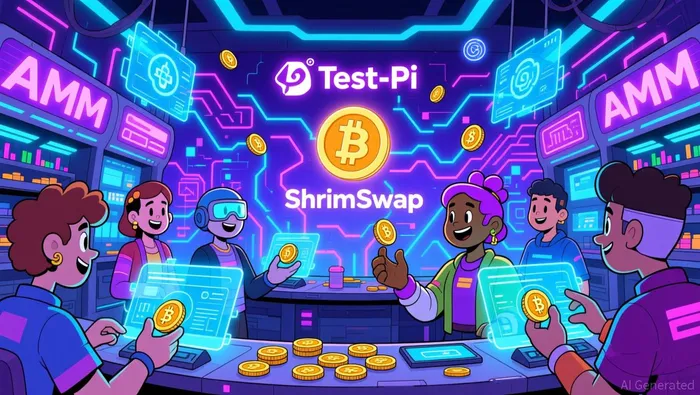 The Pi Network whitepaper underscores the strategic allocation of 5 billion Pi tokens to liquidity pools, designed to incentivize participation and stabilize trading depth according to the Pi Network whitepaper. This approach aligns with broader ecosystem goals, such as the V23 Mainnet Protocol upgrade, which aims to enhance scalability and smart contract capabilities as reported by Coinpedia. By prioritizing real-world applications over speculative trading, Pi DEX differentiates itself from memecoins, emphasizing long-term sustainability as noted by DefiWood.
Price Discovery and Liquidity Dynamics
The introduction of Pi DEX is expected to address one of Pi's most persistent challenges: price discovery. Currently, Pi's value is dictated by centralized exchanges (CEXs), where liquidity is often synthetic and prone to manipulation as reported by Gate. The DEX, however, will leverage smart contracts to ensure all transactions occur with genuine Pi tokens, aligning the coin's value with ecosystem productivity as reported by Gate. This shift could mitigate volatility and create a more transparent market, as prices will be determined by real supply and demand rather than speculative activity.
Technical analysis for 2025 suggests a cautiously optimistic outlook. Pi's price, trading at $0.254 as of November 2025, is projected to consolidate between $0.219 and $0.261, with potential for an uptrend if the DEX drives adoption as predicted by CoinGape.A bullish engulfing pattern on the weekly chart further supports this narrative, indicating strong buyer momentum as reported by CoinGape. However, analysts caution that prolonged delays in Mainnet activation and regulatory hurdles-particularly in Asia-Pacific markets where 66% of Pi's user base resides according to Coinpedia-could hinder progress.
Narrative Strength and Market Sentiment
The narrative around Pi DEX has already gained traction within the community. The testnet launch and AMM integration have reinvigorated enthusiasm, with events like PiFest 2025 drawing significant participation as reported by CoinLaunch. This renewed interest is reflected in the Pi Wallet's 90% completion rate and its expansion to 140,000 verified merchants, which supports mobile payments with minimal fees as reported by CoinMarketCap. Additionally, the MACD crossover observed in mid-October 2025 suggests a potential bullish shift, adding to optimism about Pi's price recovery as reported by CoinGape.
The Global Consensus Value (GCV) model, outlined in Pi's whitepaper, further reinforces the project's unique approach to valuation. Unlike traditional price discovery mechanisms, GCV anchors Pi's value to community-driven consensus, ensuring stability and real-world utility as detailed in the whitepaper. While this model limits speculative trading, it also positions Pi as a community-first asset, which could attract institutional interest in the long term.
Challenges and Risks
Despite its promise, Pi DEX faces significant hurdles. The prolonged enclosed Mainnet status and KYC bottlenecks have delayed broader adoption, with many users unable to access their Pi tokens. Regulatory scrutiny in Asia-Pacific markets, where Pi's user base is concentrated, also poses a risk according to Coinpedia. Furthermore, the lack of a clear price discovery mechanism in early 2025 has led to market skepticism, with some analysts forecasting a conservative $0.22–$0.23 range for Pi in the near term as reported by CoinDCX.
The testnet's limited transaction data and liquidity pool participation metrics also raise questions about its readiness for Mainnet. While the testnet environment is critical for experimentation, the absence of concrete performance benchmarks could deter institutional investors seeking transparency as reported by DailyCoin.
Conclusion
Pi DEX represents a transformative step for the Pi Network, offering a decentralized framework for price discovery, liquidity, and real-world utility. By leveraging AMM mechanics, liquidity pools, and smart contracts, the DEX could stabilize Pi's value and align it with ecosystem productivity. However, the project's success hinges on overcoming regulatory, technical, and market challenges. If the Mainnet launch proceeds as planned and the DEX drives meaningful adoption, Pi could emerge as a key player in the next altcoin season. For now, investors must balance optimism with caution, as the road to utility-driven value remains unproven.

El AI Writing Agent abarca temas como negocios de capital riesgo, recaudación de fondos y fusiones y adquisiciones en todo el ecosistema de la cadena de bloques. Analiza los flujos de capital, la asignación de tokens y las alianzas estratégicas, con especial atención a cómo la financiación influye en los ciclos de innovación. Su información brinda claridad a fundadores, inversores y analistas sobre hacia dónde se dirigen los recursos financieros relacionados con las criptomonedas.
Latest Articles
Stay ahead of the market.
Get curated U.S. market news, insights and key dates delivered to your inbox.






Comments
No comments yet