
Pi Coin's ISO 20022 Exclusion: Strategic Focus on MiCA Compliance and Ecosystem Growth


 Aime Summary
Pi Coin's absence from the ISO 20022 compliance list has sparked debate in the cryptocurrency community, but analysts argue the omission aligns with the project's unique development trajectory and regulatory priorities. The ISO 20022 standard, a global framework for financial messaging and cross-border payments, primarily targets digital assets designed for institutional banking integration. Pi Network, however, operates under a distinct model focused on social mining, community-driven adoption, and EU regulatory compliance, making its exclusion from the list both expected and strategic.
ISO 20022 governs financial transactions, including bank transfers and cross-border settlements, by standardizing data formats and protocols. Cryptocurrencies like XRPXRP--, XLMXLM--, and ALGO, which are ISO 20022-compliant, are engineered to facilitate seamless integration with traditional banking systems. These tokens cater to institutional use cases, such as remittances and asset-backed transfers, where interoperability with legacy infrastructure is critical.
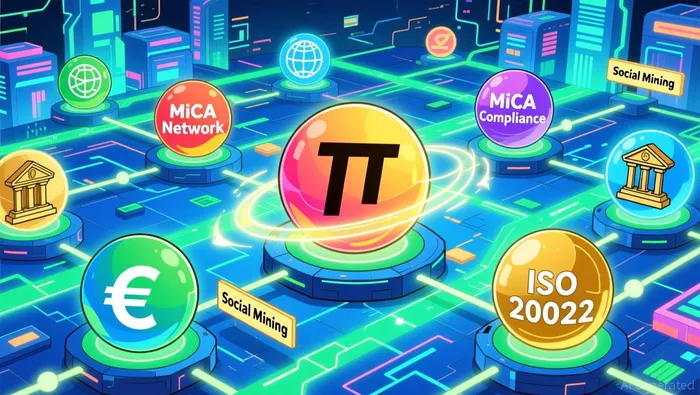 Pi Network, which launched its MiCA-compliant white paper in October 2025, has prioritized regulatory alignment with the European Union's Markets in Crypto-Assets (MiCA) framework. This move enables the project to pursue public trading on EU-licensed exchanges like OKCoin and OKX, with a formal public offer slated for November 28, 2025. Unlike ISO 20022, which emphasizes banking integration, MiCA compliance ensures transparency, risk disclosure, and operational accountability for retail and institutional investors alike.
Crypto analyst Mansingh Rajput explains that Pi Coin's exclusion from ISO 20022 is neither an oversight nor a setback. The project's current phase focuses on establishing a self-sustaining ecosystem, including a non-custodial wallet and developer-friendly tools, rather than immediate banking system integration. Rajput notes that ISO 20022 compliance requires "accurate pricing mechanisms, liquidity across exchanges, and regulatory clarity"-milestones Pi Network is pursuing methodically according to experts.
The Pi team has also avoided supply manipulations or value-protection mechanisms that could complicate regulatory scrutiny. By emphasizing community governance and real-world utility, the project aims to build organic adoption before engaging with traditional financial infrastructure according to industry analysis.
While ISO 20022 inclusion could eventually enhance Pi's institutional appeal, Rajput argues that premature integration would be counterproductive. "Banks will adopt Pi on its own terms as the network demonstrates value," he said, highlighting the project's recent launch of the Valour Pi ETP on Sweden's Spotlight Stock Market as a regulated entry point for investors.
Pi's MiCA compliance and controlled market rollout position it for broader acceptance in Europe, a critical step toward achieving global utility. As the network transitions to a fully open mainnet, its focus on accessibility-allowing smartphone users to mine without specialized hardware-remains central to its mission.
---

Stay ahead of the market.
Get curated U.S. market news, insights and key dates delivered to your inbox.


AInvest
PRO
AInvest
PRO



Comments
No comments yet