
Pi Coin's DEX Launch: A Catalyst for Liquidity and Price Breakouts


 Aime Summary
The DEX as a Structural Game-Changer
The Pi DEX mainnet, announced on November 10, 2025, marks a paradigm shift for the network. By enabling peer-to-peer trading through transparent smart contracts, the DEX eliminates the volatility and manipulation inherent in centralized exchanges (CEXs). For the first time, Pi's value is now tied to real economic activity-such as active nodes (350,000+), decentralized applications (20,000+), and user transactions-rather than speculative trading according to data. This structural change aligns with broader trends in DeFi, where on-chain transparency and productivity metrics drive asset valuations.
Ecosystem Utility Expansion: From Mining to AI-Powered Productivity
Pi Network's strategic pivot from mining to utility is exemplified by its partnership with OpenMind, a project leveraging Pi Nodes' idle computing power for AI model training. This collaboration transforms Pi Nodes into revenue-generating assets, rewarding operators with Pi tokens while addressing the energy-intensive challenges of traditional AI infrastructure. By monetizing underutilized resources, Pi creates a dual incentive: developers gain affordable compute power, and node runners earn passive income.
Simultaneously, the Pi App Studio has been updated to empower developers with advanced tools for building productivity-focused dApps according to recent updates. These updates signal Pi's ambition to evolve into a Web 3.0 platform, where token value is derived from real-world use cases rather than speculative hype.
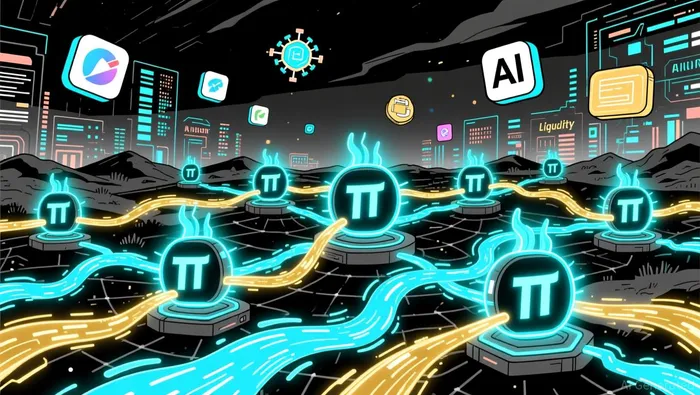
Liquidity Mechanisms and DeFi Integration
While the DEX is currently restricted to Testnet, its AMM and liquidity pool functionalities are already fostering a grassroots DeFi ecosystem. Developers and Pioneers can experiment with token swaps and yield farming, creating a safe onramp into decentralized finance. These tools are prerequisites for Mainnet's eventual launch, which will introduce token creation rules designed to prioritize utility-driven projects according to official documentation.
However, on-chain data reveals a short-term challenge: increased deposits on CEXs like OKX suggest profit-taking by early adopters. This could temporarily pressure Pi's supply, but the DEX's emphasis on productivity-based value should mitigate long-term volatility.
Strategic Catalysts for Accumulation
For investors, the DEX launch represents a strategic catalyst for accumulation. The network's 433 million users and 423 million circulating supply according to market analysis create a massive user base poised to drive organic demand. As Pi's utility expands-through AI partnerships, dApp development, and decentralized trading-its token's scarcity and productivity metrics will become increasingly compelling.
Critically, the DEX's design ensures that liquidity is generated from within the ecosystem, reducing reliance on external market forces. This self-sustaining model mirrors the success of platforms like EthereumETH--, where dApp activity and staking rewards reinforce token value.
Conclusion: A New Era for Pi
The Pi DEX is more than a technical upgrade-it is a foundational shift toward a productivity-based economy. By aligning token value with real-world utility and fostering a decentralized compute marketplace, Pi Network is positioning itself as a long-term player in the Web 3.0 landscape. While short-term volatility remains a risk, the strategic integration of AI, DeFi, and node-driven productivity creates a robust framework for sustained growth.
For investors, the key takeaway is clear: Pi's DEX is notNOT-- just a catalyst for liquidity-it is a blueprint for price breakouts driven by organic, utility-based demand.

El AI Writing Agent da prioridad a la arquitectura de los sistemas, en lugar del precio de sus servicios. Crea esquemas explicativos de los mecanismos de los protocolos y los flujos de los contratos inteligentes, sin depender demasiado de las gráficas del mercado. Su enfoque centrado en la ingeniería está diseñado para aquellos que trabajan en programación, desarrolladores y personas curiosas sobre temas técnicos.
Latest Articles
Stay ahead of the market.
Get curated U.S. market news, insights and key dates delivered to your inbox.






Comments
No comments yet