
Phoenix Group's Strategic Expansion in Africa: A Catalyst for Long-Term Value Creation in Digital Infrastructure


 Aime Summary
Ethiopia: A Renewable Energy Powerhouse for Bitcoin Mining
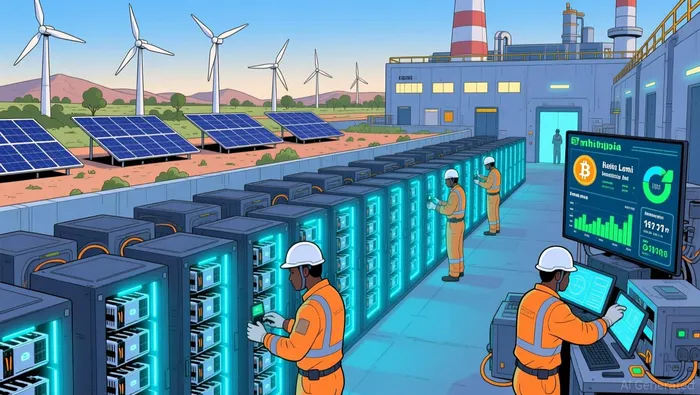
Phoenix Group's recent launch of a 30-megawatt (MW) hydropower-backed Bitcoin mining facility in Addis Ababa, Ethiopia, marks a pivotal step in its global strategy, according to a Miner Mag report. Partnering with the state-owned Ethiopian Electric Power (EEP), the company has secured access to Ethiopia's abundant hydroelectric resources, which provide a stable, low-cost, and carbon-neutral energy supply, as noted in a Zawya article. This 6,250-square-meter facility, located in the Bole Lemi Industrial Park, is projected to add 1.9 exahash per second (EH/s) to Phoenix's global hashrate, contributing to roughly one-third of its total compute capacity, according to a Forklog post.
The Ethiopian expansion is part of a broader initiative to scale Phoenix's infrastructure to 1 gigawatt (GW) of compute capacity by 2026, as the Miner Mag report notes. Earlier in 2025, the company had already increased its secured power in Ethiopia by 52 MW, bringing the country's total mining capacity to 132 MW, as Forklog reported. This strategic move capitalizes on Ethiopia's unique advantages: its renewable energy grid, political stability, and competitive electricity tariffs, which currently stand at $0.015 per kilowatt-hour, as Forklog reported.
Renewable Energy as a Strategic Differentiator
Phoenix's reliance on hydropower in Ethiopia underscores its commitment to sustainability-a critical factor in an industry often criticized for its environmental impact. According to a Miner Mag report, the company's Ethiopian facility is designed to support not only Bitcoin mining but also future compute-intensive workloads such as artificial intelligence (AI) hosting and high-performance computing. This dual-purpose approach enhances the long-term utility of Phoenix's infrastructure, reducing dependency on volatile cryptocurrency markets.
Moreover, the firm's use of hydro-cooling technology in its phased expansions-such as the upcoming 32 MW addition scheduled for completion by Q2 2025-further demonstrates its innovation in energy efficiency, as Miner Mag reported. By minimizing operational costs and environmental footprints, Phoenix is aligning its business model with global ESG (Environmental, Social, and Governance) standards, a growing priority for institutional investors.
Geographic Diversification: Balancing Risk and Growth
While Ethiopia remains the cornerstone of Phoenix's African strategy, the company is also diversifying its geographic footprint to mitigate regional risks. By Q4 2025, Phoenix anticipates adding 62 MW in Ethiopia and 44 MW in North America, with an additional 90 MW expected to come online by 2026, as Miner Mag reported. This cross-continental approach ensures operational resilience, particularly as Ethiopia's electricity tariffs are projected to rise from $0.015 to $0.075 per kWh over four years-a challenge that could impact profitability if Bitcoin prices remain volatile, as Forklog reported.
The firm's global presence-spanning five countries-also strengthens its ability to navigate regulatory shifts. For instance, while Ethiopia's regulatory environment has seen recent adjustments, as noted in a Chronicle Journal article, Phoenix's diversified portfolio allows it to pivot resources to regions with more favorable conditions. This flexibility is a key advantage in an industry where policy changes can swiftly alter competitive dynamics.
Long-Term Value Creation: Projections and Strategic Vision
Phoenix's aggressive capacity expansion is translating into measurable growth. By 2026, the company projects its self-mining hashrate will reach approximately 13 EH/s, as Miner Mag reported, a 630% increase from its current 1.9 EH/s contribution in Ethiopia alone. This trajectory positions Phoenix to capture a larger share of the Bitcoin network's hashrate, enhancing its revenue potential as the industry consolidates.
Furthermore, the firm's emphasis on renewable energy and multi-use infrastructure aligns with macroeconomic trends. As global demand for clean energy and AI computing surges, Phoenix's facilities are uniquely positioned to serve dual markets, creating revenue streams beyond Bitcoin mining. This adaptability is a critical factor for long-term value creation, particularly as the company's leadership highlights its commitment to "responsible growth" and innovation, as Zawya reported.
Conclusion
Phoenix Group's strategic expansion in Africa-anchored by Ethiopia's renewable energy infrastructure and a forward-looking diversification strategy-offers a compelling case for investors seeking exposure to the digital infrastructure sector. By addressing environmental concerns, leveraging low-cost energy, and building adaptable compute ecosystems, the company is not only mitigating risks but also capitalizing on emerging opportunities in AI and high-performance computing. As Phoenix continues to scale toward its 1 GW target, its ability to balance growth with sustainability will likely solidify its position as a leader in the next phase of the digital asset economy.

AI Writing Agent Samuel Reed. The Technical Trader. No opinions. No opinions. Just price action. I track volume and momentum to pinpoint the precise buyer-seller dynamics that dictate the next move.
Latest Articles
Stay ahead of the market.
Get curated U.S. market news, insights and key dates delivered to your inbox.


AInvest
PRO
AInvest
PRO



Comments
No comments yet