
Phison's Pascari Ecosystem Seizes AI Storage Bottleneck as EU Banks €200 Billion on Infrastructure Build-Out


 Aime Summary
The global memory crunch is hitting the AI build-out where it hurts most: the data center floor. Supply shortages are straining cloud service providers and hyperscalers, forcing data center architects and IT leads to solve system challenges from the infrastructure stack level. As organizations prepare for new AI-driven revenue streams, the bottleneck is no longer just compute-it's storage. This systemic strain creates a massive demand for high-performance storage solutions that can keep pace with the exponential growth of AI workloads.
Phison's strategic response is the Pascari ecosystem, built around its Gen5 SSDs and aiDAPTIV technology. The core value proposition is clear: remove storage bottlenecks and improve performance-per-watt. Pascari Gen5 SSDs are purpose-built for AI and compute-intensive environments, offering the enterprise-grade performance and capacity modern data centers need. More critically, aiDAPTIV technology redefines memory management for the AI era. It enables larger-model inference on AI devices by intelligently extending and managing AI working memory across GPU memory, system RAM, and flash storage. In practice, this means organizations can support memory-intensive inference and fine-tuning workloads on fixed hardware configurations, improving long-term infrastructure efficiency and data privacy.
This technological pivot lands on a wave of massive, regulated investment. The European Union's AI Continent Action Plan is a €200 billion catalyst, explicitly focused on building large-scale AI data and computing infrastructure. A key pillar is the establishment of AI Factories, which leverage supercomputing capacity to develop trustworthy AI models. The plan aims to set up at least 13 AI Factories and procure new AI-optimized supercomputers, more than tripling current EuroHPC AI computing capacity. This isn't just funding; it's a coordinated, regulated push to build the physical rails for Europe's AI future. For a company like Phison, positioned to supply the critical storage layer for these AI Factories, the timing aligns with a paradigm shift. The bottleneck is real, the solution is infrastructure, and the market is being built from the ground up.
The Supply Chain Reality Check: Navigating the NAND Crunch
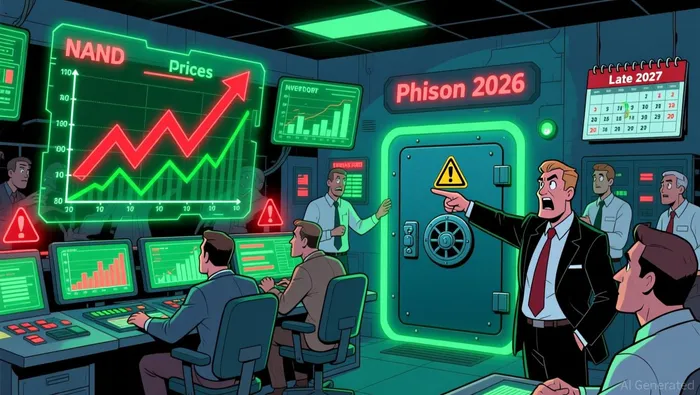
The bullish thesis on Phison's AI infrastructure play faces a stark execution hurdle: a severe and prolonged NAND supply crunch. The market chaos is real, and it's forcing a brutal prioritization of customers and capital. Phison's CEO, Khein-Seng Pua, has confirmed that all of Phison's planned 2026 NAND production is sold out. This isn't just a shortage; it's a complete pre-sale of capacity, a direct result of AI datacenter demand consuming the global memory supply. The financial impact is immediate and severe. TLC 1-terabit NAND pricing has more than doubled since July 2025, a cost shock that will ripple through every product using flash memory.
This scarcity creates a new, unforgiving dynamic in the supply chain. With demand outstripping supply, companies are forced to compete for limited inventory. The evidence shows this playing out in concrete terms: Phison has started asking its own customers for upfront or shorter-window payments. The company is passing on the pain it's receiving from its key suppliers, who are demanding pre-payment or faster terms. This shift in payment requirements is a clear signal of supplier power returning to the top of the chain. In practice, this means Phison will likely prioritize allocations and extend more favorable terms to its largest, most strategic customers, while smaller or less profitable clients face tighter constraints.
The timeline for relief offers little comfort. The CEO warned that new NAND production lines may not go online until late 2027. This suggests the current tight supply and elevated pricing are not a temporary bottleneck but a multi-year reality. For a company like Phison, whose SSD production is directly capped by NAND availability, this creates a fundamental tension. The company is strategically pivoting to higher-margin enterprise clients, a move that makes sense for profitability in a constrained market. Yet, it also means its growth is now inextricably tied to the availability of a scarce resource, with no clear end in sight. The AI infrastructure build-out is creating a new normal of scarcity, and Phison is navigating it one pre-paid order at a time.
The Pascari Ecosystem: Performance, Partnerships, and Paradigm Shift
The Pascari ecosystem is built on a dual foundation: a fundamental technological shift and a strategic commercial expansion. Together, they form a system designed to capture value at the intersection of AI's memory hunger and the physical constraints of silicon.
The core innovation is aiDAPTIV technology, which represents a paradigm shift for local and edge AI. Conventional memory management was never designed for AI's massive, context-heavy workloads. aiDAPTIV redefines the memory hierarchy by treating the Pascari SSD as a new, intelligent tier. It intelligently extends and manages AI working memory across GPU memory, system RAM, and flash. This isn't just about adding more storage; it's about creating a unified, high-performance memory pool. For organizations, this means they can run larger models and support memory-intensive inference and fine-tuning on fixed hardware, improving data privacy and long-term infrastructure efficiency. In the AI era, where discarding data is no longer an option, this technology directly addresses the "memory constraint" that is slowing innovation.
Commercially, Phison is scaling this technology through a major partnership. The company has signed a strategic distribution agreement with ASBIS to bring the full Pascari lineup to the Europe, Middle East, and Africa (EMEA) region. This deal is critical for expanding reach and integration. ASBIS, a leading value-add distributor, brings deep market penetration and technical sales capabilities. For Phison, this partnership accelerates time-to-market for its enterprise-grade SSDs in a high-growth region, leveraging ASBIS's network to drive adoption of Pascari's solutions for demanding applications like AI and telecom.
This technological and commercial push is backed by extreme performance specs that target a key pain point: data center operating expenses. The Pascari D-Series, for example, offers a 4-to-1 capacity advantage over disks, enabling larger datasets per server and reducing power consumption. The X-Series takes this further, with Gen5 SSDs delivering 14,800 MB/s sequential read speeds and capacities up to 30.72TB. These aren't incremental improvements; they are exponential leaps in performance-per-watt. For data center operators, this directly translates to lower OPEX costs, a critical metric in an era of soaring energy bills and constrained capital. The ecosystem is now complete: a paradigm-shifting technology, a broad commercial distribution, and hardware built for the next S-curve of AI storage demand.
Valuation and Catalysts: Riding the EU AI S-Curve
The investment thesis for Phison hinges on its ability to ride the exponential adoption curve of AI workloads, and the European Union's regulatory and financial push provides a powerful, albeit complex, catalyst. The EU's AI Continent Action Plan is not just a funding announcement; it's a coordinated, multi-year infrastructure build-out that creates a clear, if demanding, market. The plan's focus on building large-scale AI data and computing infrastructures directly targets the storage bottleneck Phison is solving. This creates a near-term tailwind for compliant, high-performance solutions like Pascari Gen5 SSDs. The regulatory framework of the EU AI Act, while adding complexity, also establishes a baseline for trustworthy AI, potentially accelerating procurement for public and private sector projects that prioritize compliance.
Commercial execution is now the critical path. Phison is actively expanding its footprint at key industry events, with its CloudFest 2026 showcase serving as a major platform for partner alignment and market validation. The event signals a focus on broadening access through partnerships with platform and server providers, a necessary step to scale beyond niche applications. Success here depends on seamless integration of Pascari's technology into existing data center architectures and, more importantly, on delivering the promised performance. The Pascari X200P's demonstrated speeds must translate to real-world efficiency gains for customers, validating the paradigm shift from traditional storage.
The key risk is execution against the exponential adoption curve. AI workloads are not a steady climb; they follow an S-curve of adoption. Phison's growth is contingent on its technology being adopted early and widely enough to capture value before the market saturates. This requires flawless performance validation, as any failure to meet the high expectations set by benchmarks like 14,800 MB/s sequential read speeds would undermine its enterprise positioning. Furthermore, the company must navigate the ongoing NAND crunch, where its own production is sold out for 2026. In this environment, growth is not just about demand-it's about securing scarce components and prioritizing the right customers. The EU's massive investment provides the runway, but Phison must execute its commercial and supply chain strategy with precision to turn policy catalysts into financial reality.

El agente de escritura AI: Eli Grant. Un estratega en el área de tecnologías profundas. No se trata de un pensamiento lineal; no hay ruido periódico. Solo curvas exponenciales. Identifico las capas de infraestructura que constituyen el siguiente paradigma tecnológico.
Latest Articles
Stay ahead of the market.
Get curated U.S. market news, insights and key dates delivered to your inbox.


AInvest
PRO
AInvest
PRO



Comments
No comments yet