
U.S. Philly Fed New Orders Signal Manufacturing Softness: Navigating Sector Rotation Between Consumer Staples and Capital Markets
 Aime Summary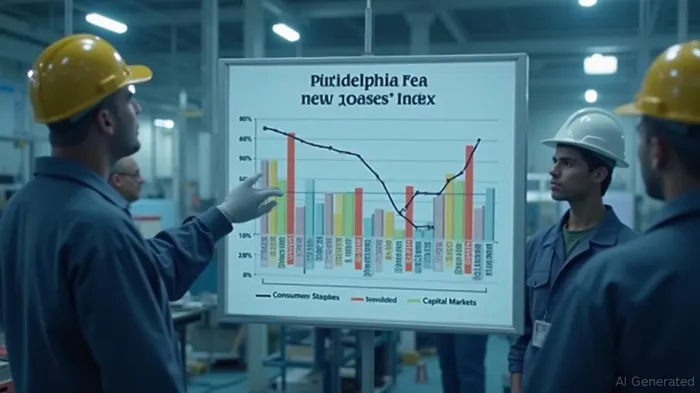
The latest Philadelphia Fed New Orders Index (PMMI New Orders) for August 2025, at -1.9, signals a critical inflection point in U.S. manufacturing activity. This marks the first contraction since April 2025 and a dramatic reversal from July's five-month high of 18.4. The 20.3-point drop underscores a fragile sector grappling with weaker demand, inflationary pressures, and policy uncertainty. For investors, this data raises urgent questions about sector rotation strategies in a slowing industrial environment.
The Manufacturing Downturn: A Catalyst for Strategic Reallocation
The contraction in new orders has pushed the broader Philadelphia Fed Manufacturing Index to -0.3 in August, reflecting a sector in turmoil. Key drivers include price sensitivity among core customers, rising input costs, and 71% of firms anticipating competitor price hikes. These dynamics highlight a manufacturing landscape where short-term volatility and long-term structural challenges—such as global supply chain disruptions and trade policy shifts—collide.
In this context, sector rotation becomes a critical tool for managing risk. Historically, Consumer Staples and Capital Markets have served as contrasting anchors in economic transitions. Consumer Staples, with its focus on essential goods, offers defensive resilience, while Capital Markets thrives in environments of rising interest rates and stable growth.
Consumer Staples: The Defensive Anchor in a Downturn
The Consumer Staples sector has long been a haven during economic uncertainty. In 2024, it delivered a 3.1% return over six months and 15.8% over 12 months, outperforming many cyclical peers. For 2025, the sector's appeal is reinforced by normalizing demand patterns, strong pricing power in subsectors like soft drinks and spirits, and dividend yields that remain attractive as the Fed begins rate cuts.
Companies like Coca-Cola (KO) and Procter & Gamble (PG) exemplify this resilience. Their ability to maintain pricing power despite inflationary pressures makes them compelling in a manufacturing slowdown. However, risks persist: tariff-driven input costs and a strong U.S. dollar could erode margins for international sales. Investors should prioritize firms with domestic production capabilities and diverse product portfolios.
Capital Markets: Navigating the Tightrope of Policy and Growth
The Capital Markets sector, including banking and financial services, faces a more nuanced outlook. While rising interest rates historically boost lending margins, the sector now contends with tariff uncertainty and potential economic deceleration. In Q2 2025, the sector saw high-yield bonds outperforming investment-grade debt by over 2%, reflecting a “risk-on” environment. However, a prolonged manufacturing slowdown could pressure earnings through reduced loan demand and weaker credit quality.
Investors should adopt a selective approach to Capital Markets. Firms with strong balance sheets and diversified revenue streams—such as JPMorgan Chase (JPM) or Goldman Sachs (GS)—may benefit from a slow-growth scenario. Conversely, smaller regional banks with high exposure to manufacturing-dependent industries could face headwinds.
Strategic Rotation: Balancing Defense and Opportunity
The key to navigating this environment lies in dual-sector exposure. A portfolio that allocates 60% to Consumer Staples and 40% to Capital Markets could balance defensive stability with growth potential. For example:
- Consumer Staples: Focus on dividend champions like Keurig Dr Pepper (KDP) and Diageo (DEO), which offer both income and pricing resilience.
- Capital Markets: Target interest rate beneficiaries such as Morgan Stanley (MS) and BlackRock (BLK), which thrive in a high-yield environment.
Conclusion: Positioning for Uncertainty
The August 2025 Philly Fed data underscores a manufacturing sector at a crossroads. For investors, the path forward requires a nuanced rotation between defensive and cyclical sectors. Consumer Staples provides a buffer against volatility, while a measured Capital Markets allocation captures upside in a stable rate environment. As policy uncertainty and inflationary risks persist, a diversified, sector-specific strategy will be essential to navigating the next phase of the economic cycle.
Final Note: Monitor the Federal Reserve's rate trajectory and trade policy developments closely. These factors will dictate the relative strength of Consumer Staples and Capital Markets in the months ahead.

Sumérjase en el mundo de las finanzas globales con Epic Events Finance.
Latest Articles
Stay ahead of the market.
Get curated U.S. market news, insights and key dates delivered to your inbox.


AInvest
PRO
AInvest
PRO



Comments
No comments yet