
U.S. Philly Fed Employment Report Signals Sector Rotation Opportunities
 Aime Summary
The U.S. Philadelphia Federal Reserve's Q2 2025 Employment Report has unveiled a stark divergence in sector performance, offering a roadmap for contrarian investors seeking to reallocate capital in a fragmented economic landscape. While the services sector continues to defy expectations with robust job creation and wage growth, manufacturing faces mounting headwinds from policy-driven disruptions and shifting labor dynamics. For investors, this data presents a compelling case to pivot toward services-oriented equities and defensive sectors while scaling back exposure to struggling industrial segments.
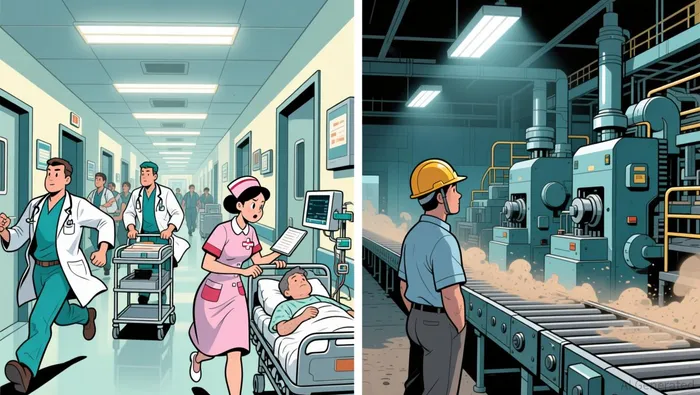
Services Sector: A Magnet for Capital Amid Structural Shifts
The services sector, particularly Education & Health Services and Professional & Business Services, has emerged as a cornerstone of economic resilience. The Philadelphia MSA added 43,000 healthcare jobs in September 2025, driven by aging demographics and rising demand for telemedicine and specialized care. Meanwhile, the S&P Global Services PMI has consistently outperformed forecasts, signaling sustained expansion in a sector that now accounts for over 80% of U.S. economic output.
Investors have already begun to reflect this reality in their portfolios. The Nasdaq Composite, heavily weighted toward tech and healthcare, has outpaced the S&P 500 , as shown in . Defensive services sectors like utilities and healthcare providers are also gaining traction, with utilities ETFs seeing a 12% inflow in Q2 2025.
However, the sector's strength is not without risks. The , for instance, has seen a , raising questions about long-term sustainability. Investors should prioritize sub-sectors with pricing power, such as AI-driven healthcare diagnostics or cloud-based professional services, to capitalize on structural tailwinds.
Manufacturing: A Sector in Retreat Amid Policy and Cost Pressures
The manufacturing sector, meanwhile, is grappling with a perfect storm of challenges. The Philadelphia Fed's manufacturing employment index fell to 5.9 in Q2 2025, a 15-year low, as tariff policies and rising energy costs eroded margins. Tariffs enacted under the Trump administration have led to , with full-time roles shrinking in favor of part-time or contract labor.
Wage growth in manufacturing has stagnated at 0.39% year-over-year, lagging behind the . This disparity highlights a broader trend: capital is fleeing capital-intensive industries in favor of sectors with higher labor productivity and less exposure to global supply chain volatility.
For investors, the message is clear: underweight manufacturing-heavy equities. Industrial and materials sectors have underperformed the broader market, with showing a -3.8% gap. While some may argue for a contrarian bet on undervalued manufacturers, the sector's structural challenges—including energy transition costs and geopolitical risks—make it a high-risk proposition.
Labor Market Dynamics: A Tale of Two Workforces
The Philadelphia labor market's in Q2 2025—above the national average—masks deeper shifts. While employment levels remain stable, full-time roles have declined, and average workweek intensity has risen, indicating a shift toward more compressed labor inputs. This trend favors services sectors that rely on flexible staffing models but could signal burnout risks in manufacturing, where labor costs are already strained.
Wage growth disparities further complicate the picture. The Professional & Business Services sector saw a , while the Information sector faced a decline. Investors should monitor these metrics closely, as they may foreshadow broader labor market imbalances.
Strategic Reallocation: Balancing Growth and Defense
To navigate this divergent environment, a is essential:
1. Overweight Services: Allocate capital to healthcare, tech, and utilities, which benefit from stable demand and favorable macroeconomic conditions.
2. Underweight Manufacturing: Reduce exposure to industrial, materials, and energy sectors, which face margin pressures and slowing global demand.
3. Defensive Hedges: Maintain positions in healthcare and utilities to balance cyclical risks, particularly as the Federal Reserve's dovish pivot boosts long-duration assets.
4. Monitor Policy Shifts: Track and interest rate movements, which could rapidly alter sector dynamics.
The Federal Reserve's 25-basis-point rate cut in September 2025 has already tilted the playing field in favor of services sectors with high capital expenditures, such as AI-driven infrastructure projects. Investors should extend duration in high-quality corporate bonds linked to services and prioritize equities with strong ESG metrics, which are increasingly valued in a decarbonizing economy.
Conclusion: A Divergent Path Forward
The Philly Fed's employment data underscores a critical inflection point: the U.S. economy is increasingly bifurcated between resilient services and struggling manufacturing. For contrarian investors, the path forward lies in capitalizing on the services sector's momentum while hedging against manufacturing's decline. By aligning portfolios with these sector-specific trends, investors can position themselves to thrive in a landscape defined by structural change and policy-driven volatility.

Stay ahead of the market.
Get curated U.S. market news, insights and key dates delivered to your inbox.


AInvest
PRO
AInvest
PRO



Comments
No comments yet