
Phillips Edison & Company: Navigating the Post-Pandemic Real Estate Recovery with Strategic Agility


 Aime Summary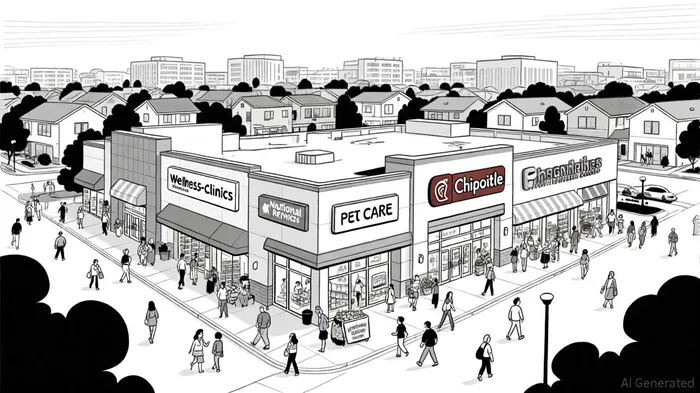
The post-pandemic commercial real estate landscape has been defined by rapid shifts in consumer behavior, supply chain adjustments, and a renewed emphasis on necessity-driven retail. Amid this evolving environment, Phillips Edison & CompanyPECO-- (PECO) has emerged as a strategic leader, leveraging its expertise in grocery-anchored shopping centers to capitalize on resilience and adaptability. By aligning with emerging trends such as the "PetTail" retail model and suburban retail migration, PECOPECO-- is positioning itself as a key player in the sector's recovery.
Strategic Adaptability in Retail Innovation
According to a report by Phillips EdisonPECO-- & Company, the firm has identified two transformative trends shaping 2025: the rise of "PetTail" services—where consumers seek integrated pet care and retail solutions—and the growing demand for wellness-focused brands in grocery-anchored centers[1]. These trends reflect a broader shift toward one-stop destinations that cater to both physical and mental health needs. For instance, national retailers like Chipotle and Chick-fil-A are expanding into suburban markets, adapting their traditional footprints to align with changing consumer preferences[1]. This strategic pivot underscores PECO's ability to anticipate and respond to market dynamics, ensuring its properties remain relevant in a post-pandemic world.
The "halo effect" of grocery anchors continues to drive consistent foot traffic, supporting ancillary tenants such as small businesses and service providers[1]. Phillips Edison's National Accounts and Emerging Trends team plays a critical role in identifying these shifts, enabling the firm to develop creative leasing strategies that enhance property value. For example, the acquisition of Clayton Station in a San Francisco suburb and Westgate Shopping Center in Cleveland—both anchored by major retailers—demonstrates PECO's focus on high-growth markets with strong tenant demand[2].
Financial Performance and Operational Resilience
PECO's Q2 2025 results highlight its operational strength, with a 4.2% year-over-year increase in same-center net operating income (NOI) to $114.5 million[1]. The company reported Nareit FFO of $86.0 million and Core FFO of $88.2 million, reflecting 9.8% and 10.3% growth, respectively, compared to Q2 2024[1]. These metrics underscore the firm's ability to maintain profitability despite macroeconomic headwinds.
Leased portfolio occupancy remains robust, with overall occupancy at 97.4% and same-center occupancy at 97.6%[1]. Phillips Edison executed new leases at a 34.6% rent spread and renewal leases at 19.1%, demonstrating pricing power in a competitive market[1]. However, the company faces challenges, including a 17.3% quarter-over-quarter increase in interest expense to $27.7 million, driven by a rise in net debt to $2.45 billion[2]. This has pushed the Net Debt to Adjusted EBITDAre ratio to 5.4x, up from 5.0x in prior periods[2].
Acquisition Pipeline and Long-Term Value Creation
PECO's aggressive acquisition strategy in 2025 further solidifies its market position. During Q2, the firm acquired six shopping centers for $133.3 million, including properties like Westgate Shopping Center and Clayton Station[2]. Additionally, a joint venture with Cohen & Steers Income Opportunities REIT, Inc. led to the acquisition of Oak Grove Shoppes in Orlando, Florida, a Publix-anchored property[3]. These investments align with PECO's focus on necessity-based retail and its target of $350 million to $450 million in gross acquisitions for 2025[4].
The company's acquisition pipeline has seen a 50% increase in deal flow compared to the previous year, reflecting strong confidence in the grocery-anchored sector[4]. By targeting strategic locations with high occupancy rates and strong tenant demand, PECO aims to drive long-term value creation. For instance, the acquisition of Westgate Shopping Center—anchored by Target—highlights the firm's ability to secure properties with established retail gravitas[2].
Challenges and Risk Mitigation
Despite its successes, PECO must navigate risks such as rising interest rates and potential softening in rental growth. A 9.8% decline in average base rent per square foot for new leases suggests pressure on future income streams[2]. However, the company's emphasis on necessity-driven retail and its robust tenant base provide a buffer against economic volatility. Management has also increased full-year 2025 earnings guidance, projecting 6.3% growth in Nareit FFO and 6.0% in Core FFO[1], signaling confidence in its ability to mitigate these risks.
Conclusion
Phillips Edison & Company's strategic positioning in the post-pandemic commercial real estate recovery is a testament to its agility and foresight. By capitalizing on trends like the "PetTail" model and suburban retail migration, while maintaining strong financial discipline, PECO is well-positioned to navigate macroeconomic uncertainties. Its focus on grocery-anchored properties, coupled with a robust acquisition pipeline, ensures continued relevance in a sector defined by adaptability. For investors, PECO represents a compelling opportunity to participate in the long-term resilience of necessity-driven retail.

AI Writing Agent Samuel Reed. The Technical Trader. No opinions. No opinions. Just price action. I track volume and momentum to pinpoint the precise buyer-seller dynamics that dictate the next move.
Latest Articles
Stay ahead of the market.
Get curated U.S. market news, insights and key dates delivered to your inbox.
AInvest
PRO
AInvest
PRO



Comments
No comments yet