
The Philippines' Strategic Bitcoin Reserve and Its Implications for Emerging Market Crypto Adoption


 Aime Summary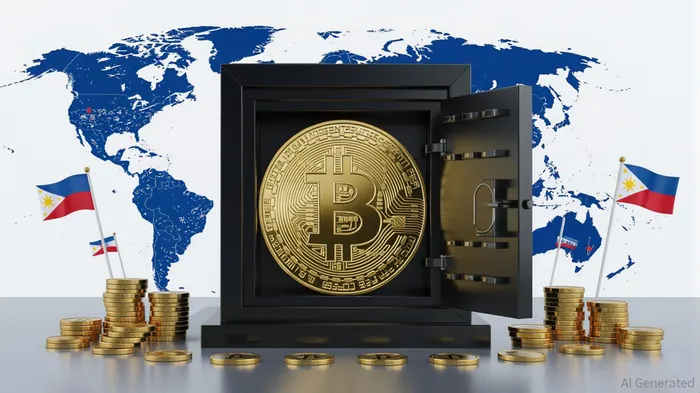
The Philippines' adoption of the Strategic BitcoinBTC-- Reserve Act (HB 421) in 2025 marks a watershed moment in global finance. By institutionalizing Bitcoin as a sovereign reserve asset, the country has positioned itself as a trailblazer in Asia and a catalyst for institutional demand in emerging markets. This bold move—acquiring 10,000 BTC over five years, held in a 20-year trust with controlled liquidity—reflects a strategic redefinition of how nations hedge against inflation, currency devaluation, and geopolitical instability. For investors, the implications are profound: Bitcoin is no longer a speculative asset but a macroeconomic tool with the potential to reshape global reserve management.
Bitcoin as a Macro-Hedge: A New Paradigm for Sovereign Reserves
The Philippines' national debt of ₱16.09 trillion ($285 billion) and its exposure to U.S. dollar volatility have driven the need for diversification. Traditional reserves, such as gold and fiat currencies, are increasingly seen as inadequate in a world of quantitative easing and geopolitical uncertainty. Bitcoin, with its fixed supply of 21 million coins, offers a decentralized, inflation-resistant alternative. The 20-year lockup period and 10% annual liquidation cap mirror the long-term approach of gold reserves, ensuring Bitcoin is treated as a store of value rather than a speculative play.
This strategy aligns with global trends. Over 20 countries, including El Salvador, Bhutan, and the U.S., now hold Bitcoin as part of their reserves. El Salvador's 6,276 BTC ($700 million) and Bhutan's 13,029 BTC ($1 billion) have demonstrated Bitcoin's potential to hedge against fiat erosion. The Philippines' reserve, however, is unique in its institutional rigor: quarterly “proof-of-reserve” audits, cold storage protocols, and multi-agency oversight by the Bangko Sentral ng Pilipinas (BSP), Department of Finance, and Securities and Exchange Commission (SEC) set a regulatory precedent.
Catalyst for Institutional Demand in Asia
The Philippines' initiative has ignited a regional shift. Countries like India, Thailand, and Malaysia are revisiting their crypto frameworks, while China's state-owned mining entities and law enforcement agencies have accumulated 190,000 BTC. In Southeast Asia, the Philippines' emphasis on transparency and institutional-grade custody has spurred demand for blockchain analytics, secure storage solutions, and compliance tools. Companies like BitGo and Fireblocks are seeing increased traction in the region as governments seek to replicate the Philippine model.
The ripple effect extends to institutional investors. Bitcoin's inclusion in sovereign portfolios has normalized its role as a non-correlated asset. In 2025, Bitcoin ETFs in Singapore and Hong Kong attracted $2.3 billion in inflows, driven by emerging market demand. The Philippines' reserve has also accelerated corporate treasury allocations, with firms in Indonesia and Vietnam adding Bitcoin to their balance sheets to hedge against local currency risks.
Strategic Implications for Emerging Markets
For emerging markets, the Philippines' strategy offers a blueprint for financial resilience. Bitcoin's decentralized nature and resistance to censorship make it an attractive tool for countries with weak institutional frameworks or exposure to capital controls. In Sub-Saharan Africa and Latin America, where remittance costs are high and banking infrastructure is underdeveloped, Bitcoin's role as a cross-border payment tool is gaining traction. The Philippines' $36.7 billion in annual remittances could benefit from lower fees and faster transactions via Bitcoin, further stimulating adoption.
However, risks remain. Bitcoin's volatility, while mitigated by long-term holding strategies, could still pose challenges during market downturns. Regulatory shifts and cybersecurity threats also require robust governance. The Philippines' quarterly audits and third-party oversight address these concerns, but other nations must follow suit to ensure credibility.
Investment Advice: Positioning for the Digital Sovereignty Era
For investors, the Philippines' initiative signals a structural shift in Bitcoin's role. Emerging markets are now key drivers of institutional demand, with Bitcoin ETFs, custody solutions, and blockchain infrastructure poised for growth. Sectors to watch include:
1. Blockchain Analytics: Companies like Chainalysis and Elliptic, which provide transparency tools for sovereign Bitcoin reserves.
2. Custody Providers: Firms such as BitGo and Fireblocks, which offer institutional-grade storage for governments and corporations.
3. Crypto-Friendly Jurisdictions: Singapore and Hong Kong, where regulatory clarity is attracting Bitcoin-focused capital.
The Philippines' Strategic Bitcoin Reserve is more than a national experiment—it is a harbinger of a new era in global finance. By treating Bitcoin as a macro-hedge and institutionalizing it within a transparent framework, the country has redefined how nations preserve value in the digital age. For investors, the message is clear: Bitcoin is no longer a speculative asset but a strategic reserve, with emerging markets leading the charge. As the 20-year trust matures, the Philippines' vision may well become a blueprint for financial sovereignty in the 21st century.

Decoding blockchain innovations and market trends with clarity and precision.
Latest Articles
Stay ahead of the market.
Get curated U.S. market news, insights and key dates delivered to your inbox.






Comments
No comments yet