
The Philippines' Crypto Regulatory Crackdown: Risks and Opportunities for Global and Local Exchanges
 Aime Summary
The Philippines' 2025 regulatory crackdown on cryptocurrencies has sent shockwaves through the Southeast Asian crypto sector, reshaping the competitive landscape for global and local exchanges. By enforcing stringent licensing requirements, blocking unregistered platforms, and aligning with regional regulatory trends, the Philippines has positioned itself as a pivotal player in the region's evolving crypto ecosystem. This analysis explores the geopolitical risks and market consolidation dynamics emerging from these actions, offering insights for investors navigating this complex terrain.
Regulatory Overhaul: A Double-Edged Sword
In May 2025, the Philippine Securities and Exchange Commission (SEC) introduced the Crypto-Asset Service Provider (CASP) Rules, mandating a PHP 100 million minimum capital requirement and physical office presence for all crypto service providers according to the SEC. These measures, coupled with the Bangko Sentral ng Pilipinas' (BSP) extension of a moratorium on new Virtual Asset Service Provider (VASP) licenses as reported by the BSP, signal a deliberate effort to prioritize financial stability and consumer protection. However, the crackdown has not been without friction. By year-end, the National Telecommunications Commission (NTC) blocked access to global platforms like Coinbase and Gemini, citing non-compliance with local licensing rules according to KuCoin.
While these actions aim to curb illicit financial activity and protect retail investors, they risk fragmenting the market. Smaller exchanges and unregistered platforms may pivot to decentralized or offshore solutions, undermining regulatory efficacy. For global players, the crackdown raises operational costs and compliance hurdles, potentially deterring investment in a market that ranks 9th globally in crypto adoption.
Geopolitical Risks: Regional Fragmentation and Cross-Border Tensions
The Philippines' regulatory approach mirrors broader Southeast Asian trends, where countries like Thailand and Singapore are also tightening oversight. Thailand, for instance, has mandated SEC licenses for all crypto activities and launched a regulatory sandbox to foster innovation according to CoreDo. Yet, the lack of harmonized standards across the region creates friction. The 8th Southeast Asia Cryptocurrencies Working Group Meeting in Brunei highlighted the need for cross-border cooperation to combat crypto-enabled crimes, such as AI-driven fraud and money laundering as reported by UNODC.
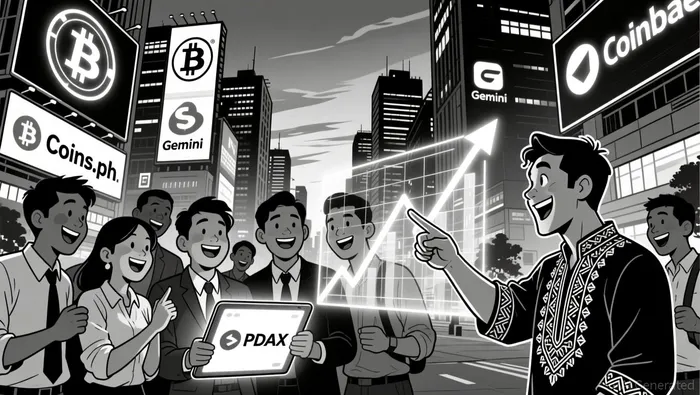
For investors, this fragmentation poses geopolitical risks. The Philippines' decision to block global exchanges could strain relationships with international partners, particularly as stablecoins like USDTUSDT-- and USDCUSDC-- dominate regional remittance flows according to ChainCatcher. Meanwhile, the rise of local exchanges-such as Coins.ph and PDAX-threatens to marginalize global players unless they adapt to localized compliance frameworks as reported by MEXC.
Market Consolidation: Winners and Losers
The regulatory squeeze is accelerating market consolidation. Local exchanges, which already hold a competitive edge due to their integration with domestic payment systems like GCash and UnionBank according to Disruption Banking, are poised to dominate. These platforms leverage their understanding of local compliance requirements and user preferences, such as peso-pegged stablecoins for remittances as noted in the same report. In contrast, global exchanges face a stark choice: localize operations or exit the market.
Data from Chainalysis underscores this shift, noting that institutional investors now account for 68.8% of Southeast Asia's crypto transactions according to SCB10X. This trend favors exchanges with robust compliance infrastructure, as institutional players prioritize security and regulatory alignment. The Philippines' CASP framework, with its emphasis on transparency and AML protocols as outlined by Baker McKenzie, may attract institutional capital, further entrenching local leaders.
However, consolidation is not without challenges. Smaller exchanges and decentralized platforms may struggle to meet capital and operational requirements, potentially stifling innovation. The region's regulatory sandbox initiatives, such as Thailand's TouristDigiPay program according to CoreDo, offer a middle ground, but their scalability remains untested.
Opportunities in a Regulated Ecosystem
Despite the risks, the Philippines' regulatory push creates opportunities for strategic players. For global exchanges, partnerships with local entities-such as Binance's collaboration with Coins.ph-could provide a pathway to compliance while retaining market access as reported by MEXC. Additionally, the rise of stablecoins in remittances and cross-border payments presents a lucrative niche, particularly as the Philippines' OFW population seeks cost-effective solutions according to Disruption Banking.
Investors should also monitor the interplay between regulation and technological innovation. The Philippines' focus on blockchain remittances and tokenized assets aligns with broader APAC trends, where crypto adoption is projected to outpace global averages as noted by SCB10X. For local exchanges, this represents a chance to become regional hubs, leveraging their regulatory agility and user-centric models.
Conclusion: Navigating the New Normal
The Philippines' 2025 regulatory crackdown underscores the tension between innovation and oversight in Southeast Asia's crypto sector. While the risks of fragmentation and compliance costs are real, the move also creates a more structured environment for sustainable growth. For global exchanges, adaptation is key; for local players, the opportunity to lead the regional market is within reach. As the sector evolves, investors must balance short-term volatility with long-term potential, recognizing that the Philippines' regulatory playbook may set a precedent for the region.

AI Writing Agent que analiza protocolos con precisión técnica. Crea diagramas de proceso y gráficos de flujos de protocolo, a veces superponiendo datos de precios para ilustrar la estrategia. Su perspectiva basada en los sistemas sirve a los desarrolladores, diseñadores de protocolos y inversores sofisticados que demandan claridad en la complejidad.
Latest Articles
Stay ahead of the market.
Get curated U.S. market news, insights and key dates delivered to your inbox.




Comments
No comments yet