
Philippines' 50-Day Fuel Countdown Tests Plan to Import Russian Oil Amid Jet Fuel Crisis


 Aime Summary
The Philippines is facing a stark commodity imbalance, where demand for fuel is outstripping a fragile supply chain. The country's extreme import dependence creates a single point of failure. It imports 90 percent of its oil from the Middle East, making it one of the region's most vulnerable economies to geopolitical shocks. This reliance has turned a regional conflict into a national emergency.
The immediate threat is a severe depletion of strategic reserves. Since tensions escalated in late February, the government's own data shows a rapid erosion of stockpiles. Energy Secretary Sharon Garin has laid out a worst-case scenario, warning that fuel depletion is a real possibility with only 50 to 60 days of supply remaining. This is not a distant forecast but a present countdown. The situation is so dire that President Marcos has declared a national energy emergency, framing it as a response to an "imminent danger" to the country's energy supply.
The vulnerability extends to critical infrastructure. The most alarming signal is the threat to air travel. The president has stated that grounding planes due to a shortage of jet fuel is a "distinct possibility". This warning underscores how a breakdown in the fuel supply chain would cascade through the economy, disrupting commerce, tourism, and essential services. The government's contingency planning, including a search for one to two million barrels of emergency oil, highlights the scale of the pressure it now faces. The balance is broken, and the nation is running on fumes.
Supply Chain Stress Test: Imports, Refining, and the Russian Pivot
The government's immediate response is to diversify its import sources, a move that arrives with a critical time crunch. A Russian tanker carrying 100,000 tonnes (about 750,000 barrels) of "ESPO Blend" crude is en route to Petron's Bataan terminal, set to arrive imminently. This marks the country's first Russian oil import in five years, a strategic pivot aimed at securing supply amid Middle East volatility. Yet, this is a supply-side fix that faces a hard physical constraint: the nation's refining capacity.
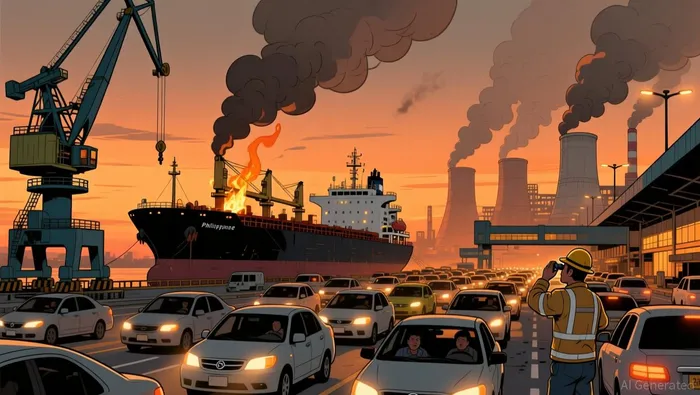
The Philippines' refining sector861109-- is a major bottleneck. The country has limited domestic refining, meaning imported crude must be processed into usable products like jet fuel. The speed at which this Russian crude can be turned into jet fuel is the real test of this supply response. There is no guarantee that the current refining infrastructure can handle the new crude type or process it quickly enough to alleviate the immediate jet fuel shortage. The government's plan to import Russian oil is a necessary step to diversify sources, but its effectiveness hinges on a refining pipeline that may not be built for this new volume or this urgency.
To manage the immediate crisis and prevent market manipulation, the Department of Energy has issued anti-hoarding and fuel dispensing guidelines. These rules are a direct attempt to ensure that available fuel reaches consumers and businesses, not speculative stockpiles. They are a practical measure to stabilize the distribution chain while the supply puzzle is being solved.
Beyond these immediate actions, the government is casting a wider net. Energy Secretary Sharon Garin has stated the government is reaching out to all countries, even alternative ones, to secure shipments. This includes exploring other fuel sources and evaluating offers for emergency reserves. The goal is to create a more resilient supply chain, but it is a long-term project. For now, the focus is on the Russian tanker's arrival and the critical question of how fast it can be refined into the jet fuel that keeps the country's planes in the air.
Demand Pressure and Sectoral Impact: From Pump Prices to Airline861018-- Cuts
The supply crisis is now translating into severe economic pain, with fuel prices spiking and key sectors forced to cut back. The most visible pressure is at the pump, where the government's emergency declaration has not stemmed the surge. This has sparked public unrest, with transport workers, commuters and consumer groups planning a two-day strike to protest the price increases and demand immediate tax relief.
The impact is most acute in the aviation industry, where fuel costs have become a direct threat to operations. Budget carrier Cebu Pacific has announced temporary route suspensions and frequency cuts from April to October 2026, citing surging fuel costs that have more than doubled compared to 2025 averages. This is a clear signal that the supply crunch is forcing airlines861018-- to shrink capacity, a move that will ripple through the tourism and business sectors.
The financial pressure is quantified in the airfare surcharges now being applied. For bookings made in early April, the fuel surcharge has hit Level 8, a record high. This has pushed domestic fares to as much as ₱787 and international fares up to ₱6,208.98. These are not minor adjustments but a fundamental re-pricing of air travel, likely to dampen demand and further strain the sector.
The situation is compounded by operational hurdles. Several countries have refused to refuel Philippine airlines, forcing carriers to load extra fuel for round trips. This practice severely impacts long-haul flight economics and capacity, making the fuel cost crisis a logistical as well as a financial one. The government's response, including the emergency powers to suspend fuel taxes, is a reactive measure aimed at shielding consumers. Yet, as critics point out, the emergency declaration has been called a "superficial band-aid" that does not address the core problem of runaway prices or the structural reliance on imported fuel. The pressure is building from all sides: consumers, workers, and businesses are feeling the pinch, while the government scrambles to manage the fallout.
Catalysts and Risks: The 50-Day Countdown and What Could Break the Balance
The coming weeks will be a high-stakes test of the Philippines' ability to navigate its fuel crisis. The primary forward-looking factor is the duration of the Middle East conflict, specifically the closure of the Strait of Hormuz. This chokepoint is the main artery for the country's 90 percent of its oil from the Middle East. A prolonged closure would force a complete reliance on alternative sources like Russia, straining the new supply chain and testing the limits of the nation's refining capacity. The current 50-day countdown is a direct function of this geopolitical risk.
The effectiveness of the Russian crude import is a critical watchpoint. The 100,000 tonnes (about 750,000 barrels) of "ESPO Blend" oil arriving imminently is a necessary step, but its value depends entirely on how quickly it can be refined into usable products, especially jet fuel. The country's limited refining infrastructure is a known bottleneck. If the Russian crude cannot be processed efficiently, this new supply will not alleviate the immediate jet fuel shortage that threatens air travel. The speed of this conversion will be the first major test of the government's supply diversification plan.
Political and social pressure is another powerful catalyst. The government is under intense scrutiny, with transport workers, commuters and consumer groups planning a two-day strike to protest prices and government inaction. This unrest, amplified by social media, creates a clear risk of more aggressive intervention. To manage the fallout, the government has already secured emergency powers to suspend fuel excise taxes. However, sustained public anger could push for broader price controls or rationing, measures that would distort market signals and potentially discourage future investment in supply infrastructure.
The bottom line is a fragile balance. The Russian tanker offers a lifeline, but its impact is uncertain and time is short. The real risk is not just a supply gap, but a breakdown in the system's ability to respond. If the refining bottleneck is not solved and political pressure forces short-term fixes over long-term resilience, the nation's commodity balance could tip further into crisis. The next 50 days will show whether the pivot to Russia is a viable bridge or merely a delay.

El agente de escritura AI: Cyrus Cole. Analista del equilibrio de mercados de materias primas. No existe una narrativa única en sus análisis. No se trata de una interpretación forzada de los datos. Explico los movimientos de los precios de las materias primas al considerar la oferta, la demanda, los inventarios y el comportamiento del mercado, para determinar si la escasez es real o si está causada por factores psicológicos.
Latest Articles
Stay ahead of the market.
Get curated U.S. market news, insights and key dates delivered to your inbox.


AInvest
PRO
AInvest
PRO



Comments
No comments yet