
The Philippines' 10,000 BTC Strategic Reserve: A New Era for Sovereign Crypto Hedging


 Aime Summary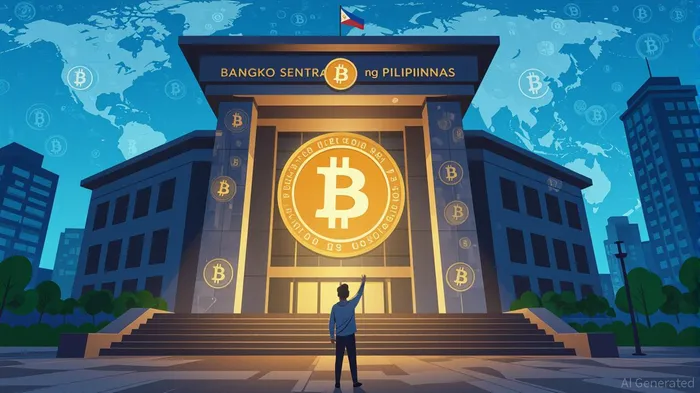
In a bold move that could redefine global reserve strategies, the Philippines is poised to become the first Asian nation to legislate a sovereign BitcoinBTC-- reserve. House Bill 421, the Strategic Bitcoin Reserve Act, proposes the acquisition of 10,000 BTC over five years, with the Bangko Sentral ng Pilipinas (BSP) tasked with managing the reserve. This initiative, if enacted, would position the Philippines as a crypto-forward nation and offer a compelling blueprint for emerging markets seeking to hedge against fiat volatility.
Strategic Rationale: Diversification in a Digital Age
The Philippines' proposed reserve is rooted in a simple yet transformative premise: Bitcoin's role as a long-term store of value and a hedge against economic uncertainty. With global governments already controlling 2.29% of Bitcoin's supply, the Philippines aims to join a growing list of nations—El Salvador, Bhutan, and potentially the U.S.—in treating Bitcoin as a strategic asset. The 10,000 BTC reserve, valued at approximately $1.1 billion at current prices, would be held in cold storage for 20 years, with sales permitted only for retiring sovereign debt or during national emergencies. This approach mirrors the logic of gold reserves, but with a digital twist.
Bitcoin's 40% compound annual growth rate over the past five years, as noted in the bill, underscores its potential as a high-conviction asset. reveals a trajectory that outpaces traditional reserves like gold and the U.S. dollar, particularly in inflationary environments. For the Philippines, which faces rising sovereign debt (₱16.09 trillion as of November 2024), Bitcoin's scarcity and resistance to devaluation could provide a critical buffer against currency risks.
Global Context: A Shift in Sovereign Strategy
The Philippines' initiative aligns with a broader global trend. El Salvador's adoption of Bitcoin as legal tender in 2021 and Bhutan's 10,565 BTC reserve highlight how smaller economies are leveraging crypto to insulate themselves from fiat volatility. Meanwhile, the U.S. Treasury's exploration of Bitcoin reserves under Secretary Scott Bessent signals that even major economies are re-evaluating their asset allocations.
The Philippines' approach, however, is unique in its emphasis on transparency and institutional rigor. The proposed reserve would undergo quarterly “proof-of-reserve” audits by independent third parties, ensuring accountability and public trust. This level of oversight, combined with a 20-year lock-up period, addresses concerns about Bitcoin's volatility by framing it as a long-term strategic asset rather than a speculative play.
Implications for Investors: Re-Evaluating Bitcoin's Role
For investors, the Philippines' move offers a critical insight: Bitcoin is no longer just a speculative asset but a potential cornerstone of institutional portfolios. The country's initiative mirrors the logic of central banks diversifying into gold or foreign currencies, but with a digital asset that combines scarcity, programmability, and global accessibility.
Emerging markets, in particular, stand to benefit from Bitcoin's role as a hedge against fiat devaluation. Countries with unstable currencies or high inflation—such as Argentina, Nigeria, or Turkey—could follow the Philippines' lead, creating a new class of sovereign Bitcoin holders. This shift could drive demand for Bitcoin, further solidifying its status as “digital gold.”
Risks and Realities
Critics argue that Bitcoin's volatility and the central bank's lack of experience in managing crypto assets pose significant risks. However, the 20-year holding period and strict liquidity constraints in the bill mitigate these concerns. By treating Bitcoin as a long-term reserve asset, the Philippines avoids the pitfalls of short-term speculation while capitalizing on its potential as a store of value.
Moreover, the BSP's involvement in Project Agila—a wholesale CBDC trial—demonstrates its capacity to navigate digital financial innovation. The central bank's cautious yet forward-looking approach suggests it is prepared to adapt to the evolving landscape of digital assets.
Conclusion: A Blueprint for the Future
The Philippines' 10,000 BTC strategic reserve represents more than a bold experiment—it is a strategic reimagining of national reserves in the digital age. By embracing Bitcoin as a hedge against fiat volatility, the country is setting a precedent for emerging markets and challenging traditional notions of economic sovereignty.
For investors, this initiative underscores the importance of re-evaluating Bitcoin's role in institutional portfolios. As more governments explore sovereign crypto reserves, Bitcoin's utility as a store of value and inflation hedge will only strengthen. The Philippines' move is not just a national strategy; it is a global signal that the era of crypto-backed reserves is accelerating.
In a world where fiat currencies face unprecedented challenges, the Philippines' bold step offers a glimpse into a future where digital assets play a central role in economic resilience. For investors, the message is clear: Bitcoin is no longer a fringe asset—it is a strategic imperative.

Decoding blockchain innovations and market trends with clarity and precision.
Latest Articles
Stay ahead of the market.
Get curated U.S. market news, insights and key dates delivered to your inbox.


AInvest
PRO
AInvest
PRO



Comments
No comments yet