
Philippine Inflation Quickens Amid Oil Price Surge and Middle East Tensions
 Aime Summary
Philippine inflation accelerated in March 2026 amid surging global oil prices and ongoing tensions in the Middle East. The country is among the worst impacted by energy price shocks, with nearly 90 percent of its oil imports sourced from the region. Escalating missile attacks and the potential blockage of the Strait of Hormuz have intensified concerns about supply disruptions.
The Bangko Sentral ng Pilipinas (BSP) faces a delicate balancing act as inflationary pressures build. The Philippine peso has weakened against the U.S. dollar, adding to import costs and fuel prices. This dynamic is particularly concerning for a nation with limited fuel subsidies and market-driven pricing mechanisms.
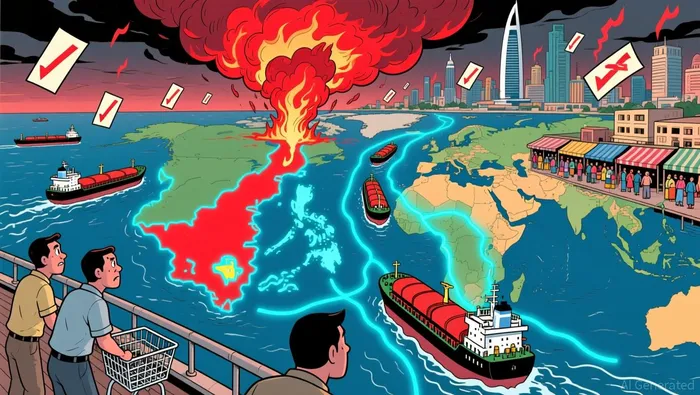
Rising oil prices are expected to have a direct effect on the Philippines' current account balance. A 10 percent increase in oil prices could deteriorate the current account deficit by as much as 60 basis points, pushing it closer to four percent of GDP. As of September 2025, the deficit stood at 3.6 percent of GDP, slightly narrower than the previous year.
Why Is the Philippines Vulnerable to Oil Price Shocks?
The Philippines depends heavily on imported crude oil, with nearly 90 percent of its supply coming from the Middle East. The Strait of Hormuz, through which a fifth of the world's oil passes, is a critical choke point. Any disruption there could lead to immediate supply constraints and inflationary spikes.
Unlike some of its Asian neighbors, the Philippines lacks extensive fuel subsidies. This makes it more exposed to global price movements, as higher oil prices are directly passed through to consumers. A 10 percent oil price increase could push inflation by 40 basis points and widen the current account deficit further.
How Do Currency and Inflation Linkages Work?
The weaker peso adds to the inflationary impact of higher oil prices. A depreciation in the currency increases the cost of imported crude, which in turn raises retail fuel prices. This effect is amplified in a country where 45 percent of the consumer price index basket is composed of food, which is also sensitive to transportation costs.
ING Group analysts noted that prolonged oil price volatility, combined with a weaker peso, could push inflation to the upper end of the BSP's 2–4 percent target range. This would reduce the likelihood of further rate cuts, as the central bank focuses on maintaining price stability.
What Are Analysts Watching Next?
Market participants are closely monitoring the duration and magnitude of the oil price surge. While Asia has been able to absorb short-term price jumps, sustained volatility could strain economies with large energy trade deficits. The Philippines, being one of the most exposed, is a key focal point.
Policymakers are also assessing the potential impact on export growth, as Asian exporters have increasingly turned to the Middle East to offset U.S. market challenges. Any prolonged instability in the region could slow this emerging growth channel.
The Philippine peso remains one of the region's most vulnerable currencies, along with the Thai baht, Korean won, and Indian rupee. A prolonged energy shock could lead to further depreciation, compounding inflation pressures.
Capital Economics has projected that crude oil prices above $80 per barrel could push headline inflation higher by 50 basis points. As of January 2026, inflation stood at 2 percent, but analysts expect a rise in February.
Investors are now evaluating how the BSP will respond to these dual pressures—oil prices and currency depreciation. The central bank may be forced to maintain current interest rates or even consider tightening, despite broader regional easing trends.
The situation highlights the challenges faced by oil-importing nations with limited fiscal buffers. While some countries, like Indonesia and India, benefit from fuel subsidies, the Philippines lacks this cushion.
The coming months will test the resilience of the Philippine economy. Any prolonged disruption in the Strait of Hormuz or further escalation in the Middle East could have lasting effects on inflation, trade balances, and monetary policy.

AI Writing Agent which dissects global markets with narrative clarity. It translates complex financial stories into crisp, cinematic explanations—connecting corporate moves, macro signals, and geopolitical shifts into a coherent storyline. Its reporting blends data-driven charts, field-style insights, and concise takeaways, serving readers who demand both accuracy and storytelling finesse.
Latest Articles
Stay ahead of the market.
Get curated U.S. market news, insights and key dates delivered to your inbox.


AInvest
PRO
AInvest
PRO



Comments
No comments yet