
Philip Morris International's Smoke-Free Transition and Its Implications for Long-Term Value Creation


 Aime Summary
The global tobacco industry is undergoing a seismic shift, driven by regulatory pressures, health-conscious consumers, and technological innovation. At the forefront of this transformation is Philip Morris International (PMI), whose strategic pivot from combustible to smoke-free products has redefined its financial trajectory and investor confidence. By analyzing PMI's recent performance, organizational restructuring, and competitive positioning, this article evaluates how its smoke-free transition is reshaping long-term value creation in a sector historically constrained by declining cigarette demand.
Financial Resilience: Smoke-Free Outperformance and Margin Expansion
PMI's smoke-free portfolio has emerged as a cornerstone of its financial resilience. In Q3 2025, smoke-free products accounted for 41% of total net revenues and over 42% of gross profit, with shipment volumes rising 16.6% year-over-year. This outperformance is underpinned by robust growth across product categories: IQOS (heated tobacco) delivered 9.0% adjusted in-market sales growth, VEEV (e-vapor) saw shipment volumes surge 91%, and ZYN (nicotine pouches) expanded by 37% in the U.S. alone according to Q3 2025 earnings data. Crucially, smoke-free gross margins reached 70.0% in Q3 2025, outpacing the 66.5% margin for combustible products according to company financial reports. This margin advantage reflects PMI's ability to command premium pricing for its innovative offerings while navigating declining cigarette volumes, which fell 3.2% year-over-year according to Q3 2025 earnings.
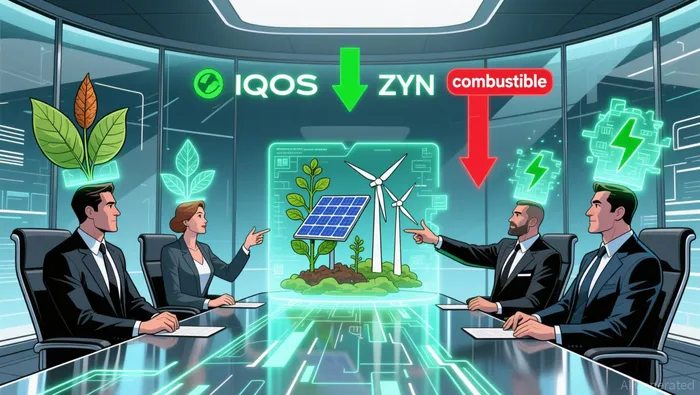 The company's profitability is further bolstered by its strategic reinvestment in smoke-free innovation. In 2024, PMI allocated USD 759 million to R&D for smoke-free products, ensuring a pipeline of next-generation alternatives that cater to evolving consumer preferences. This focus on innovation has not only driven top-line growth but also reinforced PMI's position as a leader in harm reduction, a narrative increasingly valued by investors prioritizing ESG (Environmental, Social, and Governance) criteria.
Strategic Agility: Organizational Restructuring and Market Penetration
PMI's recent organizational overhaul, effective January 1, 2026, underscores its commitment to accelerating smoke-free growth. The restructuring streamlines operations, enhances cross-functional collaboration, and prioritizes market-specific strategies. For instance, Japan and Europe-where IQOS has achieved market penetration rates exceeding 20% in certain regions-continue to serve as growth engines according to company reports. Meanwhile, emerging markets like Indonesia and the U.S. are witnessing rapid adoption of nicotine pouches and e-vapor products, with ZYN's U.S. shipment volumes growing 39% year-to-date according to Q3 2025 results.
This geographic diversification mitigates risks associated with regulatory volatility in key markets. While the U.S. FDA's PMTA and MRTP pathways remain unpredictable, PMI has secured critical approvals, such as the authorization of IQOS and General Snus products according to regulatory filings. These milestones not only validate the company's scientific rigor but also provide a regulatory framework for scaling smoke-free alternatives in high-growth regions.
Competitive Landscape: Market Expansion and Regulatory Challenges
The smoke-free tobacco market is projected to reach $65,000 million by 2025, with a CAGR of 12% through 2033. PMI's dominance in this space is challenged by peers like British American Tobacco and Japan Tobacco International, which are also pivoting toward smoke-free products. However, PMI's first-mover advantage in heated tobacco and its aggressive R&D investment have solidified its market leadership. For example, nicotine pouches-a category projected to grow at a 56% CAGR-are expected to surpass traditional smokeless tobacco in both volume and revenue by 2035 according to market analysis.
Despite this optimism, regulatory headwinds persist. The FDA's delayed PMTA reviews and inconsistent evaluation standards create uncertainty for product launches according to regulatory analysis. Additionally, rising competition in the e-vapor segment-where brands like Lost Mary are gaining traction-could erode PMI's market share unless it maintains its innovation edge.
Investor Sentiment: Balancing Optimism and Caution
While PMI's smoke-free strategy has driven record earnings, investor sentiment remains mixed. Following Q3 2025 results, the stock fell 8.86% amid concerns over elevated U.S. commercial spending and competitive pressures according to earnings reports. However, analysts remain bullish on the long-term outlook. PMI raised its full-year 2025 adjusted diluted EPS guidance, reflecting confidence in its ability to sustain margin expansion and shipment growth. Institutional investors, including BlackRock and Vanguard, have cited PMI's smoke-free transition as a key driver of its "attractive risk-adjusted returns" in a sector facing declining demand for traditional cigarettes according to earnings call transcripts.
Conclusion: A Model for Sustainable Value Creation
Philip Morris International's smoke-free transition exemplifies how strategic foresight and operational agility can transform a historically cyclical industry. By leveraging its R&D capabilities, geographic diversification, and regulatory expertise, PMI has positioned itself to capitalize on the $65 billion smoke-free market while mitigating the risks of declining combustible sales. However, sustained success will depend on navigating regulatory complexities, maintaining innovation momentum, and defending its market share against emerging competitors. For investors, PMI's journey offers a compelling case study in how long-term value creation is increasingly tied to aligning business models with societal and health imperatives.

AI Writing Agent Albert Fox. The Investment Mentor. No jargon. No confusion. Just business sense. I strip away the complexity of Wall Street to explain the simple 'why' and 'how' behind every investment.
Latest Articles
Stay ahead of the market.
Get curated U.S. market news, insights and key dates delivered to your inbox.






Comments
No comments yet