
PG&E Just Trapped the Fire-Bill Sellers — the $14.11 Reclaim Decides the Squeeze
 Aime Summary
A regulated utility doesn't fall 18% in a single session and then quietly trade. PG&EPCG-- did both in the same week, and the second move is the one that matters.
The crash had a date and a cause. On Monday, August 31, California's Assembly stripped the wildfire-liability protections out of Senate Bill 492, and PG&E shares plummeted 18% to $13.58 after the Assembly's move left the utility with reduced liability protections. That single drop was roughly three times a normal PG&E day's range — the stock's average true range is about $0.96. Sellers weren't nibbling; they were dumping on a political headline.
Then the story reversed as the session closed. The Assembly declined to take up the bill, and SB 492 died without a vote on the final day of the legislative session. The headline investors sold into — a California law that would leave utility shareholders exposed to un-capped wildfire liability, without a replenished state fund underneath — never actually became law.
That is the mechanical setup for a bear trap. Investors sold PG&E as though the worst-case bill had passed. It hadn't. Anyone who shorted or dumped shares at $13.58 and below on that fear is now holding the wrong side of the trade if the recovery holds.

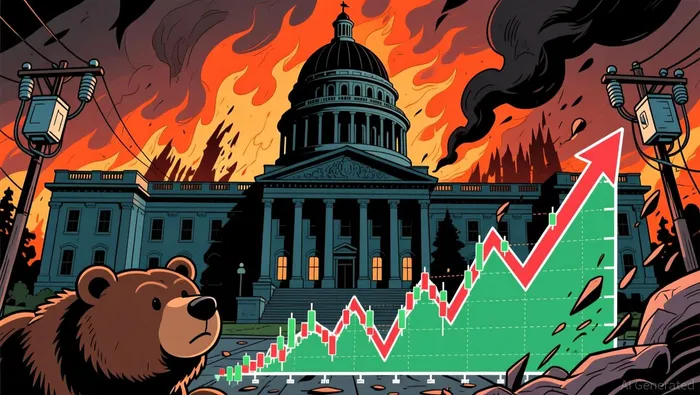
And it is recovering. Through Thursday, PG&E closed up 4.7% at $13.96, reclaiming ground on 65.6 million shares — more than $900 million of value changing hands. Scaled against the longer chart, though, this is a reversal attempt inside a broken trend, not a fresh breakout: the stock is still down about 22% over five days and 18% over twenty, with the 50-day average at $17.15 and the 200-day at $16.78. The rebound is starting one and a half points below the shelf it fell off of.
The one gate that settles it
Everything now runs through $14.11, Thursday's high and the first ceiling this bounce has to crack. Clear it on a daily close with volume still expanding and buyers open a relatively thin stretch back toward the wreckage of the pre-crash range around $15.50–$16 — the gap the Monday collapse left in the tape. That is also where the 50- and 200-day averages now cluster, so the move would meet real supply once it gets there.
Below the gate, the setup stays alive only while the stock holds roughly $13.30, the low of the past two sessions. Lose that and the bear-trap thesis is broken; the next floor is the 52-week low at $12.59, and beneath it the chart offers little to stop a rollover.
| Scenario | Trigger | Path | Invalidation | Horizon |
|---|---|---|---|---|
| Squeeze expands | Daily close above $14.11 on rising volume | Gap-fill toward $15.50–$16, then the 50/200-day shelf | Close back under $13.30 | Days to weeks |
| Bounce fails | Loss of ~$13.30 | Retest of $12.59, then a redrawn lower map | A decisive hold of $13.30 | Intraday to days |
What the tape shows — and what it doesn't
The participation leans "relief rally" more than "institutions reloading." Thursday's order flow showed net buying in every size bucket, but it was led by retail and medium orders. Block trading was essentially flat — $24.8 million in against $23.4 million out — and large orders were only marginally net positive. That is frightened participants stepping back into the name, which is real demand, but it is not yet a confirmed stampede of big institutional accumulators.
The sharper thing traders may be missing is that neither decisive outcome has actually happened. The bill that would have left PG&E defenseless died, which is good for the chart. But no durable liability framework exists either; the Assembly has pledged fall hearings, and Governor Newsom, who opposed the outcome, said he would remain involved until January. So Thursday's rebound reprices a specific scare. It does not remove the risk that caused the crash; it postpones it for a few months.
The verdict
Hold $13.30 and the trap stays armed: a close above $14.11 opens the gap-fill toward the $16 shelf, and the sellers who dumped on the fire-bill panic become the fuel. Lose $13.30 and the rebound is a failed squeeze, with $12.59 as the next floor.
Respect the timeframe. This is a bounce trade off an oversold panic — RSI sits near 33 — not a newly minted uptrend, and the weekly structure remains broken below the $16.80 averages. The chart can plausibly carry a squeeze back to $16. What a chart cannot do is clear the liability cloud. That decision runs through Sacramento and January, not through a level.

Stay ahead of the market.
Get curated U.S. market news, insights and key dates delivered to your inbox.


AInvest
PRO
AInvest
PRO




Comments
No comments yet