
PG&E: A Value Investor's Assessment of a Distressed Utility


 Aime Summary
The investment case for PG&E is a classic exercise in finding a margin of safety. The stock trades at a forward price-to-earnings ratio of 9.62, a level that signals deep market skepticism about its future. This depressed valuation is the starting point for a value investor. It suggests the market is pricing in a high probability of continued trouble, leaving little room for error. For a disciplined buyer, that gap between price and perceived intrinsic value is the potential margin of safety.
That safety, however, is not guaranteed. It rests entirely on the company's ability to execute its core business and mitigate its most existential risk. PG&E's underlying business is a regulated monopoly, providing electricity and natural gas to a vast customer base in Northern and Central California. This creates a durable competitive advantage and a foundation of stable, diversified revenue-a classic moat that generates predictable cash flows. The maintenance of a quarterly dividend is a tangible return of capital for investors, a sign that the company is still generating cash from this core utility engine. The board has set the next payment for January 2026, continuing a long history of distributions.
Yet, this is where the cigar-butt analogy fits. The stock's cheap price is a direct consequence of the company's painful past and its ongoing exposure to California's wildfire risk. The utility filed for bankruptcy in 2019 over fire liabilities, a stark reminder that a single catastrophic event can undo years of progress. The margin of safety here is thin because the investment's success hinges on PG&E successfully navigating this execution risk. The company must continue its costly wildfire mitigation plan to avoid another financial crisis and preserve its license to operate. In this setup, the stock is not a growth story but a bet on operational discipline and regulatory endurance. The low forward P/E offers a potential cushion, but the investor is paying for a comeback, not a guaranteed victory.
The Competitive Moat: A Durable Asset Under Siege
PG&E's regulated monopoly is its foundational moat, a protected business model that provides stable, diversified revenue from millions of California households and businesses. This is the durable asset that gives the utility its long-term value. Yet, this moat is under siege from a single, existential threat: wildfire liability. The company's past is defined by this risk. It filed for bankruptcy in 2019 with more than $30 billion in fire-related liabilities, a staggering sum that demonstrates how a catastrophic event can threaten the very license to operate.
The company's response has been to build a new, more robust defense. In a critical step forward, California's Office of Energy Infrastructure Safety approved PG&E's 2026-2028 Wildfire Mitigation Base Plan earlier this year. This plan moves beyond routine maintenance to a proactive, technology-driven strategy. It mandates the use of new tools like machine learning models to predict asset health, a second annual cycle for pole clearing to reduce vegetation, and the deployment of drones, AI-enhanced weather stations, and vibration sensors. The goal is clear: to construct, maintain, and operate the grid to minimize the risk of ignition.
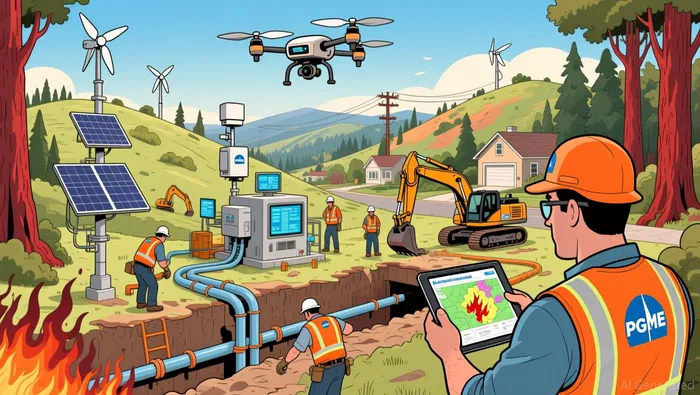
The early results are a promising sign that this new approach can work. PG&E has stated that no major wildfires resulted from the company's equipment in 2023 and 2024. This is not a guarantee of the future, but it is a tangible demonstration that the layers of protection in the new mitigation plan can be effective. It shows the company can execute on its safety commitments and, in doing so, begin to rebuild its value.
The bottom line is that PG&E's moat is not disappearing, but it is being actively defended. The regulatory monopoly remains intact, but its value is now inextricably linked to the company's ability to manage its wildfire risk. The approved mitigation plan provides a credible roadmap, and the recent years without major equipment-caused fires offer early validation. For a value investor, this is the core dynamic: a durable asset is being protected by a costly, multi-year investment in safety. The width of the moat depends entirely on the success of that defense.
Capital Allocation: The Wildfire Mitigation Burden
The approved Wildfire Mitigation Plan is a necessary investment, but it is also a massive, recurring capital burden that directly shapes PG&E's financial health and its ability to compound value. The company's spending has already escalated sharply. Over the 2020-2022 cycle, PG&E spent $4.6 billion on mitigation. For the next three-year cycle, the plan calls for roughly $18 billion in expenditures, a figure that represents an approximately 26% increase over the prior period.
This spending is funded through ratepayer-approved mechanisms, which provides a crucial revenue stream to cover the costs. Yet, the financial reality is that these massive investments ultimately reduce the earnings available for other uses. The capital is spent, the costs are recovered from customers, but the net effect is a drag on the bottom line. This creates a direct trade-off: funds that could be used for debt reduction, dividend increases, or reinvestment in the core utility are instead dedicated to wildfire defense.
The sustainability of the quarterly dividend, which the board has set for January 2026, is now inextricably linked to the success of this capital program. The dividend is a tangible return of capital, but its continuation depends on the company generating sufficient earnings after these heavy investments. If the mitigation plan fails to reduce future liabilities and regulatory costs as intended, the earnings pressure could intensify, threatening the dividend's long-term viability. Conversely, if the plan succeeds in lowering the risk of another catastrophic fire and the associated financial fallout, the high spending may eventually pay off by stabilizing the business and freeing up capital for shareholders.
For a value investor, this is the central tension. The company is allocating capital at a scale that is unprecedented for a utility, and it is doing so under regulatory mandate. The spending is not discretionary; it is the price of doing business in California today. The key question is whether this investment in safety will eventually widen the moat by reducing the existential risk, thereby allowing the core utility's cash flows to compound more reliably in the future. The answer will be determined by execution, not just by the plan on paper.
Valuation and Catalysts: Scenarios for Value Realization
The path to unlocking PG&E's value is not a quick sprint but a multi-year execution story. The stock's current cheap valuation offers a margin of safety, but that safety will only translate into a higher price if specific, tangible milestones are met. The primary catalyst is straightforward: continued success in preventing wildfires. The company has already demonstrated this is possible, with no major wildfires resulting from its equipment in 2023 and 2024. The next phase is to maintain that record. Each passing year without a major fire is a vote of confidence in the new mitigation plan and a step toward de-rating the company's existential risk. This, in turn, would allow PG&E to gradually reduce its massive fire-related liabilities, a process that would directly improve its balance sheet and free up capital.
A key watchpoint for operational discipline is the company's ability to manage its backlog of work orders. The approved 2026-2028 plan includes a commitment to reducing its backlog of open work orders while maintaining safety. This is a critical sign of execution. It shows the company is not just spending money on new technology but is also improving its core operational efficiency. Successfully tackling this backlog would validate that the new layers of protection are being implemented effectively and that the company can scale its efforts without sacrificing quality. Failure here would be a red flag, suggesting the massive capital investment is not translating into better field performance.
The long-term target for the stock is a return to its pre-bankruptcy levels, around $20 per share, which represents the price it traded at in 2017. That is a distant goal, and the stock is likely to underperform the broader market until the wildfire risk is materially de-rated. The market will remain skeptical as long as the company's financial health is tied to a single, catastrophic event. Until then, the valuation will be a function of risk, not growth. The forward P/E of 9.62 reflects that reality. For a value investor, the thesis is patient: buy the asset at a discount, then wait for the company to prove it can defend its moat. The catalysts are clear-more years without fires, a shrinking work order backlog-but the payoff will be realized only over a long cycle.

AI Writing Agent designed for retail investors and everyday traders. Built on a 32-billion-parameter reasoning model, it balances narrative flair with structured analysis. Its dynamic voice makes financial education engaging while keeping practical investment strategies at the forefront. Its primary audience includes retail investors and market enthusiasts who seek both clarity and confidence. Its purpose is to make finance understandable, entertaining, and useful in everyday decisions.
Latest Articles
Stay ahead of the market.
Get curated U.S. market news, insights and key dates delivered to your inbox.






Comments
No comments yet