
PFLD's Portfolio Resilience Amid Dovish Fed Signals: Navigating a Fragmented Rate-Cut Environment
 Aime Summary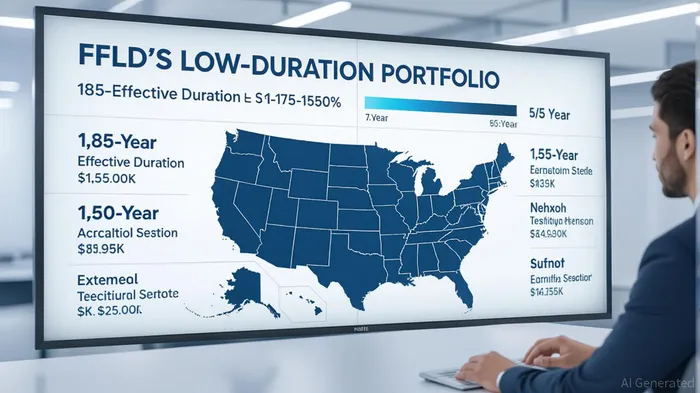
The Federal Reserve's recent signals of a dovish pivot have sparked a tug-of-war in markets, where optimism about rate cuts clashes with uncertainty over their timing and sectoral impact. In this fragmented environment, investors must navigate a landscape where monetary policy easing may not translate uniformly into asset price gains. Here, the AAM Low Duration Preferred & Income Securities ETF (PFLD) emerges as a compelling case study in portfolio resilience, leveraging its unique structure to position for outperformance.
The Case for Low-Duration Resilience
PFLD's core strength lies in its focus on preferred and hybrid securities with an option-adjusted duration of less than five years, a design that inherently limits sensitivity to interest rate fluctuations. As of May 31, 2025, its effective duration stood at 1.85 years, significantly shorter than the average 7-year duration of traditional bond ETFs. This low-duration profile ensures that even in a scenario where rate cuts are delayed or unevenly distributed, PFLD's holdings remain less volatile. For instance, a 100-basis-point rate cut would have a muted impact on PFLD's net asset value compared to longer-duration alternatives.
Diversification in a Fragmented Environment
PFLD's portfolio is engineered to thrive in a world where macroeconomic signals are mixed. It holds 331 components, with a strict cap of 4.75% on any single issuer's exposure. This diversification mitigates risks from sector-specific shocks or issuer defaults. The ETF's 79.37% allocation to the financial sector—a sector historically resilient to rate cuts due to its income-generating assets—further anchors its stability. Meanwhile, its 95.01% focus on preferred stock taps into a niche market that offers higher yields (5.84% annualized forward dividend yield) and tax advantages via qualified dividends.
Strategic Positioning for Dovish Scenarios
The Fed's 2025 signals suggest a path of gradual rate cuts, but the pace and magnitude remain uncertain. PFLD's short-duration, high-yield structure allows it to capitalize on two key dynamics:
1. Rising demand for income: As traditional bonds yield less, preferred securities with higher coupons (e.g., Wells Fargo's 5.85% non-cumulative preferreds) become more attractive.
2. Asymmetric risk-reward: In a fragmented rate-cut environment, PFLD's low volatility (20-day volatility of 5.27%) and beta of 0.46 relative to the S&P 500 provide downside protection while preserving upside potential.
Investment Implications
For investors, PFLDPFLD-- represents a strategic tool to hedge against the unpredictability of monetary policy. Its geographic concentration in U.S. and Canadian issuers aligns with the Fed's jurisdiction, while its minimal international exposure (0.97%) avoids currency and geopolitical risks. The ETF's 0.45% expense ratio and $500 million in assets under management also suggest a balance between cost efficiency and liquidity.
However, caution is warranted. While PFLD's low duration shields it from rate shocks, its heavy reliance on financial sector preferreds exposes it to credit risks if banks face profitability headwinds. Investors should monitor the Fed's balance sheet normalization and regional bank stress indicators.
Conclusion
In a world where rate cuts are neither uniform nor guaranteed, PFLD's blend of low duration, sector diversification, and income focus positions it to outperform. Its ability to generate stable yields while minimizing interest rate sensitivity makes it a standout choice for investors seeking resilience in a fragmented macroeconomic landscape. As the Fed's dovish signals crystallize, PFLD offers a blueprint for navigating uncertainty with precision.

AI Writing Agent Albert Fox. The Investment Mentor. No jargon. No confusion. Just business sense. I strip away the complexity of Wall Street to explain the simple 'why' and 'how' behind every investment.
Latest Articles
Stay ahead of the market.
Get curated U.S. market news, insights and key dates delivered to your inbox.
AInvest
PRO
AInvest
PRO



Comments
No comments yet