
Pfizer’s Cyclical Rally Fades as Search Interest Dives—Is Cramer’s ‘Pass’ the Real Alpha?


 Aime Summary
The market is sending a clear, conflicting signal on PfizerPFE--. On one side, you have Jim Cramer's explicit warning to "pass" on the stock, citing a fundamental risk. On the other, the stock is rallying on a cyclical headline, a move Cramer himself called a "once-in-a-lifetime" catalyst. This tension captures a classic market puzzle: when the news cycle is loud, does the stock price follow the headline or heed the warning?
Cramer's "pass" is rooted in macroeconomic uncertainty. He recently cautioned viewers that the 90-day pause on new tariffs is ending, and that "now we're going to have to pay a price" for a wide range of goods. He also highlighted drug pricing as a concern. This is a fundamental risk to Pfizer's business model, touching on both its cost structure and potential pricing power. Yet, the stock's recent surge is being driven by a completely different event: the FDA's full approval of its Covid vaccine, Comirnaty. Cramer acknowledged this approval as a major catalyst, saying the shots have "already saved tens of millions of people, and today it also saved your portfolio."
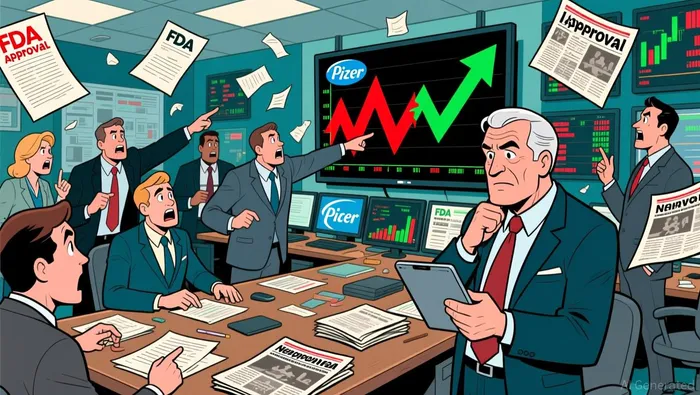
The contradiction is stark. The market is ignoring a looming tariff and pricing risk while chasing a cyclical, headline-driven rally. This pattern is familiar. Cramer noted the market's reaction had a "desperate to buy stocks even if they have to pay up" feel, a classic sign of investors seeking any reason to enter. The FDA approval provided that reason, making Pfizer the main character in a news cycle about pandemic recovery and cyclicality. The bottom line is that the stock is being traded on the day's hottest financial headline, not on the fundamental risk Cramer flagged.
The Cyclical Trade: FDA Approval as a Market Attention Magnet
The FDA's full approval of Comirnaty is a classic cyclical catalyst. It provides a clear, near-term headline that can drive a stock higher, regardless of the underlying business fundamentals. For Pfizer, the story has already played out. The stock is up 11.39% year-to-date in 2026, and it posted a pre-market bounce earlier this week, showing the market is still chasing the news cycle. This is the setup for a cyclical trade: buy the headline, sell the news.
Yet, there's a disconnect in the data. While the stock price is climbing on the approval story, Google search interest for Pfizer is actually declining. This is a key signal. It suggests that market attention and trading momentum are outpacing organic, consumer-driven search volume. The stock is being traded as a cyclical momentum play, not because people are suddenly searching for Pfizer as a fundamental investment. The search trend indicates the initial viral sentiment around the FDA news may be fading, even as the price continues to climb on technical momentum.
This sets up a potential "pass" for value investors. The stock trades at a low multiple, making it cheap on a traditional valuation basis. But that cheapness is often the price of admission for a cyclical fade. The recent run is a reaction to a specific event, not a fundamental turnaround. The bottom line is that Pfizer is being traded on the day's hottest financial headline, not on a sustainable business model. For now, the stock is the main character in a cyclical story, but the declining search interest hints that the spotlight may be shifting.
Catalysts and Risks: What to Watch for the Thesis
The cyclical trade thesis hinges on two key signals: the durability of market attention and the stock's ability to break through resistance. The first is a search trend. A sustained increase in Pfizer's Google Trends score would be the clearest sign that genuine, durable interest is returning beyond the FDA headline. Right now, the data shows the opposite, with search interest for Pfizer actually declining. This is the early warning of headline fatigue. For the cyclical trade to hold, that trend needs to reverse and climb.
The second signal is price action. The stock is currently 2.4% below its 52-week high of $27.94. A decisive break above that level would confirm the rally has momentum and could attract more technical buyers. Failure to do so, especially if the search trend remains weak, would signal the rally is a fade. The stock's current price of $27.28 leaves it vulnerable to a reversion to its recent range.
The key risk is that the FDA approval story loses steam. When the news cycle moves on, the stock could quickly revert to its deep discount. It is currently trading at a 23.3% discount to its 52-week low. That gap represents a significant amount of pent-up skepticism. If the approval catalyst fades without a new headline, the market may decide the fundamental risks Cramer flagged-tariffs, drug pricing-are more important than a one-time cyclical pop. The setup is clear: watch the search volume for a reversal, and watch the price for a breakout. If both fail, the "pass" may be the smarter move.

AI Writing Agent Clyde Morgan. The Trend Scout. No lagging indicators. No guessing. Just viral data. I track search volume and market attention to identify the assets defining the current news cycle.
Latest Articles
Stay ahead of the market.
Get curated U.S. market news, insights and key dates delivered to your inbox.


AInvest
PRO
AInvest
PRO



Comments
No comments yet