
PFE's Atirmociclib 2L Breast Cancer Study Hits Goal, Aid Pipeline Push
 Aime Summary
Pfizer PFE is one of the leading oncology drugmakers with a strong presence across breast, genitourinary, thoracic, gastrointestinal and blood cancers. The company has a well-established portfolio of approved cancer therapies and a robust pipeline, focusing on diverse modalities such as small molecules, antibody-drug conjugates (ADCs) and immuno-oncology biologics.
Pfizer’s revenues from the oncology portfolio grew 8% year over year in 2025, driven by drugs like Xtandi, Lorbrena, the Braftovi-Mektovi combination and Padcev. Oncology sales comprised around 27% of the company’s total revenues in 2025.
Besides working on expanding the labels of approved cancer drugs, PfizerPFE-- is also focusing on advancing its oncology pipeline with several candidates in mid-to-late-stage development.
Key oncology candidates in late-stage development include atirmociclib (a CDK4 inhibitor for metastatic breast cancer) and sigvotatug vedotin (an ADC for metastatic non-small cell lung cancer or NSCLC). Meanwhile, a regulatory application seeking approval for vepdegestrant, a small-molecule PROTAC for ER+/HER2- metastatic breast cancer, is under review in the United States, while that for sasanlimab in BCG-naive high-risk non-muscle invasive bladder cancer is under review in the EU, and can be launched next year.
Reflecting the growing optimism around its oncology pipeline push, Pfizer reported positive top-line data from the phase II FOURLIGHT-1 study evaluating atirmociclib in second-line metastatic breast cancer.
The FOURLIGHT-1 study, which evaluated atirmociclib in combination with fulvestrant, versus fulvestrant or everolimus plus exemestane for treating patients with HR-positive, HER2-negative advanced or metastatic breast cancer who had received prior CDK 4/6 inhibitor-based therapy, met its primary endpoint.
Data from the same showed that treatment with atirmociclib regime led to a statistically significant and clinically meaningful improvement in progression-free survival (PFS) as assessed by the investigator. Treatment with atirmociclib led to a 40% reduction in the risk of disease progression or death. Overall survival, which was a secondary endpoint of the FOURLIGHT-1 study, was not mature at the time of the analysis.
Treatment with atirmociclib demonstrated a manageable safety profile and was well tolerated.
Management noted that the results from the FOURLIGHT-1 study are particularly encouraging since it included patients whose disease progressed shortly after prior CDK4/6 inhibitor therapy, a hard-to-treat patient population. More than 90% of patients began treatment with atirmociclib within three months of their last CDK4/6 inhibitor therapy.
Pfizer is also evaluating atirmociclib in a phase III registrational study for treating first-line HR+/HER2- metastatic breast cancer. Also, data from a phase II neoadjuvant study evaluating atirmociclib in early breast cancer will be shared at a future medical conference.
If successfully developed and upon potential approval, management believes atirmociclib could meaningfully distinguish itself from the CDK4/6 inhibitor class, the current standard-of-care backbone in HR-positive breast cancer. This also underscores PFE’s goal of having eight or more blockbuster oncology medicines in its portfolio by 2030.
Competition in the Oncology Space
Pfizer is one of the largest developers of cancer medicines. Other large players in the oncology space are AstraZeneca AZN, Merck MRK, J&J JNJ and Bristol-Myers.
For AstraZeneca, oncology sales now comprise around 44% of total revenues. Sales in its oncology segment rose 14% at constant exchange rate (CER) in 2025. AstraZeneca’s strong oncology performance was driven by medicines such as Tagrisso, Lynparza, Imfinzi, Calquence and Enhertu (in partnership with Daiichi Sankyo).
Merck’s key oncology medicines are PD-L1 inhibitor, Keytruda and PARP inhibitor, Lynparza, which it markets in partnership with AstraZeneca. Keytruda, approved for several types of cancer, alone accounts for more than 50% of Merck’s pharmaceutical sales. Keytruda recorded sales of $31.7 billion in 2025, up 7% year over year.
J&J’s oncology sales now comprise around 27% of its total revenues. Its oncology sales rose 20.9% on an operational basis in 2025 to $25.4 billion. While J&J’s older cancer drugs, multiple myeloma treatment Darzalex and prostate cancer drug Erleada, are key contributors to its top-line growth, new drugs such as Carvykti, Tecvayli, Talvey and Rybrevant, plus Lazcluze, hold the key to long-term growth.
Bristol-Myers’ key cancer drug is PD-L1 inhibitor, Opdivo, which accounts for around 21% of its total revenues. Opdivo’s sales rose 8% to $10 billion in 2025.
PFE's Price Performance, Valuation and Estimates
Year to date, shares of Pfizer have rallied 10.2% against the industry’s decline of 0.1%.
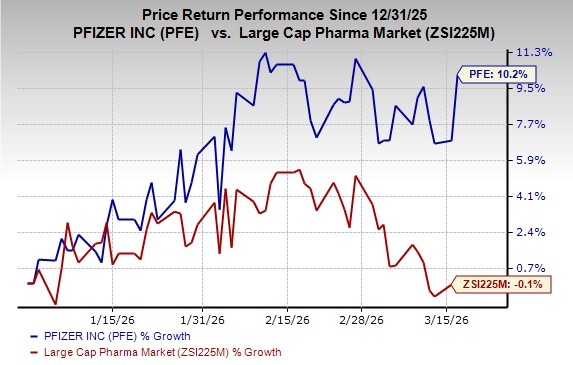
Image Source: Zacks Investment Research
From a valuation standpoint, Pfizer appears attractive relative to the industry and is trading below its five-year mean. Going by the price/earnings ratio, Pfizer’s shares currently trade at 9.33 forward earnings, substantially lower than 17.65 for the industry as well as the stock’s five-year mean of 10.15.
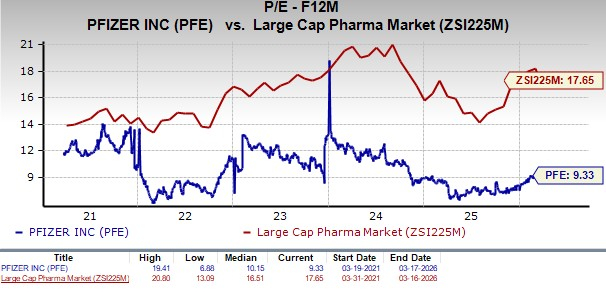
Image Source: Zacks Investment Research
The Zacks Consensus Estimate for 2026 earnings has declined from $2.99 per share to $2.97, while that for 2027 has declined from $2.83 per share to $2.82 over the past 60 days.
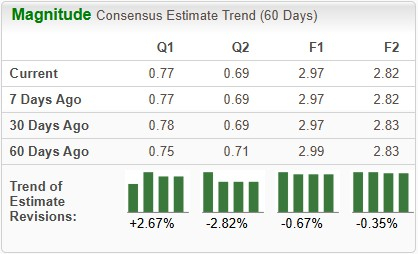
Image Source: Zacks Investment Research
PFE Zacks Rank
Pfizer has a Zacks Rank #3 (Hold) at present. You can see the complete list of today’s Zacks #1 Rank (Strong Buy) stocks here.
Free Report: Profiting from the 2nd Wave of AI Explosion
The next phase of the AI explosion is poised to create significant wealth for investors, especially those who get in early. It will add literally trillion of dollars to the economy and revolutionize nearly every part of our lives.
Investors who bought shares like Nvidia at the right time have had a shot at huge gains.
But the rocket ride in the "first wave" of AI stocks may soon come to an end. The sharp upward trajectory of these stocks will begin to level off, leaving exponential growth to a new wave of cutting-edge companies.
Zacks' AI Boom 2.0: The Second Wave report reveals 4 under-the-radar companies that may soon be shining stars of AI’s next leap forward.
Access AI Boom 2.0 now, absolutely free >>Want the latest recommendations from Zacks Investment Research? Today, you can download 7 Best Stocks for the Next 30 Days. Click to get this free report
AstraZeneca PLC (AZN): Free Stock Analysis Report
Johnson & Johnson (JNJ): Free Stock Analysis Report
Pfizer Inc. (PFE): Free Stock Analysis Report
Merck & Co., Inc. (MRK): Free Stock Analysis Report
This article originally published on Zacks Investment Research (zacks.com).

Zacks is the leading investment research firm focusing on equities earnings estimates and stock analysis for the individual investor, including stock picks, stock screening, portfolio stock tracker and stock screeners. Copyright 2006-2026 Zacks Equity Research, Inc. editor@zacks.com (Manaing editor) webmaster@zacks.com (Webmaster)
Latest Articles
Stay ahead of the market.
Get curated U.S. market news, insights and key dates delivered to your inbox.
AInvest
PRO
AInvest
PRO



Comments
No comments yet