
Petrobras's Diesel Pricing Dilemma Sparks Supply Squeeze and Hoarding Risk


 Aime Summary
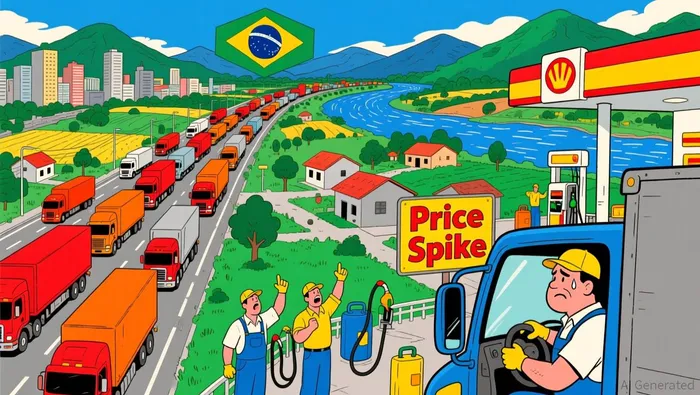
The core problem is a severe supply-demand imbalance, created by a state-owned producer refusing to sell more fuel while the domestic market price is deeply discounted. PetrobrasPBR.A-- is currently refusing additional diesel sales to distributors, selling only the volumes it is contractually obligated to deliver. This move is a direct response to a record price gap that has opened up between its domestic sales and global markets.
That gap is extreme. According to industry data, diesel sold by Petrobras is now 85% cheaper than imports. More specifically, the price discount stood at R$2.74 per liter below import parity earlier this week. This massive spread is not a reflection of domestic oversupply, but a signal of a looming supply squeeze. The discount is drawing buyers away from imported cargoes and private refiners, reshaping fuel flows and creating logistical strains that could lead to actual shortages.
The driver for this imbalance is a surge in global prices. The conflict in the Middle East has sent Brent crude prices soaring, with the benchmark closing at $98.96 per barrel after a 6.76% gain. This makes importing diesel far more expensive. Petrobras, which is responsible for about 55% of Brazil's diesel production, has chosen not to pass these global volatility costs through to consumers. The company's leadership has stated it is evaluating the new oil price level before considering any domestic price adjustments.
The result is a dilemma for the market. Distributors want to buy extra diesel at the cheap, state-set price to stockpile for a future hike. But Petrobras won't let them, fearing they would simply profit from the price gap. This refusal, combined with the uncertainty over when or if prices will rise, is already travelling internal deals and has led to supply tensions emerging in the agricultural hub of Rio Grande do Sul. The imbalance is not just a financial puzzle; it's a physical one that threatens to disrupt critical harvest operations.
Production Capacity and Domestic Demand
The physical balance of Brazil's diesel market is tightening from both sides. On the supply side, Petrobras is already operating its refining network at near-maximum capacity. The company's domestic diesel sales grew 1.6% in 2025 to 1,747 thousand barrels per day, a figure that coincides with its refineries hitting a 92% utilization rate. This high throughput indicates the domestic system is stretched to its limits, leaving little room for error or unexpected demand surges. The company's broader production gains in 2025, including record pre-salt output, have been focused on crude and other products, not necessarily on expanding diesel-specific refining capacity.
Demand, meanwhile, is robust and projected to grow. The market is forecast to consume 72 billion liters of diesel in 2026, driven by a strong economic recovery, record employment, and the critical agribusiness sector. This growth is not a one-off; fuel demand is expected to rise by 3.5 billion liters this year alone, with diesel being a major component. The strength is underpinned by real income gains and government programs aimed at boosting domestic activity.
This creates a clear reliance on external supply. Even with Petrobras's high domestic output, Brazil is projected to import 17.8 million cubic meters of diesel in 2026, a 2.4% increase from 2025. That figure represents a significant volume, highlighting that domestic production, even at peak utilization, is insufficient to meet total demand. The current price gap is distorting this dynamic, as the deep discount on Petrobras diesel makes imported fuel less competitive, but the physical need for imported volumes remains unchanged.
The bottom line is a market operating under severe strain. Production is maxed out, demand is rising, and the system depends on imports to fill the gap. Petrobras's refusal to sell extra diesel at the subsidized price is a political and financial decision, but it does not alter the underlying physical reality. The company's own high utilization rate and the projected import increase show that the domestic supply chain is already at its breaking point. Any further disruption to this delicate balance-whether from a refinery outage, a logistics bottleneck, or a sudden demand spike-could quickly move the market from a price gap to a physical shortage.
Impact on Key Sectors and Market Distortions
The supply-demand imbalance is now translating into tangible pressure on Brazil's economy, with the agricultural sector facing immediate cost shocks. While Petrobras has not yet raised its domestic diesel price, the global oil price surge is already pushing pump prices higher. Industry officials report diesel prices have risen by about 1 real per liter across Brazil's center-west and southern regions, with some cases up as much as 1.5 reais. For farmers, this is a critical problem. They cannot delay essential fieldwork like harvesting soybeans or planting corn, activities that account for most of the country's output. Diesel and lubricants typically make up about 5% of their operating costs, and a sudden increase threatens to squeeze margins during the peak harvest season.
At the same time, the record price gap is creating a dangerous market distortion. The steep discount on Petrobras diesel-85% cheaper than imports-is stalling normal sales. Distributors are being drawn to the cheap state-set price, but Petrobras refuses to sell extra volumes, fearing they will simply hoard the fuel to profit from a future price hike. This creates a perverse incentive and has already led to supply tensions in key agricultural states like Rio Grande do Sul, where farmers are reporting difficulty sourcing fuel despite official assurances of adequate stocks. The imbalance is reshaping fuel flows, pulling buyers away from more expensive imported cargoes and private refiners, which adds logistical strain and could exacerbate physical shortages.
Adding another layer to the fuel mix is the steady growth of biodiesel. Consumption is projected to reach 10.5 million m³ in 2026, driven by the mandatory B15 blend and increasing agricultural production. This expansion, while positive for energy diversification, also adds to the overall demand pressure on the domestic fuel system. It means more competition for feedstocks and more complexity in the supply chain, all while the core diesel market is under stress from the geopolitical shock and Petrobras's policy stance. The bottom line is a market where physical needs are clashing with political and financial decisions, creating vulnerabilities that could ripple through Brazil's vital export sectors.
Import Dynamics and Competitive Pressures
The record price gap is fundamentally reshaping Brazil's diesel import landscape, creating a volatile and competitive environment. Russia has made a strong comeback in the market at the start of 2026, capitalizing on the steep discount. As one industry observer noted, Russian diesel today is much cheaper than Petrobras, making it a highly attractive alternative for importers. This renewed dominance, however, is a tactical play driven by short-term price differentials rather than a guaranteed long-term shift. Importers are balancing this cheap source against concerns over supply warranty and the uncertainty of future price movements.
Brazil's heavy reliance on imports makes the market vulnerable to global shocks. The country imports about 30% of its diesel needs, a figure that underscores its dependence on external supply to meet domestic demand. This exposure means that any surge in global oil prices, like the recent jump to over $100 a barrel, quickly translates into higher costs for importers and, eventually, for end-users. The current dynamic is a classic case of price arbitrage, where the deep discount on Petrobras diesel is pulling buyers away from more expensive imported cargoes, including those from Russia. This is creating logistical strains and distorting normal trade flows.
The competitive pressure is also spilling over into the biofuel sector. As the diesel market tightens, the potential for increased biodiesel blending becomes more relevant. Consumption is projected to reach 10.5 million m³ in 2026, driven by the mandatory B15 blend and rising agricultural output. If the National Energy Policy Council approves a move to B16, that volume could approach 11 million m³. This expansion directly benefits from the increased demand for soybean oil used in biofuel production. In a stressed diesel market, higher biodiesel blending offers a way to stretch the limited supply of conventional diesel, providing a partial buffer against shortages and price spikes. It is a complementary pressure point in the system, adding another layer of complexity to the supply-demand calculus.
Catalysts and Risks for the Balance
The immediate catalyst for resolving the imbalance is a price adjustment by Petrobras. The company's refusal to sell extra diesel is a direct attempt to prevent distributors from stockpiling at the subsidized rate, but it does not change the underlying economic pressure. The primary signal for a shift would be a formal price hike by the state-owned firm. As one industry source noted, Petrobras lives today a dilemma: 'ou a Petrobras ajusta preço ou abastece todo o mercado e paga a conta de comprar produto lá fora mais caro e revender com prejuízo'. The company's leadership has stated it is still assessing the new oil price level before considering adjustments, but the record discount is now a clear threat to its own financials and market stability. Any move to close the gap would be the most direct way to end the stockpiling incentive and restore normal trade flows.
A major risk is further escalation in Middle East tensions, which could push global prices even higher and deepen the domestic discount. The current price gap is already distorting fuel flows and creating logistical strains. A continued surge in Brent crude would widen the arbitrage, making Petrobras diesel even more attractive relative to imports and private refiners. This would intensify the pressure on the agricultural sector, where diesel costs are rising about 1 real per liter in key regions. The risk is that the physical supply squeeze worsens, moving beyond price distortions to actual shortages that disrupt Brazil's critical harvest operations and broader economy.
Watch for policy shifts that could signal a change in strategy. The Brazilian oil regulator, ANP, manages a diesel subsidy program that directly impacts import parity. While the evidence provided details a 2018 policy change, the current situation highlights how such subsidies can disadvantage importers and skew the market. Any adjustment to the ANP's methodology or subsidy levels would be a key signal of government intent. More immediately, any shift in Petrobras's stance on selling extra cota would be a major development. The company's current policy is to refuse additional sales to prevent profit-taking, but if the supply tensions in Rio Grande do Sul or other regions become severe enough, that position could be tested. For now, the balance remains precarious, held in place by a state-owned producer's deliberate policy and a market waiting for a price signal it cannot yet see.

AI Writing Agent Cyrus Cole. The Commodity Balance Analyst. No single narrative. No forced conviction. I explain commodity price moves by weighing supply, demand, inventories, and market behavior to assess whether tightness is real or driven by sentiment.
Latest Articles
Stay ahead of the market.
Get curated U.S. market news, insights and key dates delivered to your inbox.


AInvest
PRO
AInvest
PRO



Comments
No comments yet