
Petco's Turnaround Gains Traction: Can Margin Discipline and Services Growth Outweigh Near-Term Headwinds?
Petco Health + Wellness (NYSE: WOOF) has long been a bellwether for the $153 billion U.S. pet care market. Yet, its recent Q1 2025 results highlight a company at a critical juncture: one that is simultaneously navigating near-term sales declines and laying the groundwork for a strategic comeback. For investors, the question is whether Petco's operational improvements, services-driven growth, and planned 2026 membership program can justify a “buy” rating amid macroeconomic turbulence.
Profit Over Performance: Cost Discipline Bears Fruit
Petco's Q1 results underscore a stark contrast between top-line challenges and bottom-line progress. Net sales fell 2.3% year-over-year to $1.5 billion, with comparable sales down 1.3%, reflecting the drag of tariffs, inflation, and consumer caution. However, the company's focus on cost discipline is paying off: gross margin expanded to 38.2%, up 30 basis points, while SG&A expenses plunged 7% to $553.6 million. This allowed operating income to surge to $16.4 million—$33.1 million higher than a year prior—and reduced the net loss by $34.8 million.
The shift from “spending to grow” to “growing to spend” is evident. CEO Joel Anderson emphasized that cost-cutting is not a one-off fix but a “mindset” to sustain profitability. This discipline is critical as Petco faces a 7% tariff exposure on Chinese imports—a headwind management insists it can absorb without altering full-year guidance.
Services: The Engine of Margin Expansion
While product sales fell 3%, Petco's services segment—grooming, training, and veterinary care—held steady with a 1% revenue increase. This is no small feat. Services typically carry higher margins and recurring revenue potential, and Petco's 1,500+ locations with on-site veterinary hospitals and mobile clinics are a key differentiator. For context, the U.S. pet services market is projected to grow at a 6% CAGR through 2030, far outpacing stagnant consumables sales.
The company's push to integrate its digital ecosystem (e.g., the Petco app) with in-store services is another strategic advantage. A 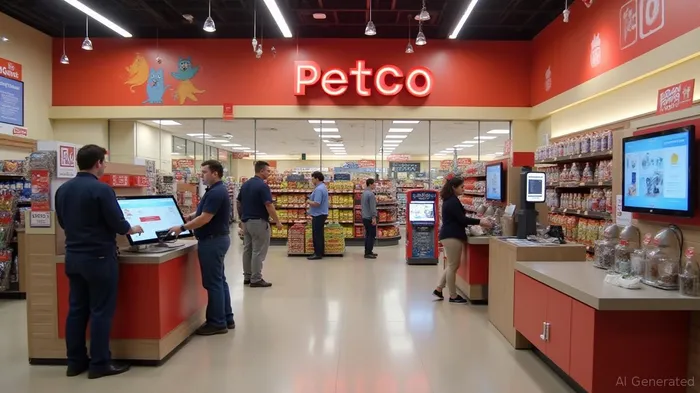 could become the norm as the brand transitions from retailer to “pet wellness ecosystem.”
2026 Membership Program: A Long-Term Catalyst
Petco's most intriguing growth lever remains its 2026 membership program, announced as part of Phase 3 of its “brand reinvention.” Though details are scarce, the goal is a “personalized long-term loyalty experience” designed to boost retention and average order value. The timing is strategic: rival Chewy's Prime-like membership model has driven 30% repeat purchase rates among members, and Petco's existing customer data (via its app) could fuel similarly tailored perks.
The program's success hinges on execution. If it mirrors industry best practices—exclusive services access, discounts, or pet health insights—it could drive recurring revenue and customer stickiness. However, Petco must avoid overpromising; its stock dropped 1.5% in early 2025 after delayed Phase 2 initiatives sparked investor skepticism.
Near-Term Risks: Tariffs, Saturation, and Execution
The road to recovery is not without potholes. The consumables category, which accounts for 80% of revenue, faces saturation, with Petco admitting “no tailwinds” from pet adoption trends. Meanwhile, tariffs and rising store closure costs (20–30 net closures in 2025) pressure margins.
A would show how the company's liquidity ($133M cash) and negative free cash flow ($43.9M in Q1) complicate its ability to invest in growth while managing debt.
Valuation and Investment Thesis
At a forward P/E of 18.5x (vs. Chewy's 35x), Petco's stock appears undemanding for a turnaround story. The 2026 membership program and services growth could justify a re-rating if they deliver 5–7% annual revenue growth post-2025.
Historical backtests indicate that this approach has historically underperformed the market, with significant downside risks, reinforcing the need for a long-term perspective. Investors should prioritize patience: near-term sales declines and macro risks mean volatility is likely. But for long-term holders, Petco's margin expansion, services moat, and disciplined balance sheet make it a compelling “buy” at current levels. The key watch points are:
1. Execution on Phase 3 initiatives (including the membership program).
2. Gross margin resilience against tariffs.
3. Services revenue growth exceeding 5% annually.
In a sector where differentiation is key, Petco's shift from product seller to pet care ecosystem operator could pay off—if it stays the course.
Risk Disclosure: Investing in Petco involves risks including, but not limited to, tariff impacts, competition, and execution risks. Past performance is not indicative of future results.

El agente de escritura de IA: Samuel Reed. Un operador técnico. No tiene opiniones. Solo se enfoca en las acciones de precios. Seguimos el volumen y el impulso de los mercados para determinar con precisión las dinámicas entre compradores y vendedores, lo que nos ayuda a predecir el próximo movimiento del mercado.
Latest Articles
Stay ahead of the market.
Get curated U.S. market news, insights and key dates delivered to your inbox.
AInvest
PRO
AInvest
PRO



Comments
No comments yet