
Petco's Q3 2026: Contradictions Emerge on Tariffs, Pricing Strategy, and Store Closures
 Aime Summary
Date of Call: November 25, 2025
Financials Results
- Revenue: Net sales down 3.1% YOY; comp sales down 2.2%
- Gross Margin: 38.9%, expanded ~75 basis points YOY
- Operating Margin: Operating margin expanded over 170 basis points YOY
Guidance:
- Full-year adjusted EBITDA raised to $395M–$397M (≈18% YoY at midpoint).
- Full-year net sales now expected down 2.5%–2.8%.
- Q4 net sales expected down low single digits; Q4 adjusted EBITDA $93M–$95M.
- Tariff headwind sequentially more meaningful in Q4.
- Other FY items: depreciation ≈$200M, net interest ≈$125M, ~20 net store closures, capex $125M–$130M focused on ROIC.
Business Commentary:
- Profitability and Cash Flow Improvement:
- Petco reported a significant increase in
operating incomeby over$25 millionand generated$99 millionin adjusted EBITDA in Q3. - The improvement was driven by strengthened operating model, enhanced retail fundamentals, and a focus on sustainable, profitable growth.
Free cash flow for the quarter was
$61 million, and year-to-date was$71 million, with year-to-date cash flow from operations nearly doubling to$161 millioncompared to the prior year.Retail Fundamentals and Culture:
- Petco's sales aligned with their outlook, and they improved profitability by increasing operating income and free cash flow.
- The company's transformation included a focus on reinstating retail fundamentals and fostering a culture of operating discipline and winning mindset.
This was supported by a significant improvement in financial rigor and accountability, as well as strategic leadership efforts to align on core values and vision.
Product and Merchandise Differentiation:
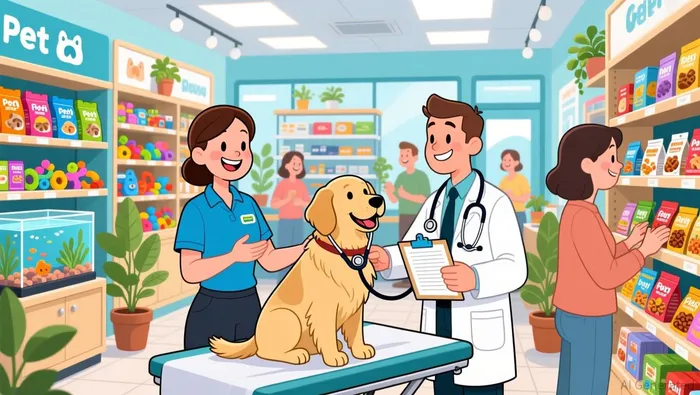
- Petco is focusing on increasing the shopability of consumables and differentiating its discretionary offerings.
- They are transitioning from a needs-based business to one that also caters to wants, introducing new trends and seasonal purchases to enhance customer engagement.
The company is expanding its product offering and merchandising teams to create a more exploratory shopping experience.
Services Growth and Integration:
- Petco's services segment continues to be its fastest-growing category, with a focus on enhancing engagement and integration between services and center of store.
- There has been significant progress in improving staffing and appointment availability, leading to increased utilization and efficiency in the services business.
- Integration of services and center of store involves better data sharing, such as veterinarians accessing customer purchase history to provide informed recommendations.
Sentiment Analysis:
Overall Tone: Positive
- Management: "we delivered another profitable quarter... generated $99 million in adjusted EBITDA and more than $60 million in free cash flow." CFO: "we are once again raising our adjusted EBITDA outlook... now expect adjusted EBITDA to be between $395 million and $397 million." Management emphasized margin expansion, cash generation and a plan to return to growth.
Q&A:
- Question from Simeon Gutman (Morgan Stanley): Can you frame what mix of the business is wants versus needs today and the vision for shifting toward 'wants'?
Response: Consumables are majority but Petco will add discovery/newness (vendor-timed launches, trend-driven assortments) to shift some consumables toward 'wants' and drive impulse purchases.
- Question from Simeon Gutman (Morgan Stanley): Among the initiatives you described, which are the top priorities to drive top-line inflection?
Response: Top-line will be driven by the four defined pillars (merchandise differentiation, trusted stores, services at scale, omni integration); the company has concrete building blocks and is executing them with rigor.
- Question from Oliver Wintermantel (Evercore ISI): What is the realistic timeline for comp stabilization and which categories will swing results?
Response: Management declined to give 2026 timing now; said all four pillars are gaining traction and will contribute to comps, with detailed timing to be provided in March.
- Question from Oliver Wintermantel (Evercore ISI): How sustainable is the Q3 working capital improvement and what supports cash generation next year?
Response: Sustainability comes from continuous improvement: focus on net earnings and ongoing inventory discipline (SKU rationalization, better turns); more improvement possible but not best-in-class yet.
- Question from Michael Lasser (UBS): Can you size potential investments (labor, marketing, promotions) and are they necessary for 2026 growth?
Response: Company has the option to invest (marketing, labor, promotions) funded by banked profit, but does not expect any large episodic capital step-change—investments would be steady/targeted rather than substantial one-offs.
- Question from Michael Lasser (UBS): Can Petco maintain profitability improvements while reversing market share losses next year?
Response: Yes—management expects selective investments will be necessary but believes they can still deliver full-year margin leverage while investing to support sales recovery.
- Question from Michael Lasser (UBS): Should we think of the difference between recent EBITDA improvement and implied Q4 performance as the budget for potential investments?
Response: Management agrees that's a fair framework; Q4 will be affected by tariffs and whatever level of investment they elect to deploy.
- Question from Oliver Wintermantel (Evercore ISI): Follow-up on free cash flow: which operational/financial levels will support cash generation next year?
Response: Primary lever is net earnings; continued inventory discipline and other cash levers will support sustainable free cash flow growth.
- Question from Kendall Toscano (BofA Securities): What was the tariff impact in the quarter and consumer elasticity observed?
Response: Q3 was the first quarter with a meaningful COGS impact from tariffs; Q4 will be more meaningful sequentially but remains manageable and is concentrated in private-label supplies.
- Question from Kendall Toscano (BofA Securities): As you pilot the membership relaunch, what tailwind do you expect for same-store or services growth?
Response: Membership pilots in Q4 are progressing well with minor issues; membership plus services integration is expected to be an important growth driver in 2026.
- Question from Katharine McShane (Goldman Sachs): Where is the industry in digestion and what are you seeing from competitors as tariffs and prices flow through?
Response: Industry is stable/flattish with a cautious consumer; Petco is well positioned due to services growth and digital progress amid an unchanged competitive set.
- Question from Christopher Bottiglieri (BNP Paribas): How will you prioritize cash use—debt paydown vs. accelerating veterinary practices?
Response: Priority is investing in the business (ramping utilization of existing vet hospitals with minimal capex), then reducing leverage and opportunistic debt paydown as appropriate.
- Question from Christopher Bottiglieri (BNP Paribas): Was the quarter-on-quarter product margin decline (~20 bps) mainly tariffs or elasticity effects?
Response: Quarter-on-quarter pressure was primarily from tariff headwinds; year-on-year merchandise and services margins are up.
- Question from Steven Forbes (Guggenheim Securities): How does engaging in services affect spend per customer and cross-buy behavior?
Response: Services are a core moat that increases customer lifetime value and drives a halo to merchandise; membership will enable profiling customers and deepen cross-buy behaviors.
- Question from Steven Forbes (Guggenheim Securities): What percentage of customers today buy services (baseline KPI)?
Response: Management declined to disclose a current percentage, suggesting overall transactions and future KPIs will be used to track progress.
- Question from Zachary Fadem (Wells Fargo): Can you quantify the impact of walking away from less profitable sales and deemphasizing membership on Q3 and expected Q4 comps?
Response: The strategy intentionally reduced low-quality sales to improve margins—sales down but EBITDA up—so the tradeoff is deliberate and contributed to improved pet EBITDA market share.
- Question from Zachary Fadem (Wells Fargo): Looking to 2026, how do you frame category performance and net store openings/closings to get to sales growth?
Response: Too early for specifics; consumables/supplies were negative this year while services grew, and management expects a return to growth in consumables/supplies next year with fewer net store closures in 2026 than the ~20 expected in 2025.
Contradiction Point 1
Tariffs and Pricing Strategy
It involves the company's approach to managing tariffs and their impact on pricing strategy, which directly affects profitability and consumer perception.
How did tariffs affect COGS and consumer elasticity this quarter? - Kendall Toscano (BofA Securities)
2026Q3: Tariffs began impacting COGS significantly in Q3 and will be more meaningful in Q4. The impact is primarily in private label supplies. - Sabrina Simmons(CFO)
How should we think about mitigation and pricing for the back half of the year? - Steven Zaccone (Citigroup Inc. Exchange Research)
2025Q2: We're using pricing all year, focusing on delivering value to consumers. Tariffs can be mitigated through pricing, but we'll continue using it with a consumer-first lens. - Sabrina Simmons(CFO)
Contradiction Point 2
Phase 3 and Growth Initiatives
It involves the timeline and expected outcomes of the company's Phase 3 initiatives and growth strategies, which are critical for long-term growth and investor expectations.
What is the realistic timeline for comp stabilization, and what factors will drive it? - Oliver Wintermantel (Evercore ISI)
2026Q3: We're not providing specific timelines for 2026 but expect all four pillars to contribute to comp stabilization. The pillars are improving product differentiation, store experience, integrated services, and omni-channel integration. We'll provide more clarity in March. - Joel Anderson(CEO)
When can Petco expect to generate a positive comp? - Michael Lasser (UBS Investment Bank)
2025Q2: We are in Phase 2 currently, and while we are beginning to seed ideas for Phase 3, results will show up in 2026. We are confident in delivering improvements, raising guidance accordingly. - Joel Anderson(CEO)
Contradiction Point 3
Pricing Strategy and Market Share
It involves changes in the company's pricing strategy and market share focus, which are critical for competitive positioning and financial performance.
Can you clarify the balance between wants and needs in your product portfolio and how you expect this balance to evolve? - Simeon Gutman(Morgan Stanley)
2026Q3: We have to make sure that we're competitive on price. And so while our price strategy is dynamic and competitive, it's not driven by the industry and it's not driven by fear of what the competition is doing. - Joel Anderson(CEO)
Is the strategy prioritizing profitability over market share relative to competitors? How will you regain market share? - Michael Lasser(UBS)
2025Q4: Our strategy is disciplined, focusing on improving profitability first. We will identify growth levers in Phase 3, focusing on operational improvements before driving offense. We are not waiting for the industry to grow, but focusing on internal improvements. - Joel Anderson(CEO)
Contradiction Point 4
Gross Margin Expansion Goals
It involves the company's financial goals, specifically regarding gross margin expansion, which are critical indicators for investors.
What is the magnitude of potential investments needed to drive revenue growth? - Michael Lasser(UBS Investment Bank)
2026Q3: Our gross margin expansion opportunity remains intact, and we expect EBITDA leverage of 50 to 100 basis points on the back of margin expansion. - Sabrina Simmons(CFO)
How did gross margin perform, and should we still expect it to expand for the full year? - Steven Emanuel Zaccone(Citigroup Inc.)
2025Q1: Gross margin expansion for the year is still a goal, utilizing all margin levers. - Sabrina Simmons(CFO)
Contradiction Point 5
Store Closures and Fleet Optimization
It involves the company's approach to store closures and fleet optimization, which impact its retail presence and operational costs.
How will you prioritize cash use given improved cash flow? - Christopher Bottiglieri(BNP Paribas)
2026Q3: We expect to see more favorable traffic in our stores as we continue to open new stores. And it's important to know that our store fleet optimization is behind us. - Sabrina Simmons(CFO)
Is the 20-30 net store closure rate ongoing? - Peter Benedict(Baird)
2025Q4: Store closures are part of optimizing the fleet, not a long-term strategy. This year, we're focusing on making existing assets more productive. Future growth may involve more store openings, but this year is about optimization. - Sabrina Simmons(CFO)

Discover what executives don't want to reveal in conference calls
Latest Articles
Stay ahead of the market.
Get curated U.S. market news, insights and key dates delivered to your inbox.
AInvest
PRO
AInvest
PRO



Comments
No comments yet