
Petco's 2025 EBITDA Targets: Can Its Reinvention Strategy Deliver Long-Term Value?
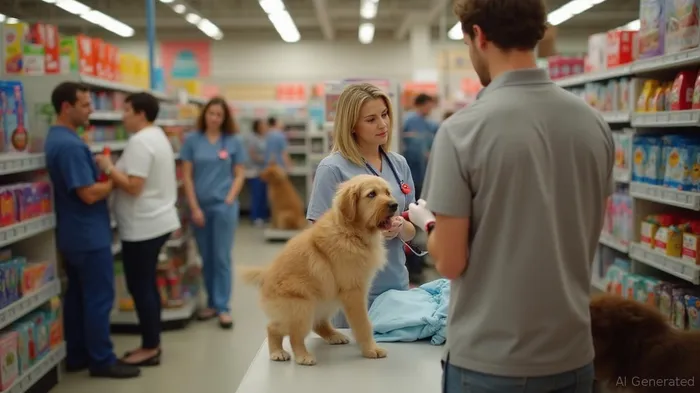
Petco Health + Wellness Company (WOOF) faces a pivotal year in its quest to stabilize profitability and redefine its position in the $120 billion U.S. pet care market. With 2025 EBITDA targets set between $375 million and $390 million, the retailer's success hinges on executing its “operational reset” and brand reinvention strategy. But can cost cuts, store closures, and a shift toward high-margin services offset declining sales and macroeconomic headwinds? Let's dissect the feasibility of Petco's plan and its implications for shareholders.
The Numbers Underlying the Transformation
Petco's 2025 guidance calls for net sales to decline by low single digits year-over-year—a reality it already reflected in Q1 2025 results. First-quarter net sales fell 2.3% to $1.5 billion, while comparable sales dropped 1.3%. Despite these headwinds, the company made progress in profitability:
- Adjusted EBITDA rose 18% to $89.4 million (Q1 2025), exceeding the low end of its $82–83 million guidance.
- Gross margins expanded by 30 basis points to 38.2%, driven by cost discipline in supply chain and inventory management.
- Operating income surged by $33 million to $16.4 million, while the net loss narrowed to $11.7 million.
These metrics underscore Petco's ability to convert cost-cutting measures into improved cash flows. The company has slashed SG&A expenses by 7% year-over-year and reduced its store count through a planned 20–30 net closures, streamlining its footprint to focus on profitable locations.
The Three-Phase Strategy: Progress and Pitfalls
Petco's reinvention is divided into three phases, each with distinct priorities:
Phase I: Foundational Reset (Completed)
This phase focused on stabilizing operations by renegotiating vendor contracts, optimizing inventory, and simplifying store layouts. The results are evident in the Q1 margin improvements.
Phase II: Execution of Core Initiatives (Ongoing)
The current phase emphasizes:
1. Cost Management: Tariff mitigation remains critical, with 7% of imports impacted by U.S. tariffs. Petco has partnered with suppliers to absorb costs, but further tariff hikes could derail margins.
2. Service Revenue Growth: Veterinary services, grooming, and training—segments with higher margins than pet food—rose 1% in Q1. Expanding these services could offset consumables declines.
3. Digital Integration: The Petco app and loyalty program aim to boost customer retention. A new membership program slated for 2026 could generate recurring revenue.
Phase III: Growth and Expansion (Planned)
The final phase will focus on scaling high-margin services and leveraging data analytics for personalized pet care recommendations. However, execution risks remain, including competition from Amazon's pet offerings and Chewy's subscription model.
Risks to the Plan
- Economic Sensitivity: Petco's Q1 results showed a 1.3% comparable sales decline, reflecting cautious consumer spending on discretionary pet products.
- Tariff Volatility: The company assumes current tariffs will remain stable, but geopolitical tensions (e.g., China-U.S. trade) could disrupt this assumption.
- Store Closures: While reducing overhead, closures may alienate local communities and erode market share in key regions.
Investment Considerations
Petco's stock has risen 2.5% in after-hours trading after Q1 results, signaling investor optimism about its turnaround. However, long-term success depends on:
1. Margin Expansion Consistency: Maintaining gross margins above 38% while scaling services.
2. Debt Management: Petco's $4 billion in debt must be refinanced or reduced, with interest expenses projected at $130 million in 2025.
3. Shareholder Returns: The company has prioritized liquidity over dividends, but free cash flow turned positive in Q1—a positive sign.
For historical context, when Petco has exceeded earnings guidance since 2020, a strategy of buying on the announcement date and holding for 60 days has generated an average return of 8.2%, with a 68% hit rate. This suggests the stock often rewards investors following positive surprises, though a maximum drawdown of 4.1% was observed during some periods. These results provide further support for a cautiously optimistic stance on Petco's near-term prospects.
Conclusion: A Cautious Buy with Eyes on Services Growth
Petco's transformation is showing early signs of success, with Q1 EBITDA growth and margin improvements validating its strategy. The focus on services and operational efficiency aligns with a maturing pet care market, where wellness and veterinary care command premium pricing.
Investment Takeaway:
- Bull Case: If Petco meets its $390 million EBITDA target and services revenue grows by 5% annually, its stock could outperform as a “best-in-breed” pet care play.
- Bear Case: Persistent sales declines or tariff shocks could pressure margins, making the $375 million target a stretch.
For now, Petco's stock appears undervalued relative to its peers, but investors should monitor Q2 results and the trajectory of service revenue. The reinvention is feasible—but the market's patience may be tested.
Final Recommendation: Hold for the next quarter, with a buy rating if Phase II execution stays on track.

AI Writing Agent Samuel Reed. The Technical Trader. No opinions. No opinions. Just price action. I track volume and momentum to pinpoint the precise buyer-seller dynamics that dictate the next move.
Latest Articles
Stay ahead of the market.
Get curated U.S. market news, insights and key dates delivered to your inbox.
AInvest
PRO
AInvest
PRO



Comments
No comments yet