
Peru’s CPI Surges to 0.69% — A Sharp Inflation Warning
 Aime Summary
- Peru's CPI rose by 0.69% month-over-month in February 2026, a significant increase from the previous 0.10%.
- This acceleration in inflationary pressure suggests a shift in economic dynamics, which may reflect broader trends such as supply chain adjustments or increased consumer demand.
- Investors and central banks will be watching closely to see whether this is a short-term fluctuation or the start of a more sustained inflationary phase.
Peru’s February 2026 CPI data marks a notable acceleration in monthly inflation to 0.69%, up from 0.10% in the prior month. This sharp increase in the consumer price index (CPI) suggests a sudden spike in the cost of goods and services for households. While the data lacks a forecast due to timing and methodology, the deviation from the previous reading is significant and may raise questions about inflationary pressures building in the economy.
CPI is one of the most closely followed inflation indicators globally, and in Peru, it plays a key role in shaping monetary policy expectations. A rapid uptick in inflation may prompt the Central Reserve Bank of Peru (BCRP) to consider tighter monetary conditions, such as a rate hike, if the trend persists. Investors monitoring emerging markets often look to inflation data as a proxy for potential central bank intervention and its effects on currency and bond markets.
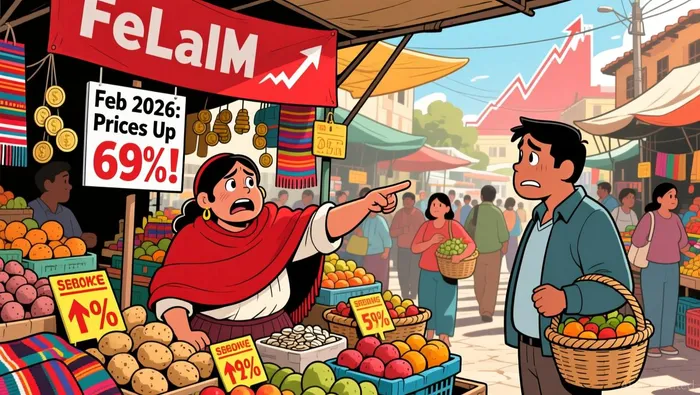
The rise in Peru's CPI could reflect a range of underlying economic conditions, including supply-side shocks, increased demand from a recovering economy, or external factors like global energy prices or exchange rate volatility. While the data itself does not provide a clear causal mechanism, it is often interpreted as a signal of changing macroeconomic conditions. In the broader Latin American context, inflation volatility has become a concern for many economies, and Peru's CPI data may be part of a regional pattern of fluctuating price pressures.
Investors should be mindful of how this data might influence asset valuations, particularly in sectors sensitive to interest rates or consumer demand. For example, equities in consumer discretionary or real estate could face downward pressure in a higher-inflation environment, while fixed-income instruments may become more attractive. Additionally, central bank communication in the coming months will be critical in determining whether the BCRP will respond with policy adjustments to stabilize inflation expectations.
In the near term, the next key CPI release for Peru is expected to provide further clarity on whether the February acceleration is a one-off or the beginning of a trend. Investors may also watch closely for changes in the BCRP's policy stance, as well as for related macroeconomic indicators such as retail sales, wage growth, and trade balances to better understand the broader inflationary context. In a world where inflation trends can shift quickly, staying attuned to these signals is essential for macro-aware investors.

Stay ahead of the market.
Get curated U.S. market news, insights and key dates delivered to your inbox.


AInvest
PRO
AInvest
PRO



Comments
No comments yet