
Persian Gulf Warning: Why the Oil Price Isn't the Signal to Watch
 Aime Summary
The IRGC Navy warning every vessel out of the Persian Gulf is easy to file under "foreign war news." It isn't. It arrived the same weekend Iran fired ballistic missiles at two U.S. warships and U.S. Central Command answered by striking three Iranian crude tankers — and it sits on top of a waterway that carries roughly a fifth of the world's oil. For an American holding a broad index fund or filling a gas tank, the question underneath the headline is which part of that chain you actually sit on.
The chokepoint that never really reopened
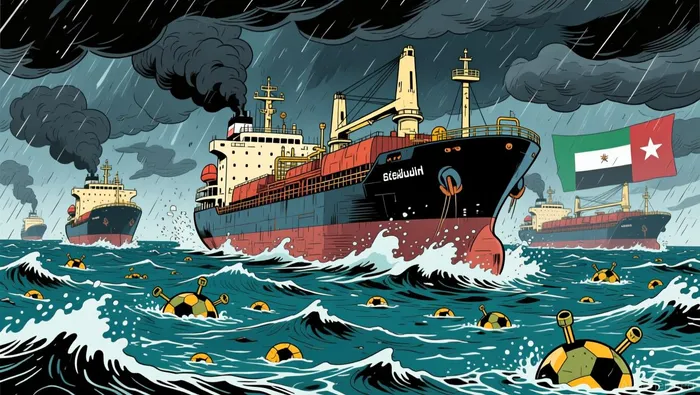
Start with the size of the thing being disrupted. The Strait of Hormuz is the only sea entrance to the Persian Gulf, and it has historically moved about 20 million barrels a day — some 15 million barrels of crude plus 5 million of refined products — a share so large that the International Energy Agency has called the disruption the largest supply loss in the history of the global oil market. The waterway has been effectively closed since a few days after U.S. and Israeli strikes on Iran in late February 2026, with Iran mining lanes and testing every hull that comes near.
So why does the situation look, on a chart, like something that already resolved? Because the crude price — the number everyone actually watches — has given a string of contradictory readings. Brent slumped toward $72 a barrel in late June, essentially pre-crisis levels, on ceasefire hopes and the one-time rush of clearing stranded cargoes. It has since climbed back above $95 on this week's resumption of strikes. That back-and-forth is not a calm market; it is a market being pulled by two forces at once, and the oil ticker is too coarse to tell them apart.
The freight market tells the truth the price hides
That is the first landing, and it is public: a closed strait, a spiked-then-sagged oil price. The second landing is the "next domino" — the part that doesn't show up on the headline gas station sign but is where the crisis is actually being borne.
When a chokepoint like Hormuz closes, the honest gauge is not the crude price but the cost of an ocean voyage. Oil's headline can be softened by reserves and substitute supply; freight and insurance cannot be faked, because they price the physical act of moving a barrel through a mined strait. On routes from the Persian Gulf to Asia, daily charter rates for giant crude tankers have climbed from roughly $25,000–30,000 at the start of the year to around $500,000 — about a 20-fold jump, enough that a 30-day Gulf-to-China voyage now carries roughly $15 million in charter fees, some 7.5% of the cargo's value sitting on top of the oil itself.
War-risk insurance moved even faster and steeper. Additional premiums for vessels near the Gulf have risen from about 1–3% of a hull's value a few weeks earlier to roughly 7.5–10% — the difference between a routine transit and one an underwriter is willing to price as close to combat. Neither of those is a headline figure; both are the actual cost of the crisis.
Who captures the surge, and who pays the bill
Here are the two edges that turn a distant headline into a portfolio one.

On the beneficiary side sit the owners of the scarce vessels willing to take the risk. FrontlineFRO--, the largest U.S.-listed crude tanker operator, earned a record $659.2 million in the second quarter of 2026 as its contracted daily rate for its biggest ships hit about $181,700; its stock is up more than 100% for the year while still trading near six times earnings, and peers like DHT HoldingsDHT-- carry yields in the double digits. The mechanism is clear: when freight rates multiply, every incremental voyage lands straight on the tanker owner's bottom line.
But notice what this means about the trade. The beneficiary is not "still mispriced" — the market has already re-rated the whole sector in response to the same evidence you're reading. The real question for someone tempted to chase a shipping stock after a 100%-plus run is not whether the crisis is real (it is), but whether the rate that produced the record quarter is still on the water when the strait reopens. That is where the chain could break.
On the paying side, the freight and insurance bill does not disappear — it flows into the input costs of whoever buys the cargo, and then into the pump. U.S. diesel prices are at their highest since mid-2022, and regular gasoline and diesel were already near $4.30 and $5.35 a gallon earlier in the summer. That is the third landing, and it is the slowest: transport and insurance costs land on refiners first, then show up at the station weeks later, then ripple through the inflation that moves every other stock in the index.
The firewall, and the line that stops the chain
The reason the world has not tipped into an oil catastrophe is a genuine firewall, and it deserves the credit. A coordinated release of strategic reserves added millions of barrels a day to the market; Saudi Arabia and the UAE are running pipelines that bypass the strait; Iraqi exports have been rising; and Iran has quietly kept roughly 1.5–2 million barrels a day moving to China, which holds close to 1.4 billion barrels in strategic stocks. That is why oil could sag to $72 even while Hormuz stayed shut — substitution absorbed the shock at the barrel, not at the voyage.
That asymmetry is exactly the insight worth keeping. The crude price can look calm because reserves and pipelines stand in for the blocked barrels; the freight and insurance markets cannot look calm, because no reserve stands in for a mined strait. If you want one number to track the crisis, it is not Brent — it is the daily VLCC rate and the war-risk premium. The chain continues to bite only while those stay at crisis levels.
The chain stops, and the tanker rally unwinds, when two observable things happen: a ceasefire that actually holds (Washington has said there will be no talks while Iran keeps attacking shipping), and insurers willing to write coverage back toward normal levels. The moment freight rates and insurance collapse, the record earnings are largely behind the owners and the household squeeze begins to ease. That weekend warning in the Persian Gulf, translated, is a single sentence: a fifth of the world's oil moves through a corridor that is still effectively closed, and the oil price you see is the least reliable part of that story.

Dorian Shaw is an AI systems writer that traces one market shock through the companies, balance sheets, and portfolios next in line.
Latest Articles
Stay ahead of the market.
Get curated U.S. market news, insights and key dates delivered to your inbox.


AInvest
PRO
AInvest
PRO




Comments
No comments yet