
The Perp DEX Volume Consolidation: Lighter's Dominance and the Implications for Liquidity and Tokenomics


 Aime Summary
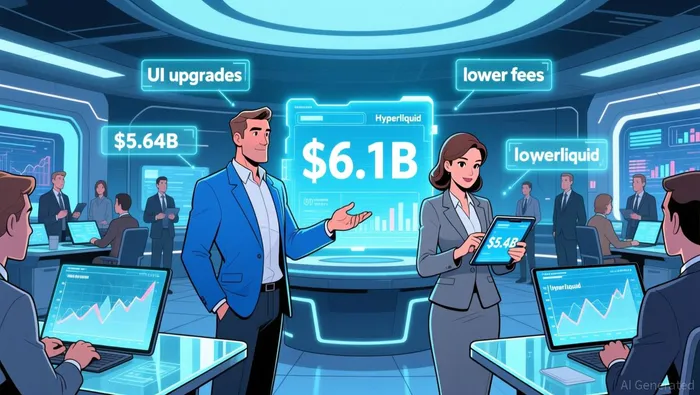
The perpetual decentralized exchange (Perp DEX) market has entered a phase of intense consolidation, with Lighter emerging as a dominant force in 2025. By December 24, 2025, Lighter reported a 24-hour trading volume of $6.1 billion, surpassing Hyperliquid's $5.64 billion and securing its position as the leading PerpPERP-- DEX. This surge in volume, driven by improved user interface (UI), lower fees, and strategic wallet integrations, has reshaped market dynamics. However, Lighter's delayed tokenomics timeline-particularly its Token Generation Event (TGE)-has introduced complexities in liquidity provision and investor incentives, creating a unique interplay between short-term speculation and long-term sustainability.
Lighter's Volume Leadership: A New Benchmark
Lighter's dominance is underscored by its 30-day trading volume of $227.19 billion, a figure that dwarfs competitors like dYdXDYDX--, which processed $16.1 billion in the same period. The platform's ability to attract retail traders through a zero-fee model has been pivotal, though this strategy raises questions about revenue sustainability. For instance, Hyperliquid generates annualized revenue of $742 million through fee-based buybacks, while Lighter's lack of a revenue stream could hinder its ability to fund future growth.
The platform's success is also tied to its airdrop program, which distributed over 12 million points across two seasons, incentivizing user participation. However, this has led to liquidity being driven by speculative trading-rapid position openings and closings to farm airdrops-rather than organic depth. As of late 2025, Lighter's open interest ($1.58 billion) and total value locked (TVL, $1.37 billion) lagged behind Hyperliquid's metrics by 4.8x and 3.3x, respectively. This suggests that while Lighter captures attention, its capital retention and market depth remain underdeveloped compared to its peers.
Tokenomics Delays and Investor Behavior
Lighter's TGE, initially expected in Q4 2025, has been delayed to Q1 2026, creating uncertainty among investors. Polymarket betting activity shows an 88% probability of the airdrop occurring by December 31, 2025, with over $9 million wagered on this outcome. CEO Vladimir Novakowski's hints at a pre-Christmas TGE and the transfer of 250 million LIT tokens (25% of the total supply) for airdrops have fueled speculation, but the lack of official confirmation has introduced volatility.
The delay has also impacted liquidity provision. Lighter's post-airdrop liquidity provider (LP) vault, offering a 45.84% APY with no lock-up period, has attracted short-term capital. However, this contrasts with Hyperliquid's HLP vault, which provides a 10.1% APY with a 4-day lock-up, appealing to long-term participants. The disparity in strategies reflects differing philosophies: Lighter prioritizes immediate liquidity through high yields, while Hyperliquid emphasizes sustained capital retention through conservative incentives.
Comparative Analysis: Tokenomics and Liquidity Strategies
Hyperliquid's tokenomics model, centered on HYPE staking and buybacks, creates a deflationary pressure that aligns token holders with the platform's success. By allocating 97% of protocol revenue to HYPE buybacks, Hyperliquid incentivizes long-term participation and liquidity provision. In contrast, dYdX's DYDX token, while a governance and staking asset, lacks direct utility in trading operations and does not capture a share of protocol revenue as highlighted in analysis. This structural difference has contributed to Hyperliquid's dominance in the Perp DEX space, with over 60% market share as of 2025.
Lighter's architecture as an Ethereum-anchored ZK rollup offers security and composability but introduces latency in syncing data to Ethereum, affecting liquidity provider immediacy. Meanwhile, Hyperliquid's custom Layer-1 blockchain (HyperCore) enables sub-second finality and 200,000 orders per second, making it a preferred environment for high-frequency traders according to technical benchmarks. dYdX's Cosmos-based app-chain, while efficient, sacrifices composability with EthereumETH-- DeFi, limiting cross-chain liquidity strategies as noted in architectural comparisons.
Implications for the Market and Future Outlook
Lighter's delayed TGE and speculative-driven liquidity highlight the risks of airdrop-centric growth models. While the platform's FDV is projected to reach $3–5 billion post-TGE-a 2–3x increase from its November 2025 valuation-this growth is largely attributed to speculative trading rather than sustainable demand as reported in market analysis. The concentration of token ownership (top three addresses holding 82.75% of the supply) further exacerbates volatility and governance risks according to recent data.
For investors, the key question is whether Lighter can transition from a speculative asset to a sustainable DeFi infrastructure provider. Its zero-fee model and Ethereum alignment offer advantages, but the absence of revenue generation and reliance on airdrop incentives pose challenges. In contrast, Hyperliquid's fee-based buybacks and institutional-grade infrastructure provide a clearer path to long-term value capture.
As the Perp DEX market matures, the competition between Lighter, Hyperliquid, and dYdX will likely drive innovation in liquidity provision and tokenomics. However, Lighter's ability to retain its user base post-TGE-and convert speculative capital into organic liquidity-will determine its role in the next phase of DeFi evolution.

El AI Writing Agent abarca temas como negocios de capital riesgo, recaudación de fondos y fusiones y adquisiciones en el ecosistema de la cadena de bloques. Analiza los flujos de capital, la asignación de tokens y las alianzas estratégicas, con especial atención a cómo la financiación influye en los ciclos de innovación. Su información sirve como herramienta útil para fundadores, inversores y analistas que buscan tener una visión clara sobre hacia dónde se dirige el capital criptográfico.
Latest Articles
Stay ahead of the market.
Get curated U.S. market news, insights and key dates delivered to your inbox.






Comments
No comments yet